Department of Biological Statistics and Computational Biology, Cornell University, Ithaca, New York 14853.
Genetics. 2013 Nov;195(3):969-78. doi: 10.1534/genetics.113.153973. Epub 2013 Aug 26.
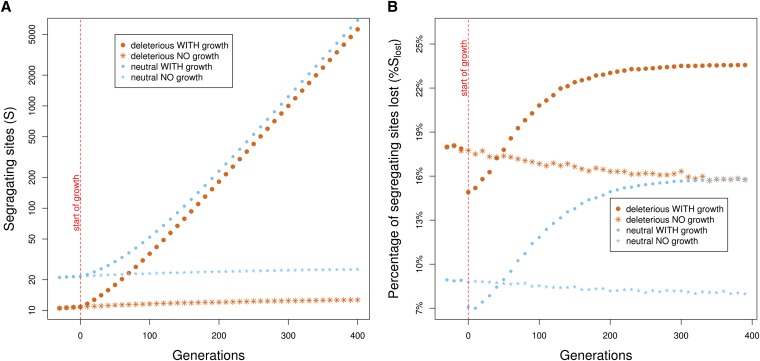
This study addresses the question of how purifying selection operates during recent rapid population growth such as has been experienced by human populations. This is not a straightforward problem because the human population is not at equilibrium: population genetics predicts that, on the one hand, the efficacy of natural selection increases as population size increases, eliminating ever more weakly deleterious variants; on the other hand, a larger number of deleterious mutations will be introduced into the population and will be more likely to increase in their number of copies as the population grows. To understand how patterns of human genetic variation have been shaped by the interaction of natural selection and population growth, we examined the trajectories of mutations with varying selection coefficients, using computer simulations. We observed that while population growth dramatically increases the number of deleterious segregating sites in the population, it only mildly increases the number carried by each individual. Our simulations also show an increased efficacy of natural selection, reflected in a higher fraction of deleterious mutations eliminated at each generation and a more efficient elimination of the most deleterious ones. As a consequence, while each individual carries a larger number of deleterious alleles than expected in the absence of growth, the average selection coefficient of each segregating allele is less deleterious. Combined, our results suggest that the genetic risk of complex diseases in growing populations might be distributed across a larger number of more weakly deleterious rare variants.
本研究探讨了在人类等经历的近期快速人口增长过程中,纯化选择是如何作用的。这并不是一个简单的问题,因为人类种群并不处于平衡状态:种群遗传学预测,一方面,随着种群规模的增加,自然选择的有效性会增加,从而消除越来越多的弱有害变体;另一方面,随着种群的增长,会有更多的有害突变被引入种群,并且它们的拷贝数增加的可能性也会增加。为了了解自然选择和人口增长的相互作用如何塑造人类遗传变异的模式,我们使用计算机模拟研究了具有不同选择系数的突变的轨迹。我们观察到,尽管人口增长极大地增加了种群中有害分离位点的数量,但它只略微增加了每个个体携带的数量。我们的模拟还显示了自然选择的有效性增加,这反映在每一代消除的有害突变的比例更高,以及对最有害的突变的更有效消除。因此,虽然每个个体携带的有害等位基因数量比没有增长时预期的要多,但每个分离等位基因的平均选择系数的有害性较小。总的来说,我们的研究结果表明,在人口增长的情况下,复杂疾病的遗传风险可能分布在更多数量的较弱有害罕见变体上。