Slater Joyce, Larcombe Linda, Green Chris, Slivinski Caroline, Singer Matthew, Denechezhe Lizette, Whaley Chris, Nickerson Peter, Orr Pamela
Department of Human Nutritional Sciences, University of Manitoba, Winnipeg, MB, Canada.
Int J Circumpolar Health. 2013 Aug 5;72. doi: 10.3402/ijch.v72i0.20723. eCollection 2013.
Increased awareness of the wide spectrum of activity of vitamin D has focused interest on its role in the health of Canada's Aboriginal peoples, who bear a high burden of both infectious and chronic disease. Cutaneous vitamin D synthesis is limited at northern latitudes, and the transition from nutrient-dense traditional to nutrient-poor market foods has left many Canadian Aboriginal populations food insecure and nutritionally vulnerable.
The study was undertaken to determine the level of dietary vitamin D in a northern Canadian Aboriginal (Dené) community and to determine the primary food sources of vitamin D.
Cross-sectional study.
Dietary vitamin D intakes of 46 adult Dené men and women were assessed using a food frequency questionnaire and compared across age, gender, season and body mass index. The adequacy of dietary vitamin D intake was assessed using the 2007 Adequate Intake (AI) and the 2011 Recommended Dietary Allowance (RDA) values for Dietary Reference Intake (DRI).
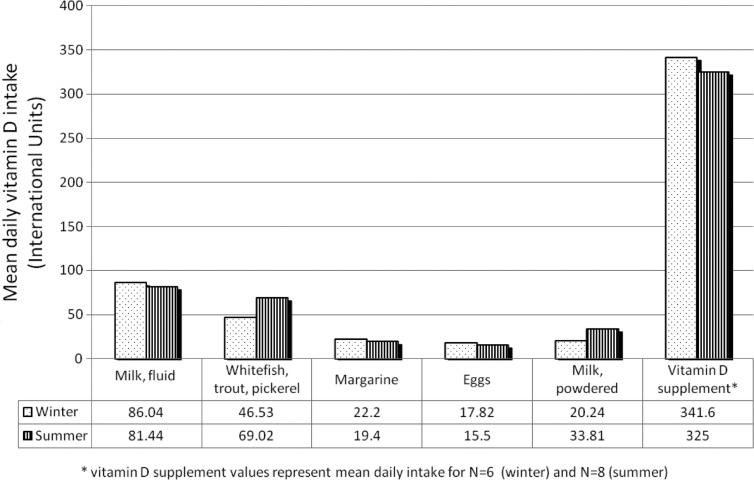
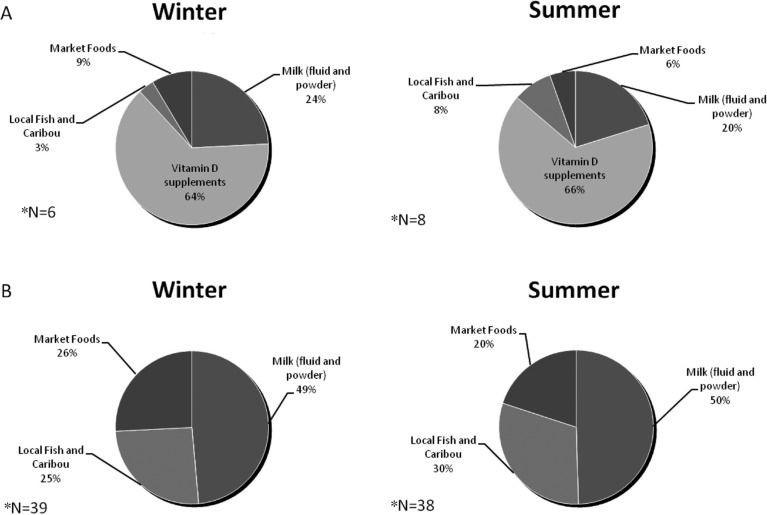
Mean daily vitamin D intake was 271.4 IU in winter and 298.3 IU in summer. Forty percent and 47.8% of participants met the vitamin D 1997 AI values in winter and summer, respectively; this dropped to 11.1 and 13.0% in winter and summer using 2011 RDA values. Supplements, milk, and local fish were positively associated with adequate vitamin D intake. Milk and local fish were the major dietary sources of vitamin D.
Dietary intake of vitamin D in the study population was low. Only 2 food sources, fluid milk and fish, provided the majority of dietary vitamin D. Addressing low vitamin D intake in this population requires action aimed at food insecurity present in northern Aboriginal populations.
对维生素D广泛活性的认识不断提高,这使得人们关注其在加拿大原住民健康中的作用,这些原住民承受着传染病和慢性病的沉重负担。在高纬度地区,皮肤合成维生素D的能力有限,而且从营养丰富的传统食物向营养匮乏的市场食物的转变,使许多加拿大原住民面临粮食不安全和营养脆弱的问题。
本研究旨在确定加拿大北部一个原住民(德内)社区的膳食维生素D水平,并确定维生素D的主要食物来源。
横断面研究。
使用食物频率问卷评估了46名成年德内男性和女性的膳食维生素D摄入量,并按年龄、性别、季节和体重指数进行了比较。使用2007年适宜摄入量(AI)和2011年膳食参考摄入量(DRI)的推荐膳食摄入量(RDA)值评估膳食维生素D摄入量的充足性。
冬季平均每日维生素D摄入量为271.4国际单位,夏季为298.3国际单位。分别有40%和47.8%的参与者在冬季和夏季达到了1997年维生素D的AI值;按照2011年RDA值,冬季和夏季这一比例降至11.1%和13.0%。补充剂、牛奶和当地鱼类与充足的维生素D摄入量呈正相关。牛奶和当地鱼类是维生素D的主要膳食来源。
研究人群的膳食维生素D摄入量较低。只有两种食物来源,即液态奶和鱼类,提供了大部分膳食维生素D。解决该人群维生素D摄入量低的问题需要针对北部原住民存在的粮食不安全采取行动。