Jiangsu Institute of Parasitic Diseases, 117 Yangxiang, Meiyuan, Wuxi, Jiangsu Province 214064, People's Republic of China.
Parasit Vectors. 2013 Aug 28;6(1):249. doi: 10.1186/1756-3305-6-249.
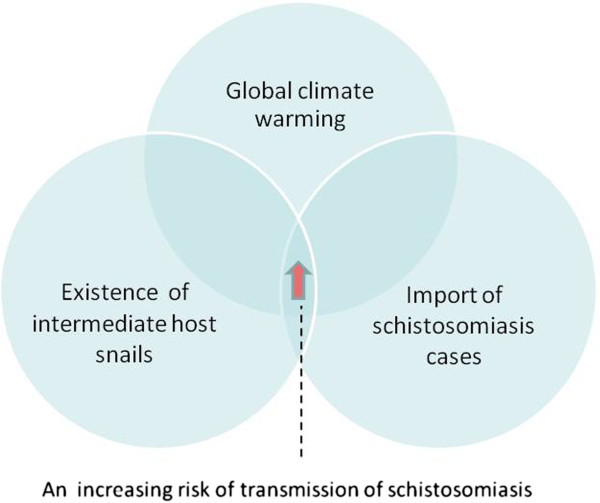
Schistosomiasis is a major disease of public health importance in humans occurring in 76 countries of the tropics and sub-tropics. In China, schistosomiasis japonica is one of the highest priorities in communicable disease control defined by the central government. Since 1970s, the habitats of Biomphalaria straminea, an intermediate host of Schistosoma mansoni in South America, have been identified in Hong Kong Special Administrative Region and Shenzhen city, Guangdong province of China. With the sharp growth in the China-aided projects in Africa and labor services export to Africa, a gradual rise in the cases infected with S. haematobium or S. mansoni is reported in those returning from Africa to China. The existence of intermediate snail hosts and import of infectious source of schistosomiasis results in concern about the transmission of African schistosomiasis in mainland China in the context of global climate change. This paper evaluates the risk of transmission of African schistosomiasis in China, and proposes countermeasures and research priorities to tackle the risk.
血吸虫病是热带和亚热带 76 个国家的重大公共卫生问题。在中国,日本血吸虫病是中央政府确定的传染病控制的最高优先事项之一。自 20 世纪 70 年代以来,在香港特别行政区和中国广东省深圳市发现了美洲血吸虫的中间宿主钉螺的栖息地。随着中国在非洲援助项目的急剧增加和向非洲劳务输出的增加,从非洲返回中国的人中感染埃及血吸虫或曼氏血吸虫的病例逐渐增加。中间螺宿主的存在和血吸虫病感染源的输入,引起了人们对在全球气候变化背景下中国大陆传播非洲血吸虫病的关注。本文评估了非洲血吸虫病在中国传播的风险,并提出了应对风险的对策和研究重点。