Andersen Stig, Fleischer Rex Karsten, Noahsen Paneeraq, Sørensen Hans Christian Florian, Mulvad Gert, Laurberg Peter
Arctic Health Research Centre, Aalborg University Hospital, Aalborg, Denmark.
Int J Circumpolar Health. 2013 Aug 5;72. doi: 10.3402/ijch.v72i0.21086. eCollection 2013.
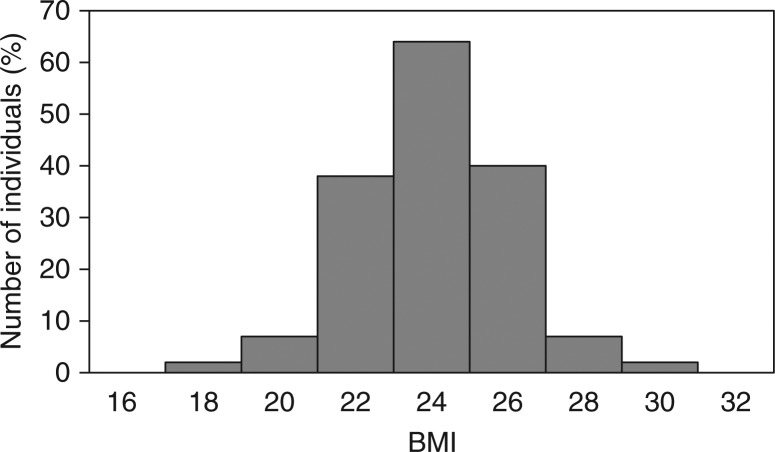
Obesity is associated with increased morbidity and premature death. Obesity rates have increased worldwide and the WHO recommends monitoring. A steep rise in body mass index (BMI), a measure of adiposity, was detected in Greenland from 1963 to 1998. Interestingly, the BMI starting point was in the overweight range. This is not conceivable in a disease-free, physically active, pre-western hunter population.
This led us to reconsider the cut-off point for overweight among Inuit in Greenland.
We found 3 different approaches to defining the cut-off point of high BMI in Inuit. First, the contribution to the height by the torso compared to the legs is relatively high. This causes relatively more kilograms per centimetre of height that increases the BMI by approximately 10% compared to Caucasian whites. Second, defining the cut-off by the upper 90-percentile of BMI from height and weight in healthy young Inuit surveyed in 1963 estimated the cut-off point to be around 10% higher compared to Caucasians. Third, if similar LDL-cholesterol and triglycerides are assumed for a certain BMI in Caucasians, the corresponding BMI in Inuit in both Greenland and Canada is around 10% higher. However, genetic admixture of Greenland Inuit and Caucasian Danes will influence this difference and hamper a clear distinction with time.
Defining overweight according to the WHO cut-off of a BMI above 25 kg/m(2) in Greenland Inuit may overestimate the number of individuals with elevated BMI.
肥胖与发病率增加和过早死亡相关。全球肥胖率都在上升,世界卫生组织建议进行监测。1963年至1998年期间,格陵兰岛检测到身体质量指数(BMI,一种肥胖度量指标)急剧上升。有趣的是,BMI的起始点处于超重范围。在一个没有疾病、身体活跃的前西方猎人种群中,这是不可想象的。
这促使我们重新考虑格陵兰岛因纽特人超重的临界点。
我们发现了3种不同的方法来定义因纽特人高BMI的临界点。首先,与腿部相比,躯干对身高的贡献相对较高。这导致每厘米身高的体重相对增加更多,与白种人相比,BMI增加了约10%。其次,根据1963年调查的健康年轻因纽特人的身高和体重,将BMI的上90百分位数定义为临界点,估计该临界点比白种人高出约10%。第三,如果假设白种人在某个BMI时具有相似的低密度脂蛋白胆固醇和甘油三酯水平,那么格陵兰岛和加拿大因纽特人的相应BMI大约高出10%。然而,格陵兰岛因纽特人和丹麦白种人的基因混合将影响这种差异,并随着时间的推移妨碍明确区分。
按照世界卫生组织规定的BMI高于25 kg/m²来定义格陵兰岛因纽特人的超重,可能会高估BMI升高的个体数量。