Department of Chemistry and Quantum Theory Project, University of Florida , 2328 New Physics Building, P.O. Box 118435, Gainesville, Florida 32611-8435, United States.
Biochemistry. 2013 Oct 1;52(39):6911-23. doi: 10.1021/bi400606b. Epub 2013 Sep 19.
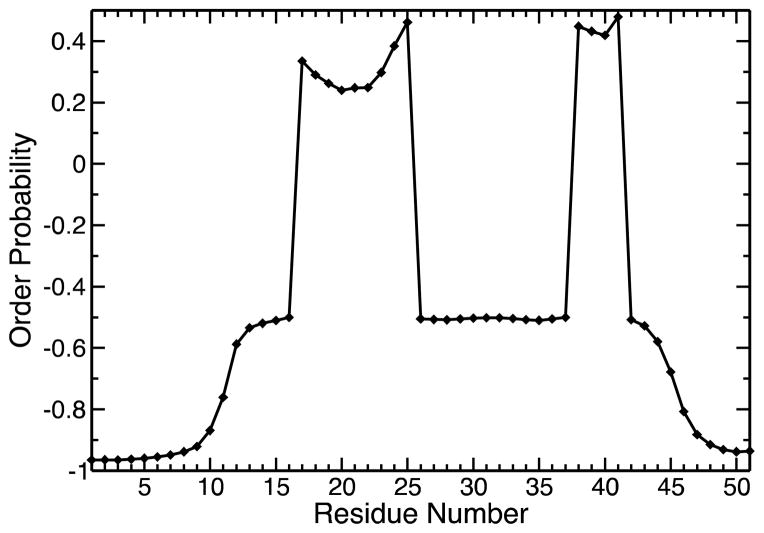
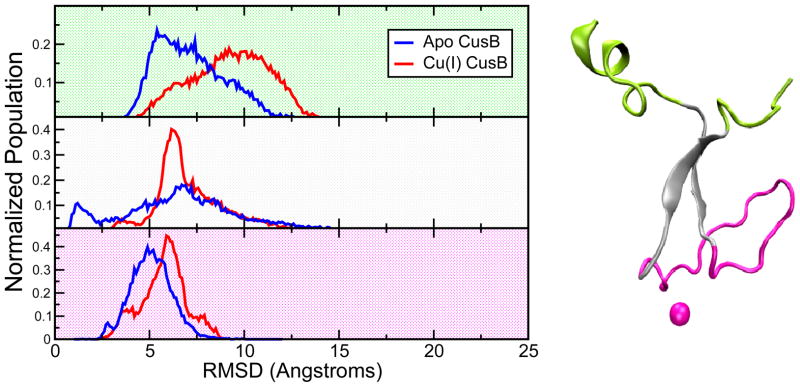
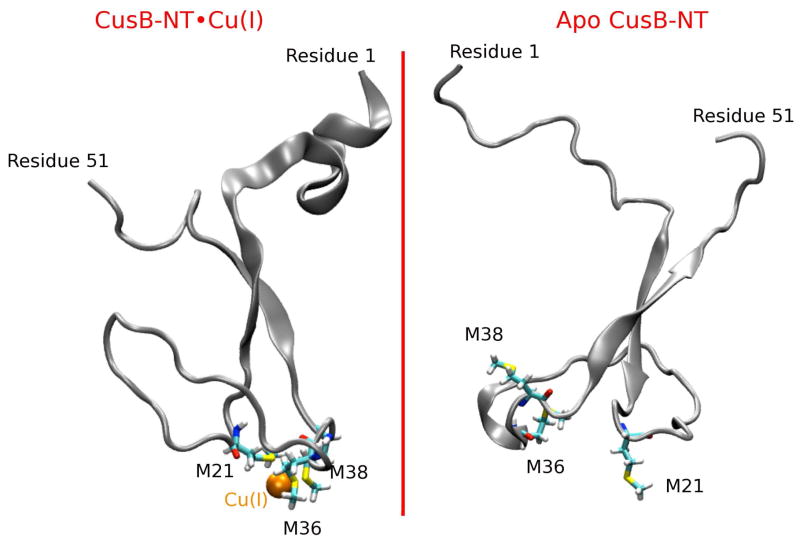
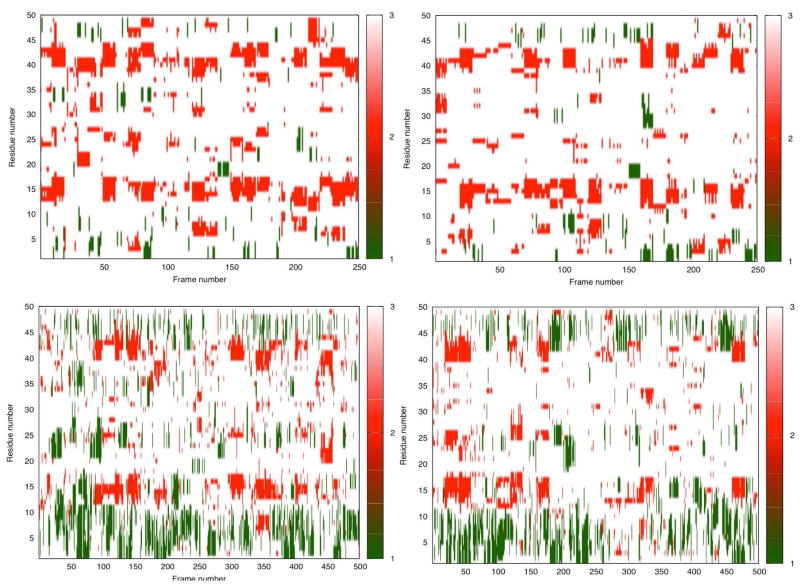
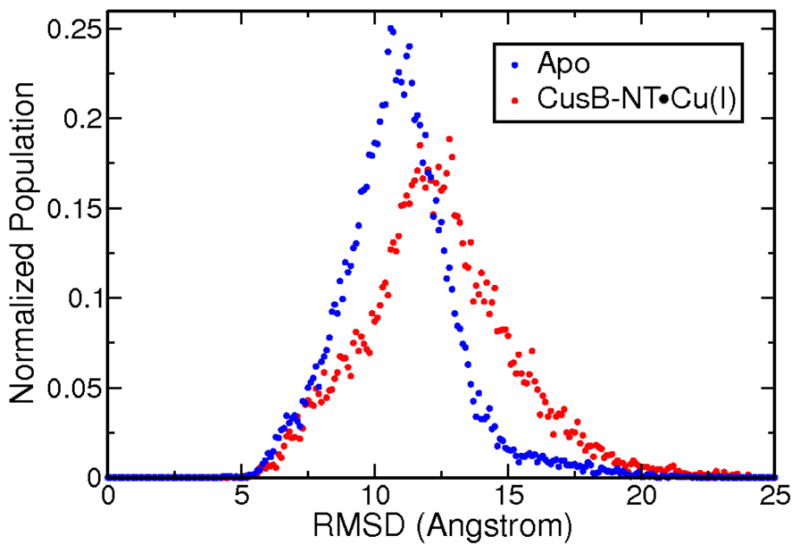
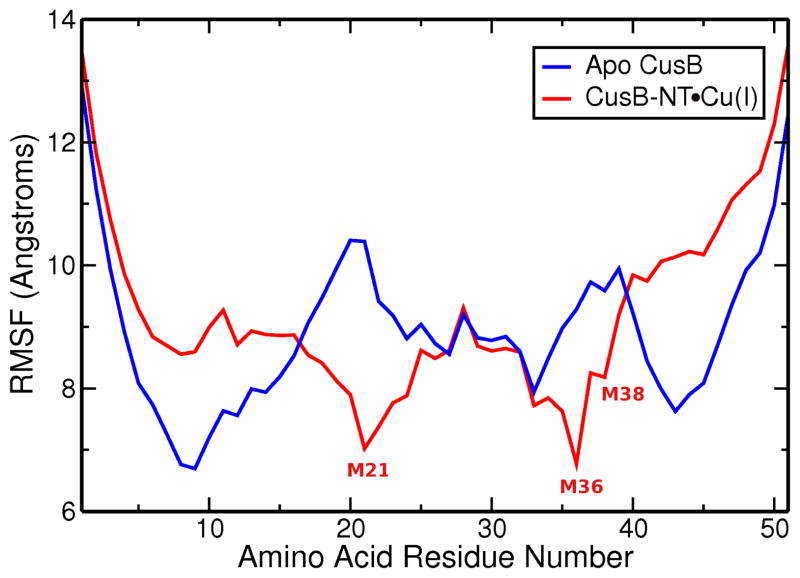
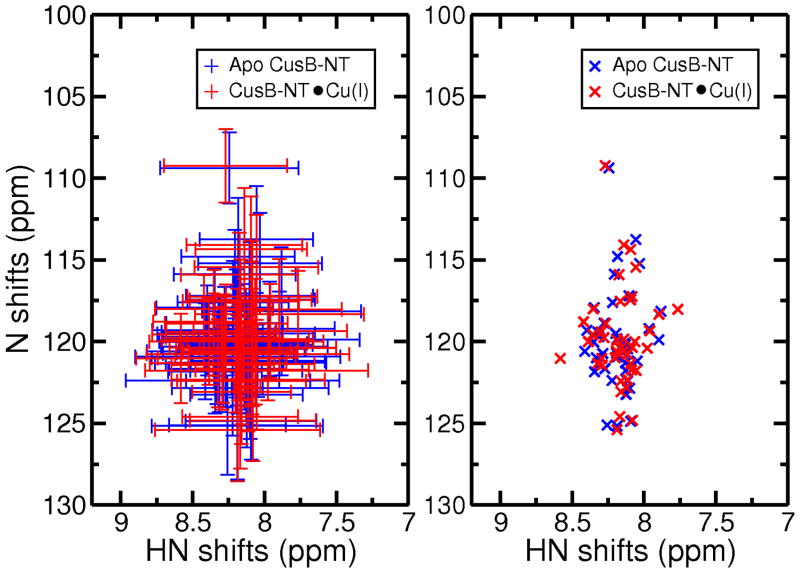
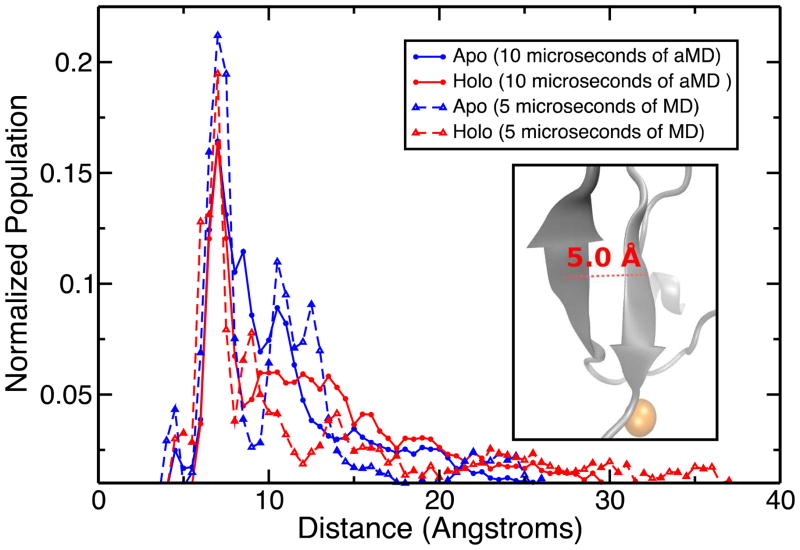
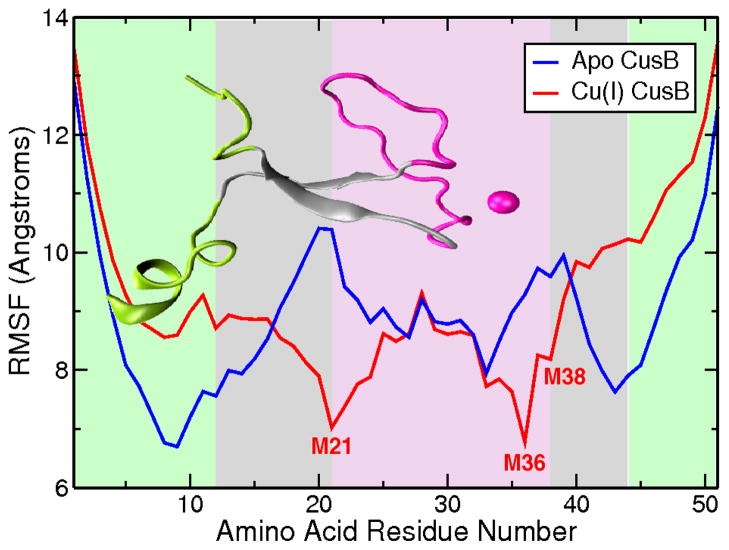
CusCFBA is one of the metal efflux systems in Escherichia coli that is highly specific for its substrates, Cu(I) and Ag(I). It serves to protect the bacteria in environments that have lethal concentrations of these metals. The membrane fusion protein CusB is the periplasmic piece of CusCFBA, which has not been fully characterized by crystallography because of its extremely disordered N-terminal region. This region has both structural and functional importance because it has been experimentally proven to transfer the metal by itself from the metallochaperone CusF and to induce a structural change in the rest of CusB to increase Cu(I)/Ag(I) resistance. Understanding metal uptake from the periplasm is critical to gain insight into the mechanism of the whole CusCFBA pump, which makes resolving a structure for the N-terminal region necessary because it contains the metal binding site. We ran extensive molecular dynamics simulations to reveal the structural and dynamic properties of both the apo and Cu(I)-bound versions of the CusB N-terminal region. In contrast to its functional companion CusF, Cu(I) binding to the N-terminus of CusB causes only a slight, local stabilization around the metal site. The trajectories were analyzed in detail, revealing extensive structural disorder in both the apo and holo forms of the protein. CusB was further analyzed by breaking the protein up into three subdomains according to the extent of the observed disorder: the N- and C-terminal tails, the central beta strand motif, and the M21-M36 loop connecting the two metal-coordinating methionine residues. Most of the observed disorder was traced back to the tail regions, leading us to hypothesize that the latter two subdomains (residues 13-45) may form a functionally competent metal-binding domain because the tail regions appear to play no role in metal binding.
CusCFBA 是大肠杆菌中的一种金属外排系统,对其底物 Cu(I) 和 Ag(I) 具有高度特异性。它用于保护细菌免受这些金属的致死浓度环境的侵害。膜融合蛋白 CusB 是 CusCFBA 的周质部分,由于其极度无序的 N 端区域,尚未通过晶体学进行充分表征。该区域具有结构和功能重要性,因为它已通过实验证明可以自行将金属从金属伴侣蛋白 CusF 中转移,并诱导 CusB 其余部分发生结构变化,从而增加 Cu(I)/Ag(I) 的抗性。了解从周质中摄取金属对于深入了解整个 CusCFBA 泵的机制至关重要,这使得解析 N 端区域的结构成为必要,因为它包含金属结合位点。我们进行了广泛的分子动力学模拟,以揭示 CusB N 端区域的apo 和 Cu(I)结合形式的结构和动态特性。与功能伴侣 CusF 相反,Cu(I)与 CusB 的 N 端结合仅导致金属位点周围的轻微局部稳定化。详细分析了轨迹,揭示了蛋白质的 apo 和全酶形式中广泛的结构无序性。根据观察到的无序程度,CusB 进一步分为三个亚结构域进行分析:N 和 C 末端尾部、中央β链基序以及连接两个金属配位蛋氨酸残基的 M21-M36 环。大部分观察到的无序性可追溯到尾部区域,这使我们假设后两个亚结构域(残基 13-45)可能形成功能上有能力的金属结合结构域,因为尾部区域似乎在金属结合中不起作用。