Inserm, U897, Centre de Recherche Epidémiologie et Biostatistique, Institut de Santé Publique, Epidémiologie et Développement (ISPED), Université Bordeaux Victor Segalen, Bordeaux, France.
PLoS One. 2013 Aug 21;8(8):e67996. doi: 10.1371/journal.pone.0067996. eCollection 2013.
Universal HIV pediatric screening offered at postnatal points of care (PPOC) is an entry point for early infant diagnosis (EID). We assessed the parents' acceptability of this approach in Abidjan, Côte d'Ivoire.
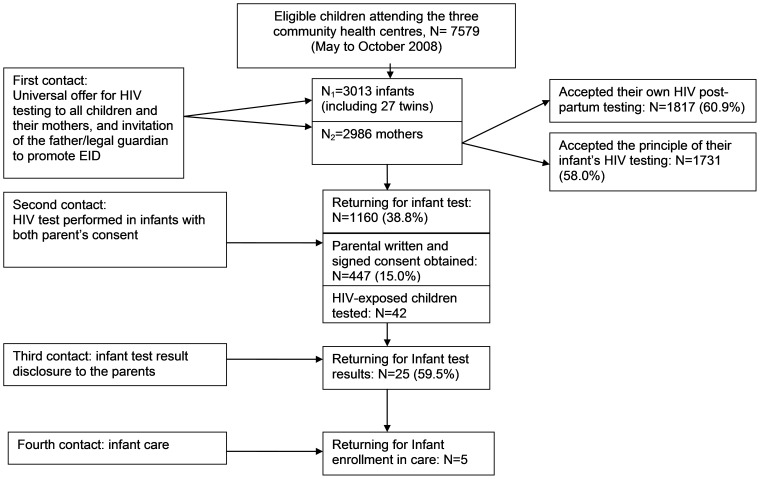
In this cross-sectional study, trained counselors offered systematic HIV screening to all children aged 6-26 weeks attending PPOC in three community health centers with existing access to HAART during 2008, as well as their parents/caregivers. HIV-testing acceptability was measured for parents and children; rapid HIV tests were used for parents. Both parents' consent was required according to the Ivorian Ethical Committee to perform a HIV test on HIV-exposed children. Free HIV care was offered to those who were diagnosed HIV-infected.
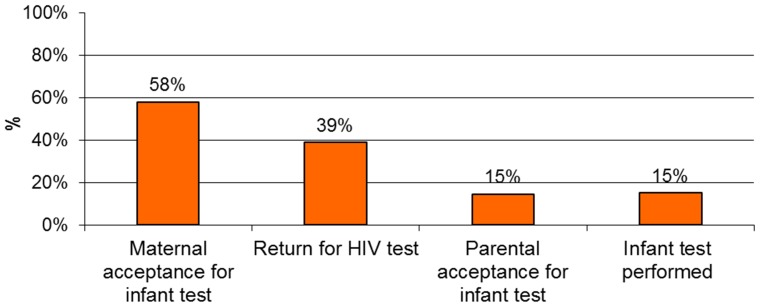
We provided 3,013 HIV tests for infants and their 2,986 mothers. While 1,731 mothers (58%) accepted the principle of EID, only 447 infants had formal parental consent 15%; 95% confidence interval (CI): [14%-16%]. Overall, 1,817 mothers (61%) accepted to test for HIV, of whom 81 were HIV-infected (4.5%; 95% CI: [3.5%-5.4%]). Among the 81 HIV-exposed children, 42 (52%) had provided parental consent and were tested: five were HIV-infected (11.9%; 95% CI: [2.1%-21.7%]). Only 46 fathers (2%) came to diagnose their child. Parental acceptance of EID was strongly correlated with prenatal self-reported HIV status: HIV-infected mothers were six times more likely to provide EID parental acceptance than mothers reporting unknown or negative prenatal HIV status (aOR: 5.9; 95% CI: [3.3-10.6], p = 0.0001).
Although the principle of EID was moderately accepted by mothers, fathers' acceptance rate remained very low. Routine HIV screening of all infants was inefficient for EID at a community level in Abidjan in 2008. Our results suggest the need of focusing on increasing the PMTCT coverage, involving fathers and tracing children issued from PMTCT programs in low HIV prevalence countries.
在产后护理点(PPOC)提供普遍的艾滋病毒儿科筛查是早期婴儿诊断(EID)的切入点。我们在科特迪瓦阿比让评估了父母对这种方法的可接受性。
在这项横断面研究中,训练有素的顾问为在 2008 年期间在三个社区卫生中心接受现有抗逆转录病毒治疗(HAART)的所有 6-26 周龄儿童及其父母/照顾者提供了系统的艾滋病毒筛查。测量了父母和儿童对艾滋病毒检测的可接受性;对父母进行快速艾滋病毒检测。根据科特迪瓦伦理委员会的规定,对艾滋病毒暴露儿童进行艾滋病毒检测需要得到父母双方的同意。对被诊断为艾滋病毒感染的人提供免费艾滋病毒护理。
我们共对 3013 名婴儿及其 2986 名母亲进行了艾滋病毒检测。虽然 1731 名母亲(58%)接受了 EID 原则,但只有 447 名婴儿获得了正式的父母同意(15%;95%置信区间(CI):[14%-16%])。总体而言,1817 名母亲(61%)同意接受艾滋病毒检测,其中 81 名母亲(4.5%;95%CI:[3.5%-5.4%])为艾滋病毒感染者。在 81 名艾滋病毒暴露儿童中,有 42 名(52%)获得了父母同意并接受了检测:5 名儿童(11.9%;95%CI:[2.1%-21.7%])为艾滋病毒感染者。只有 46 名父亲(2%)前来诊断他们的孩子。父母对 EID 的接受程度与产前自我报告的艾滋病毒状况密切相关:与报告产前艾滋病毒未知或阴性的母亲相比,艾滋病毒感染的母亲提供 EID 父母同意的可能性高六倍(调整后的优势比:5.9;95%CI:[3.3-10.6],p=0.0001)。
尽管母亲对 EID 原则的接受程度适中,但父亲的接受率仍然很低。2008 年在阿比让,对所有婴儿进行常规艾滋病毒筛查对社区一级的 EID 效率低下。我们的研究结果表明,需要注重提高 PMTCT 的覆盖率,让父亲参与,并追踪来自艾滋病毒低流行国家 PMTCT 方案的儿童。