Department of Aquatic Ecology, Netherlands Institute of Ecology (NIOO-KNAW), Wageningen, The Netherlands.
PLoS One. 2013 Aug 26;8(8):e71737. doi: 10.1371/journal.pone.0071737. eCollection 2013.
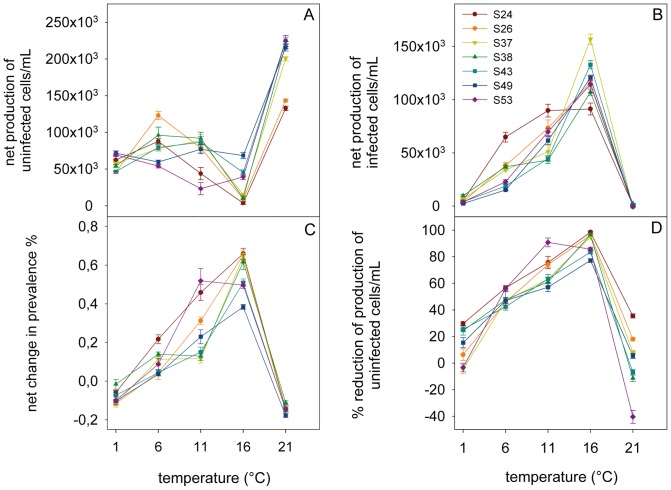
The cost of parasitism often depends on environmental conditions and host identity. Therefore, variation in the biotic and abiotic environment can have repercussions on both, species-level host-parasite interaction patterns but also on host genotype-specific susceptibility to disease. We exposed seven genetically different but concurrent strains of the diatom Asterionella formosa to one genotype of its naturally co-occurring chytrid parasite Zygorhizidium planktonicum across five environmentally relevant temperatures. We found that the thermal tolerance range of the tested parasite genotype was narrower than that of its host, providing the host with a "cold" and "hot" thermal refuge of very low or no infection. Susceptibility to disease was host genotype-specific and varied with temperature level so that no genotype was most or least resistant across all temperatures. This suggests a role of thermal variation in the maintenance of diversity in disease related traits in this phytoplankton host. The duration and intensity of chytrid parasite pressure on host populations is likely to be affected by the projected changes in temperature patterns due to climate warming both through altering temperature dependent disease susceptibility of the host and, potentially, through en- or disabling thermal host refugia. This, in turn may affect the selective strength of the parasite on the genetic architecture of the host population.
寄生虫的成本通常取决于环境条件和宿主身份。因此,生物和非生物环境的变化不仅会对物种层面的宿主-寄生虫相互作用模式产生影响,还会对宿主基因型特异性的疾病易感性产生影响。我们将七种不同的但同时存在的菱形藻(Asterionella formosa)菌株暴露于其自然共存的壶菌寄生虫(Zygorhizidium planktonicum)的一个基因型中,横跨五个环境相关的温度。我们发现,测试寄生虫基因型的耐热范围比其宿主的耐热范围更窄,为宿主提供了一个“冷”和“热”的低感染或无感染的避难所。对疾病的易感性因宿主基因型而异,并且随温度水平而变化,因此在所有温度下没有一个基因型是最具或最不具抗性的。这表明,在这种浮游植物宿主中,热变化在维持与疾病相关的性状多样性方面发挥了作用。由于气候变暖导致温度模式的预期变化,壶菌寄生虫对宿主种群的压力的持续时间和强度可能会受到影响,这既通过改变宿主对温度相关疾病的易感性,也可能通过启用或禁用热宿主避难所来实现。这反过来又可能影响寄生虫对宿主种群遗传结构的选择强度。