Department of Fisheries and Wildlife, Michigan State University, East Lansing, MI 48824, USA.
Department of Large Animal Clinical Sciences, Michigan State University, East Lansing, MI 48824, USA.
Proc Biol Sci. 2021 Aug 11;288(1956):20210881. doi: 10.1098/rspb.2021.0881.
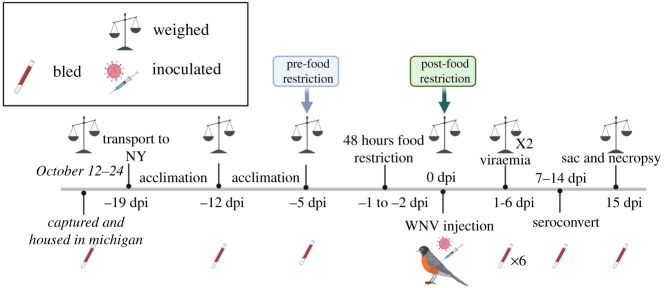
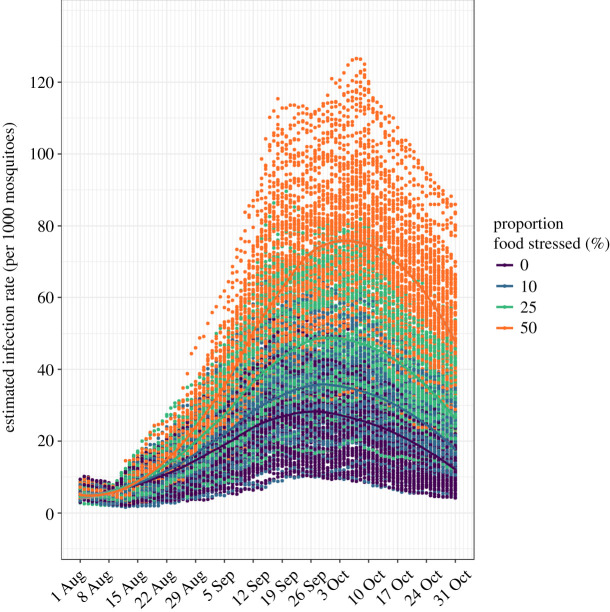
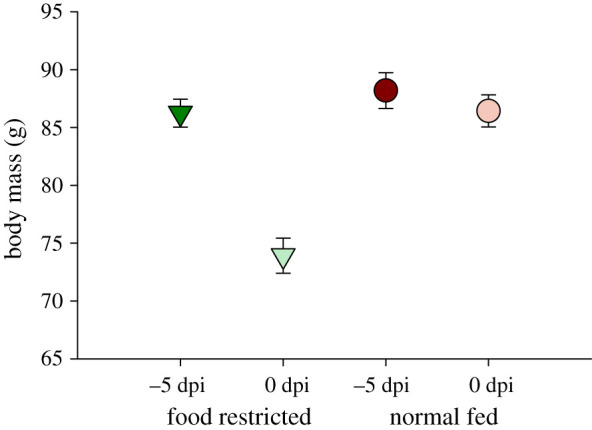
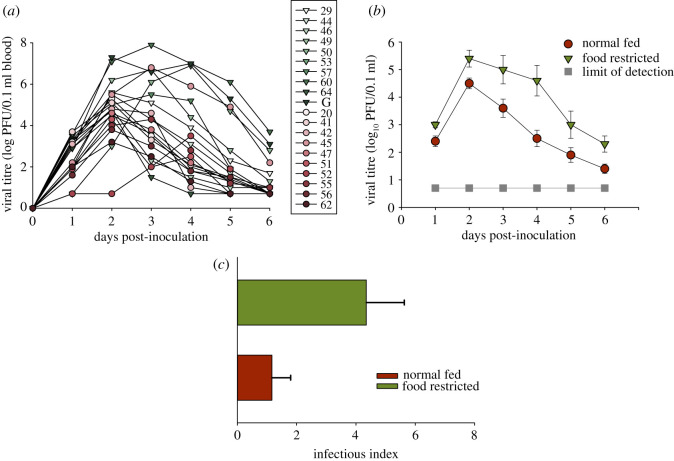
Food limitation is a universal stressor for wildlife populations and is increasingly exacerbated by human activities. Anthropogenic environmental change can significantly alter the availability and quality of food resources for reservoir hosts and impact host-pathogen interactions in the wild. The state of the host's nutritional reserves at the time of infection is a key factor influencing infection outcomes by altering host resistance. Combining experimental and model-based approaches, we investigate how an environmental stressor affects host resistance to West Nile virus (WNV). Using American robins (), a species considered a superspreader of WNV, we tested the effect of acute food deprivation immediately prior to infection on host viraemia. Here, we show that robins food deprived for 48 h prior to infection, developed higher virus titres and were infectious longer than robins fed normally. To gain an understanding about the epidemiological significance of food-stressed hosts, we developed an agent-based model that simulates transmission dynamics of WNV between an avian host and the mosquito vector. When simulating a nutritionally stressed host population, the mosquito infection rate rose significantly, reaching levels that represent an epidemiological risk. An understanding of the infection disease dynamics in wild populations is critical to predict and mitigate zoonotic disease outbreaks.
食物限制是野生动物种群面临的普遍压力源,而人类活动的加剧使这种压力源越发严重。人为造成的环境变化会极大地改变宿主的食物资源的可获得性和质量,并影响野生动物中的宿主-病原体相互作用。感染时宿主营养储备的状态是影响宿主抵抗力从而改变感染结果的一个关键因素。本研究结合实验和基于模型的方法,调查了环境压力源如何影响宿主对西尼罗河病毒(WNV)的抵抗力。我们使用美洲知更鸟()作为研究对象,该物种被认为是 WNV 的超级传播者,检测了在感染前立即进行急性禁食对宿主病毒血症的影响。结果表明,与正常喂养的知更鸟相比,感染前禁食 48 小时的知更鸟病毒载量更高,且具有传染性的时间更长。为了了解处于食物压力下的宿主的流行病学意义,我们开发了一个基于代理的模型,该模型模拟了 WNV 在鸟类宿主和蚊子媒介之间的传播动态。在模拟营养压力下的宿主种群时,蚊子的感染率显著上升,达到了代表流行病学风险的水平。了解野生动物种群中的感染疾病动态对于预测和减轻人畜共患病的爆发至关重要。