College of Fisheries and Life Science, Shanghai Ocean University, Shanghai, China.
PLoS One. 2013 Aug 26;8(8):e73414. doi: 10.1371/journal.pone.0073414. eCollection 2013.
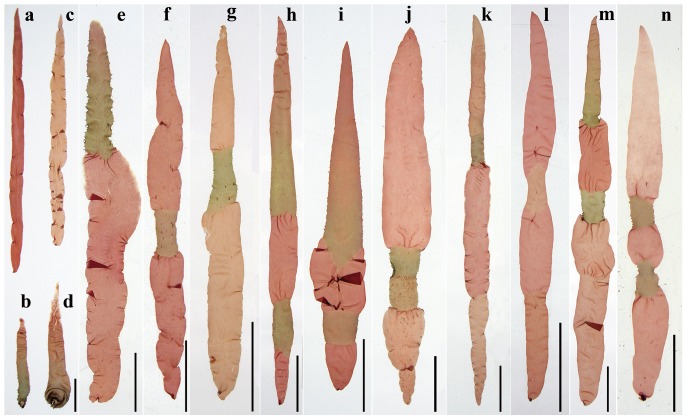
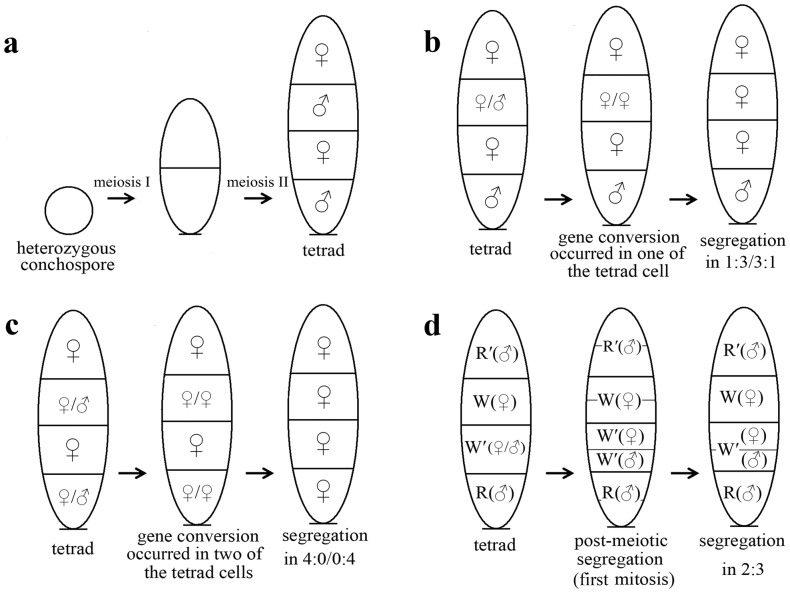
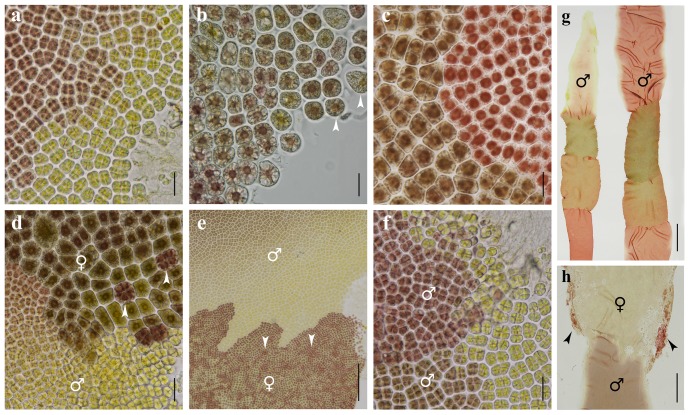
Pyropia haitanensis has a biphasic life cycle with macroscopic gametophytic blade (n) and microscopic filamentous conchocelis (2n) phase. Its gametophytic blades have long been believed to be mainly dioecious. However, when crossing the red mutant (R, ♀) with the wild type (W, ♂), the parental colors were segregated in F1 blades, of which 96.1% were linearly sectored with 2-4 color sectors. When color sectors were excised from the color-sectored blades and cultured singly, 99.7% of the color sectors appeared to be unisexual with an equal sex ratio. Although the sex of color sector did not genetically link with its color, the boundaries of both sex and color sectors coincided precisely. About 87.9% of the examined color-sectored blades were monoecious and the percentage increased with the number of color sectors of a blade. The gametophytic blades from each conchocelis strain produced by parthenogenesis of the excised color sectors were unisexual and unicolor, showing the same sex and color as their original sectors. These results indicate that most of the sexually reproduced Py. haitanensis blades are monoecious, and their sex is controlled by segregation of a pair of alleles during meiosis of conchospore, forming a sex-sectored tetrad. During the subsequent development of blades, one or two lower cell(s) of the tetrad contribute mainly to rhizoid formation, and rarely show their sexual phenotype, leading to reduced frequency of full sex phenotype of the meiotic blades. Moreover, the aberrant segregations of sex genes or color genes in a few of F1 blades were probably due to gene conversions, but there was no sex transfer in Py. haitanensis.
坛紫菜具有二倍体的叶状体(n)和单倍体的壳孢子丝状体(2n)两种生活史阶段。其叶状体长期以来被认为主要是雌雄异体的。然而,当将红色突变体(♀)与野生型(♂)杂交时,F1 叶状体中出现了双亲颜色的分离,其中 96.1%呈线性分带,有 2-4 个颜色带。当从分色叶状体上切下颜色带并单独培养时,99.7%的颜色带表现为单性,雌雄比例相等。尽管颜色带的性别与其颜色在遗传上没有联系,但性别和颜色带的边界却完全吻合。约 87.9%的检查过的分色叶状体是雌雄同体的,而且随着叶状体的颜色带数量的增加,雌雄同体的比例也增加。从切除的颜色带的单性生殖产生的每个壳孢子丝状体的配子体叶片都是单性的,而且颜色是单色的,表现出与原始叶片相同的性别和颜色。这些结果表明,坛紫菜中大多数有性繁殖的叶状体是雌雄同体的,其性别是由减数分裂中一对等位基因的分离控制的,形成一个性别分带的四分孢子体。在随后的叶片发育过程中,四分孢子体中的一个或两个较低的细胞主要贡献于假根的形成,很少表现出其性表型,导致减数分裂叶片的完全性表型频率降低。此外,F1 叶片中少数性基因或颜色基因的异常分离可能是由于基因转换引起的,但坛紫菜中没有性转移。