Department of Obstetrics and Gynecology, Columbia University College of Physicians and Surgeons, New York, New York; Herbert Irving Comprehensive Cancer Center, New York, New York.
J Surg Res. 2014 Jan;186(1):458-66. doi: 10.1016/j.jss.2013.07.042. Epub 2013 Aug 13.
Although a number of prohemostatic agents that are applied intraoperatively have been introduced to minimize bleeding, little is known about the patterns of use and the factors that influence use. We examined the use of hemostatic agents in patients undergoing major surgery.
All patients who underwent major general, gynecologic, urologic, cardiothoracic, or orthopedic surgery from 2000-2010 who were recorded in the Perspective database were analyzed.
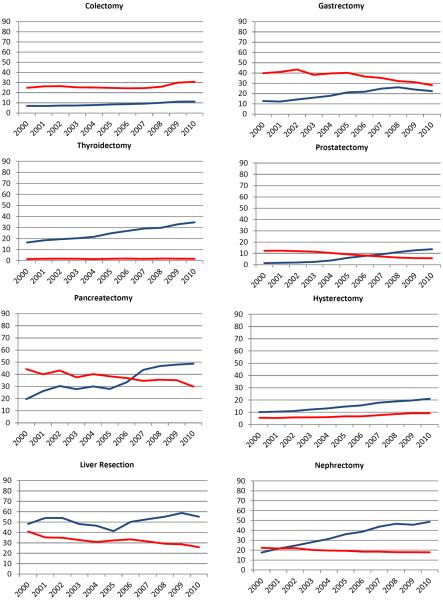
Among 3,633,799 patients, hemostatic agents were used in 30.3% (n = 1,102,267). The use of hemostatic agents increased from 28.5% in 2000 to 35.2% in 2010. Over the same period, the rates of transfusion declined for pancreatectomy (-14.4%), liver resection (-15.0%), gastrectomy (-11.7%), prostatectomy (-6.6%), nephrectomy (-4.6%), hip arthroplasty (-10.4%), and knee arthroplasty (-6.6%). Over the same time period, the transfusion rate increased for colectomy (6.0%), hysterectomy (3.7%), coronary artery bypass graft (8.4%), valvuloplasty (4.2%), lung resection (1.9%), and spine surgery (1.6%). Transfusion remained relatively stable for thyroidectomy (0.2%).
The use of hemostatic agents has increased rapidly even for surgeries associated with a small risk of transfusion and bleeding complications. In addition to patient characteristics, surgeon and hospital factors exerted substantial influence on the allocation of hemostatic agents.
尽管有许多用于减少术中出血的止血药物,但对于这些药物的使用模式及其影响因素知之甚少。我们调查了在接受大型手术的患者中止血药物的使用情况。
分析了 2000 年至 2010 年期间 Perspective 数据库中记录的所有接受普通外科、妇科、泌尿科、心胸外科或骨科大手术的患者。
在 3633799 名患者中,有 30.3%(n=1102267)使用了止血药物。止血药物的使用从 2000 年的 28.5%增加到 2010 年的 35.2%。同期,胰腺切除术(-14.4%)、肝切除术(-15.0%)、胃切除术(-11.7%)、前列腺切除术(-6.6%)、肾切除术(-4.6%)、髋关节置换术(-10.4%)和膝关节置换术(-6.6%)的输血率下降。同期,结直肠切除术(6.0%)、子宫切除术(3.7%)、冠状动脉旁路移植术(8.4%)、瓣膜成形术(4.2%)、肺切除术(1.9%)和脊柱手术(1.6%)的输血率增加。甲状腺切除术(0.2%)的输血率相对稳定。
即使是在出血和并发症风险较小的手术中,止血药物的使用也迅速增加。除患者特征外,外科医生和医院因素对止血药物的分配也有很大影响。