Pepenella Sharon, Murphy Kevin J, Hayes Jeffrey J
Department of Biochemistry and Biophysics, University of Rochester Medical Center, University of Rochester, 601 Elmwood Ave, Box 712, Rochester, NY, 14625, USA.
Chromosoma. 2014 Mar;123(1-2):3-13. doi: 10.1007/s00412-013-0435-8. Epub 2013 Aug 31.
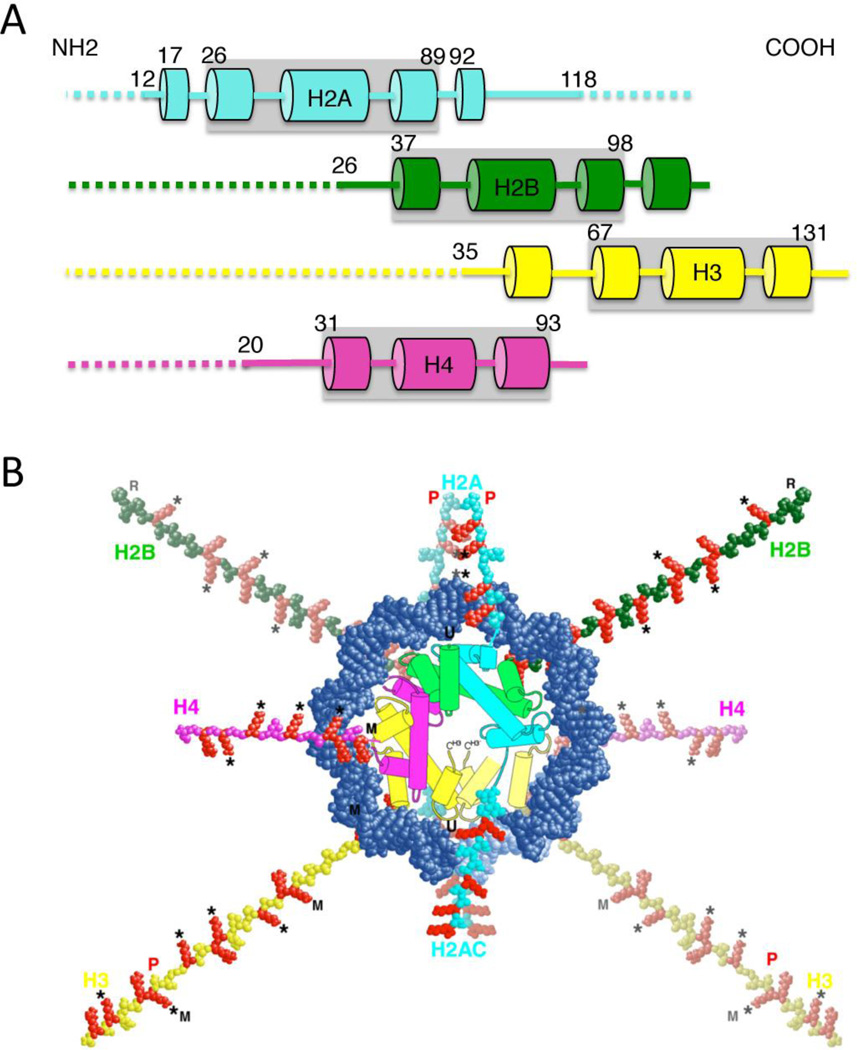
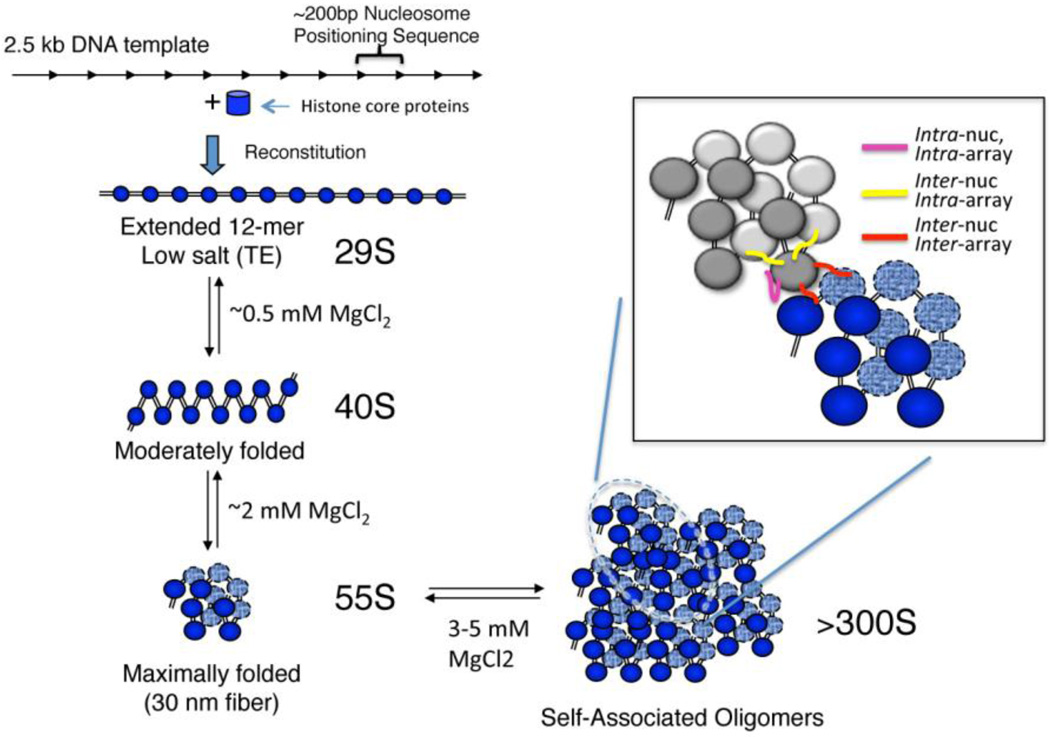
Eukaryotic chromatin is a hierarchical collection of nucleoprotein structures that package DNA to form chromosomes. The initial levels of packaging include folding of long strings of nucleosomes into secondary structures and array-array association into higher-order tertiary chromatin structures. The core histone tail domains are required for the assembly of higher-order structures and mediate short- and long-range intra- and inter-nucleosome interactions with both DNA and protein targets to direct their assembly. However, important details of these interactions remain unclear and are a subject of much interest and recent investigations. Here, we review work defining the interactions of the histone N-terminal tails with DNA and protein targets relevant to chromatin higher-order structures, with a specific emphasis on the contributions of H3 and H4 tails to oligonucleosome folding and stabilization. We evaluate both classic and recent experiments determining tail structures, effect of tail cleavage/loss, and posttranslational modifications of the tails on nucleosomes and nucleosome arrays, as well as inter-nucleosomal and inter-array interactions of the H3 and H4 N-terminal tails.
真核染色质是一种核蛋白结构的分层集合,它包装DNA以形成染色体。最初的包装水平包括将长串核小体折叠成二级结构以及阵列-阵列缔合形成更高阶的三级染色质结构。核心组蛋白尾部结构域是高阶结构组装所必需的,并介导核小体内外与DNA和蛋白质靶点的短程和长程相互作用,以指导它们的组装。然而,这些相互作用的重要细节仍不清楚,是许多研究兴趣和近期研究的主题。在这里,我们综述了定义组蛋白N端尾部与与染色质高阶结构相关的DNA和蛋白质靶点相互作用的工作,特别强调了H3和H4尾部对寡核小体折叠和稳定的贡献。我们评估了经典和近期的实验,这些实验确定了尾部结构、尾部切割/缺失的影响以及尾部的翻译后修饰对核小体和核小体阵列的影响,以及H3和H4 N端尾部的核小体间和阵列间相互作用。