Koch Katherine S, Leffert Hyam L
Hepatocyte Growth Control and Stem Cell Laboratory, Department of Pharmacology, School of Medicine, University of California, San Diego, CA, USA.
Hepat Med. 2010 Mar;2010(2):39-47. doi: 10.2147/HMER.S7208.
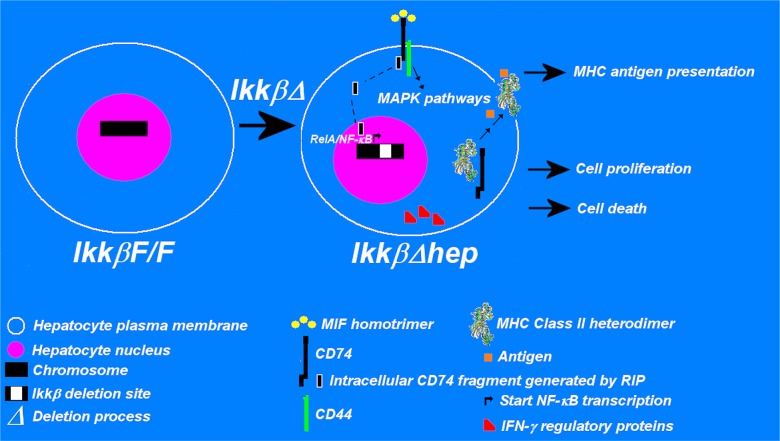
Macrophage migration inhibitory factor (MIF) is causally related to the pathogenesis of chronic liver disease but its hepatocellular mechanisms of action are largely unknown. Scattered reports in the literature hint at functional connections between the expression of MIF and major histocompatibility complex (MHC) Class II molecules. Not surprisingly, these relationships have not yet been explored in hepatocytes because MIF and MHC Class II cell surface receptors are commonly expressed by other cell types including various antigen presenting cells of the immune system. On the other hand, mounting evidence suggests that heteromeric MIF receptors share a common molecule with intracellular MHC Class II complexes, ., CD74, which also serves as the MHC Class II chaperone; and, while it is unclear what cancer-related role(s) MHC Class II receptors might play, increasing evidence suggests that MIF and CD74 are also implicated in the biology of hepatocellular carcinoma. These reports are provocative for two reasons: firstly, mice carrying hepatocyte-targeted deletions of , an IκB kinase complex subunit required for the activation of the transcription factor NF-κB (nuclear factor-κB), have been shown to display heightened susceptibilities to hepatotoxins and chemical hepatocarcinogens; secondly, microarray profiling observations indicate that hepatocytes constitutively and "ectopically" overexpress genes, particularly CD74, CD44 (a MIF-receptor subunit) and MHC Class II I-A/E β and I-A α chains, and gene families that regulate host immune process and immune defense responses. These findings together suggest that mice might express functional MIF and MHC Class II receptors, leading to increased hepatocellular sensitivity to MIF signaling as well as to the unusual property of antigen presentation; both functions might contribute to the heightened liver disease phenotypes of mice. The findings raise questions about the potential existence of cohorts of human patients with genetic abnormalities of that might confer heightened susceptibility to liver disease including hepatocellular carcinoma.
巨噬细胞移动抑制因子(MIF)与慢性肝病的发病机制存在因果关系,但其在肝细胞中的作用机制尚不清楚。文献中的零星报道暗示了MIF表达与主要组织相容性复合体(MHC)II类分子之间的功能联系。不出所料,这些关系尚未在肝细胞中得到探索,因为MIF和MHC II类细胞表面受体通常由其他细胞类型表达,包括免疫系统的各种抗原呈递细胞。另一方面,越来越多的证据表明,异源三聚体MIF受体与细胞内MHC II类复合物共享一个共同分子,即CD74,它也作为MHC II类分子伴侣;虽然尚不清楚MHC II类受体可能在癌症中发挥什么作用,但越来越多的证据表明,MIF和CD74也与肝细胞癌的生物学有关。这些报道具有启发性,原因有两个:首先,已证明携带靶向肝细胞缺失IκB激酶复合体亚基(转录因子NF-κB激活所需)的小鼠对肝毒素和化学致癌物更敏感;其次,微阵列分析观察表明,肝细胞组成性地且“异位”过表达基因,特别是CD74、CD44(MIF受体亚基)以及MHC II类I-A/Eβ和I-Aα链,以及调节宿主免疫过程和免疫防御反应的基因家族。这些发现共同表明,该小鼠可能表达功能性MIF和MHC II类受体,导致肝细胞对MIF信号的敏感性增加以及抗原呈递的异常特性;这两种功能可能都导致该小鼠肝病表型的加剧。这些发现引发了关于人类患者中可能存在导致对包括肝细胞癌在内的肝病易感性增加的基因异常群体的问题。