Schnell Susanne, Markl Michael, Entezari Pegah, Mahadewia Riti J, Semaan Edouard, Stankovic Zoran, Collins Jeremy, Carr James, Jung Bernd
Department of Radiology, Northwestern University, Chicago, Illinois, USA.
Magn Reson Med. 2014 Aug;72(2):522-33. doi: 10.1002/mrm.24925. Epub 2013 Sep 4.
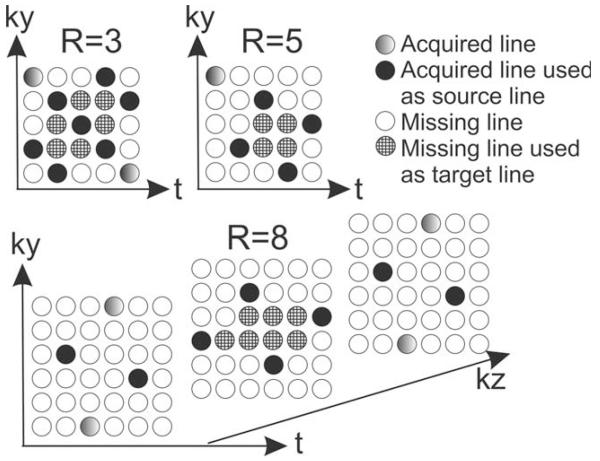
The purpose of this study was to evaluate the utility of k-t parallel imaging for accelerating aortic four-dimensional (4D)-flow MRI. The aim was to systematically investigate the impact of different acceleration factors and number of coil elements on acquisition time, image quality and quantification of hemodynamic parameters.
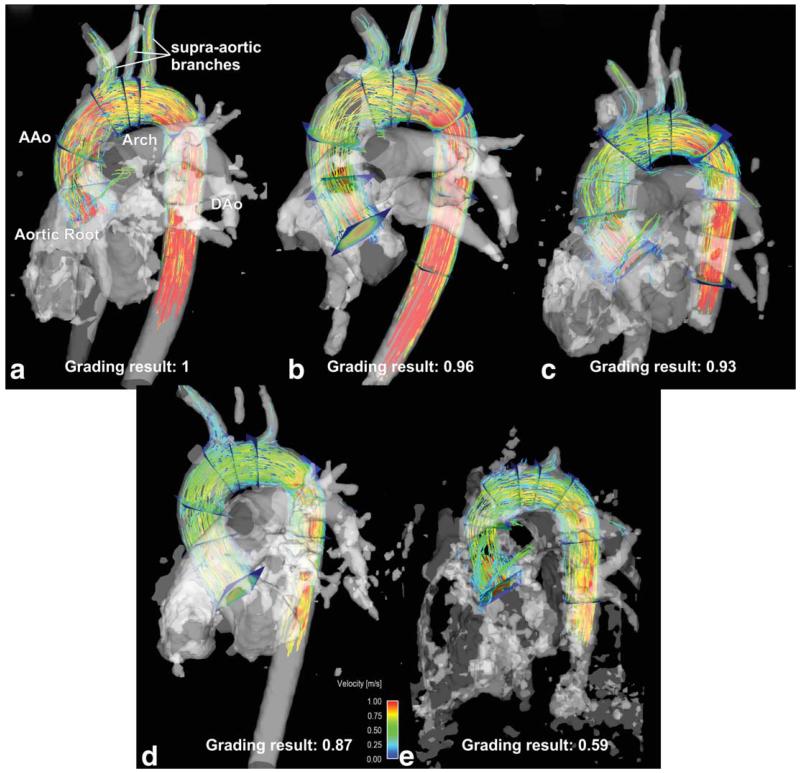
k-t accelerated 4D-flow MRI (spatial/temporal resolution = 2.1 × 2.5 × 2.5 mm/40.0 ms) was acquired in 10 healthy volunteers with acceleration factors R = 3, 5, and 8 using 12- and 32-channel receiver coils. Results were compared with conventional parallel imaging (GRAPPA [generalized autocalibrating partial parallel acquisition], R = 2). Data analysis included radiological grading of three-dimensional blood flow visualization quality as well as quantification of blood flow, velocities and wall shear stress (WSS).
k-t GRAPPA significantly reduced scan time by 28%, 54%, and 68%, for R = 3, 5, and 8, respectively, while maintaining image quality as demonstrated by overall similar image quality grading. Significant differences in peak WSS (diff12ch = -5.9%, diff32ch = 18.5%) and mean WSS (diff32ch = 13.9%) were found at the descending aorta for both receiver coils for R = 5 (PWSS < 0.04). Peak velocity differed for R=8 at the aortic root (-7.4%) and descending aorta (-12%) with PpeakVelo < 0.03.
k-t GRAPPA acceleration with a 12- or 32-channel receiver coil and an acceleration of 3 or 5 can compete with a standard GRAPPA R = 2 acceleration.
本研究旨在评估k-t并行成像在加速主动脉四维(4D)血流磁共振成像(MRI)中的效用。目的是系统研究不同加速因子和线圈单元数量对采集时间、图像质量和血流动力学参数定量的影响。
对10名健康志愿者采用12通道和32通道接收线圈,分别以加速因子R = 3、5和8进行k-t加速4D血流MRI(空间/时间分辨率 = 2.1×2.5×2.5 mm/40.0 ms)采集。将结果与传统并行成像(GRAPPA [广义自校准部分并行采集],R = 2)进行比较。数据分析包括对三维血流可视化质量进行放射学分级以及对血流、速度和壁面切应力(WSS)进行定量分析。
对于R = 3、5和8,k-t GRAPPA分别显著减少扫描时间28%、54%和68%,同时通过总体相似的图像质量分级表明图像质量得以保持。对于R = 5,在两个接收线圈的降主动脉处均发现峰值WSS(12通道差异=-5.9%,32通道差异 = 18.5%)和平均WSS(32通道差异 = 13.9%)存在显著差异(峰值WSS < 0.04)。对于R = 8,在主动脉根部(-7.4%)和降主动脉(-12%)处峰值速度存在差异,峰值速度P < 0.03。
采用12通道或32通道接收线圈且加速因子为3或5的k-t GRAPPA加速可与标准GRAPPA R = 2加速相媲美。