Department of Electrical and Computer Engineering, Swanson School of Engineering, University of Pittsburgh, Pittsburgh, Pennsylvania, USA.
PLoS One. 2013 Aug 29;8(8):e73577. doi: 10.1371/journal.pone.0073577. eCollection 2013.
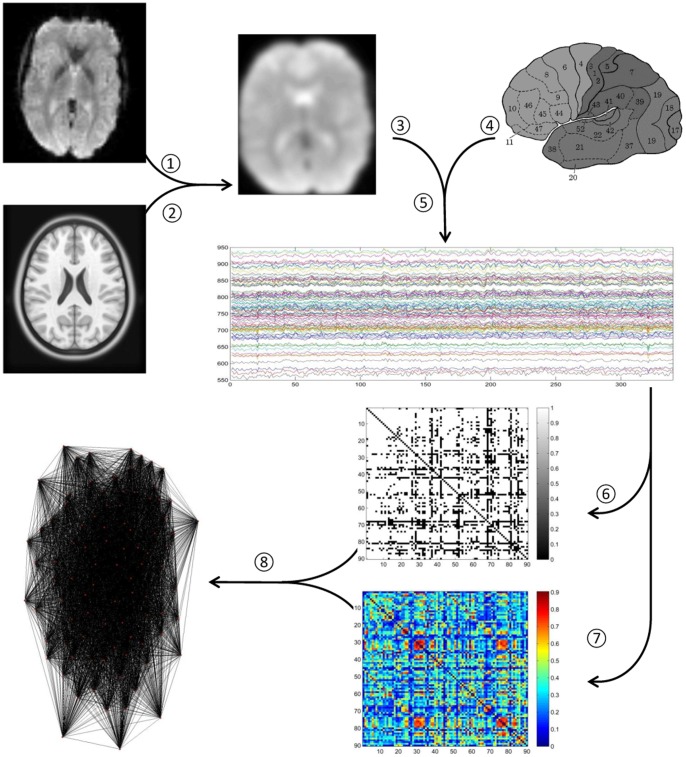
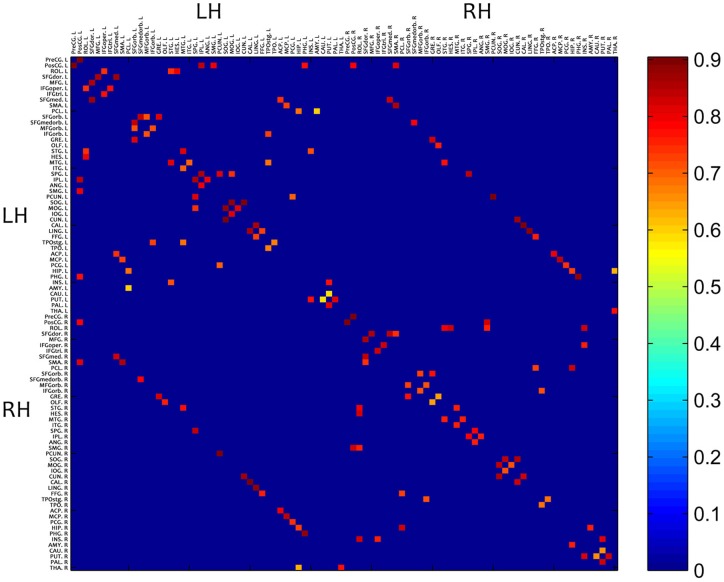
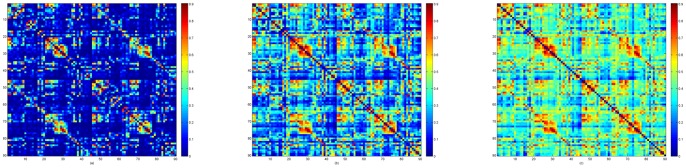
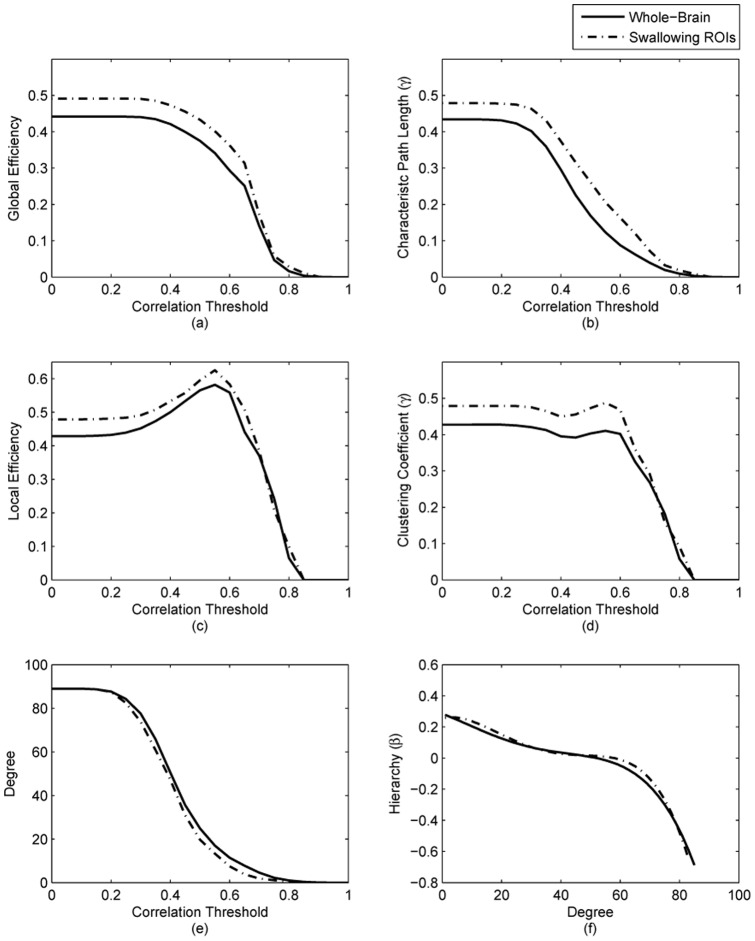
Functional connectivity between brain regions during swallowing tasks is still not well understood. Understanding these complex interactions is of great interest from both a scientific and a clinical perspective. In this study, functional magnetic resonance imaging (fMRI) was utilized to study brain functional networks during voluntary saliva swallowing in twenty-two adult healthy subjects (all females, [Formula: see text] years of age). To construct these functional connections, we computed mean partial correlation matrices over ninety brain regions for each participant. Two regions were determined to be functionally connected if their correlation was above a certain threshold. These correlation matrices were then analyzed using graph-theoretical approaches. In particular, we considered several network measures for the whole brain and for swallowing-related brain regions. The results have shown that significant pairwise functional connections were, mostly, either local and intra-hemispheric or symmetrically inter-hemispheric. Furthermore, we showed that all human brain functional network, although varying in some degree, had typical small-world properties as compared to regular networks and random networks. These properties allow information transfer within the network at a relatively high efficiency. Swallowing-related brain regions also had higher values for some of the network measures in comparison to when these measures were calculated for the whole brain. The current results warrant further investigation of graph-theoretical approaches as a potential tool for understanding the neural basis of dysphagia.
在吞咽任务期间,大脑区域之间的功能连接仍然没有得到很好的理解。从科学和临床的角度来看,理解这些复杂的相互作用非常重要。在这项研究中,使用功能磁共振成像(fMRI)来研究二十二名成年健康受试者(均为女性,[Formula: see text]岁)在自愿吞咽唾液时的大脑功能网络。为了构建这些功能连接,我们为每个参与者计算了九十个大脑区域的平均部分相关矩阵。如果两个区域的相关性超过一定阈值,则认为它们具有功能连接。然后使用图论方法分析这些相关矩阵。特别是,我们考虑了整个大脑和与吞咽相关的大脑区域的几个网络度量。结果表明,显著的成对功能连接主要是局部的和半球内的,或者是对称的半球间的。此外,我们表明,与规则网络和随机网络相比,所有人类大脑功能网络虽然在某种程度上有所不同,但都具有典型的小世界特性。这些特性允许在网络内以相对较高的效率传输信息。与整个大脑相比,吞咽相关的大脑区域的一些网络度量值也更高。目前的结果证明,图论方法作为理解吞咽困难神经基础的潜在工具值得进一步研究。