• 文献检索
  • 文档翻译
  • 深度研究
  • 学术资讯
  • Suppr Zotero 插件Zotero 插件
  • 邀请有礼
  • 套餐&价格
  • 历史记录
应用&插件
Suppr Zotero 插件Zotero 插件浏览器插件Mac 客户端Windows 客户端微信小程序
定价
高级版会员购买积分包购买API积分包
服务
文献检索文档翻译深度研究API 文档MCP 服务
关于我们
关于 Suppr公司介绍联系我们用户协议隐私条款
关注我们

Suppr 超能文献

核心技术专利:CN118964589B侵权必究
粤ICP备2023148730 号-1Suppr @ 2026

文献检索

告别复杂PubMed语法,用中文像聊天一样搜索,搜遍4000万医学文献。AI智能推荐,让科研检索更轻松。

立即免费搜索

文件翻译

保留排版,准确专业,支持PDF/Word/PPT等文件格式,支持 12+语言互译。

免费翻译文档

深度研究

AI帮你快速写综述,25分钟生成高质量综述,智能提取关键信息,辅助科研写作。

立即免费体验

引人注目的气味:嗅觉能引起 4 个月大婴儿持续注视人脸和眼睛。

Eye-catching odors: olfaction elicits sustained gazing to faces and eyes in 4-month-old infants.

机构信息

Developmental Ethology and Cognitive Psychology Group, Center for Smell, Taste and Food Science, Dijon, France.

出版信息

PLoS One. 2013 Aug 28;8(8):e70677. doi: 10.1371/journal.pone.0070677. eCollection 2013.

DOI:10.1371/journal.pone.0070677
PMID:24015175
原文链接:https://pmc.ncbi.nlm.nih.gov/articles/PMC3756010/
Abstract

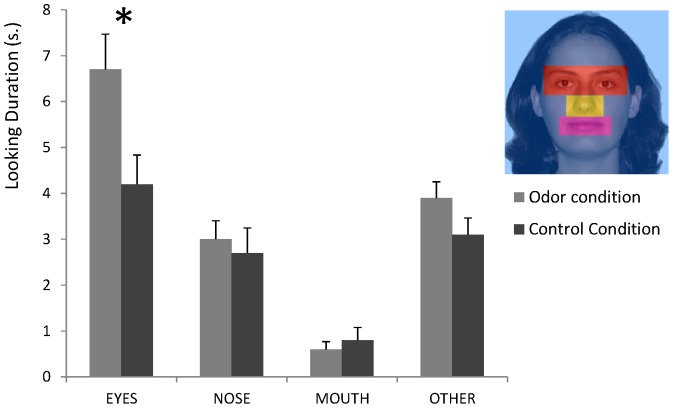
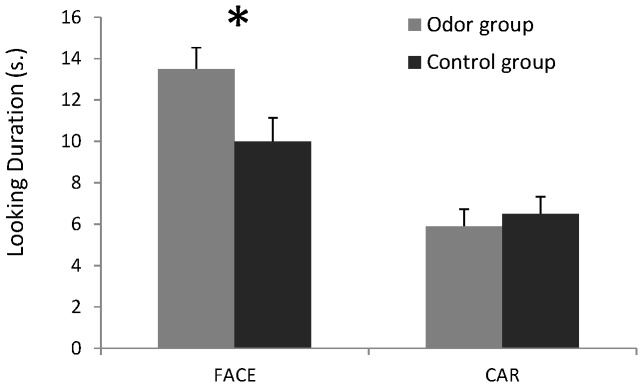
This study investigated whether an odor can affect infants' attention to visually presented objects and whether it can selectively direct visual gaze at visual targets as a function of their meaning. Four-month-old infants (n = 48) were exposed to their mother's body odors while their visual exploration was recorded with an eye-movement tracking system. Two groups of infants, who were assigned to either an odor condition or a control condition, looked at a scene composed of still pictures of faces and cars. As expected, infants looked longer at the faces than at the cars but this spontaneous preference for faces was significantly enhanced in presence of the odor. As expected also, when looking at the face, the infants looked longer at the eyes than at any other facial regions, but, again, they looked at the eyes significantly longer in the presence of the odor. Thus, 4-month-old infants are sensitive to the contextual effects of odors while looking at faces. This suggests that early social attention to faces is mediated by visual as well as non-visual cues.

摘要

本研究旨在探究气味是否能影响婴儿对视觉呈现物体的注意力,以及其是否能根据物体的意义选择性地引导视觉注视点。研究招募了 48 名四个月大的婴儿(n=48),在他们观看视觉场景的同时记录他们的眼动轨迹。这些婴儿被随机分配到气味组或对照组,他们观看的场景由静止的人脸和汽车图片组成。正如预期的那样,与汽车相比,婴儿会注视人脸更长时间,但在闻到气味时,这种对人脸的自发偏好明显增强。同样,当婴儿观察人脸时,他们会注视眼睛更长时间,但在闻到气味时,他们注视眼睛的时间明显更长。因此,四个月大的婴儿在观察人脸时对气味的环境影响很敏感。这表明,婴儿对面部的早期社会关注是由视觉和非视觉线索共同介导的。

https://cdn.ncbi.nlm.nih.gov/pmc/blobs/9c44/3756010/5798d9675dad/pone.0070677.g003.jpg
https://cdn.ncbi.nlm.nih.gov/pmc/blobs/9c44/3756010/8fdfd41c4842/pone.0070677.g001.jpg
https://cdn.ncbi.nlm.nih.gov/pmc/blobs/9c44/3756010/123576d2d6be/pone.0070677.g002.jpg
https://cdn.ncbi.nlm.nih.gov/pmc/blobs/9c44/3756010/5798d9675dad/pone.0070677.g003.jpg
https://cdn.ncbi.nlm.nih.gov/pmc/blobs/9c44/3756010/8fdfd41c4842/pone.0070677.g001.jpg
https://cdn.ncbi.nlm.nih.gov/pmc/blobs/9c44/3756010/123576d2d6be/pone.0070677.g002.jpg
https://cdn.ncbi.nlm.nih.gov/pmc/blobs/9c44/3756010/5798d9675dad/pone.0070677.g003.jpg

相似文献

1
Eye-catching odors: olfaction elicits sustained gazing to faces and eyes in 4-month-old infants.引人注目的气味:嗅觉能引起 4 个月大婴儿持续注视人脸和眼睛。
PLoS One. 2013 Aug 28;8(8):e70677. doi: 10.1371/journal.pone.0070677. eCollection 2013.
2
Does any mother's body odor stimulate interest in mother's face in 4-month-old infants?母亲的体味是否会引起 4 个月大婴儿对面孔的兴趣?
Infancy. 2020 Mar;25(2):151-164. doi: 10.1111/infa.12322. Epub 2020 Jan 12.
3
Observing Others' Gaze Direction Affects Infants' Preference for Looking at Gazing- or Gazed-at Faces.观察他人的注视方向会影响婴儿对注视或被注视面孔的观看偏好。
Front Psychol. 2018 Aug 13;9:1503. doi: 10.3389/fpsyg.2018.01503. eCollection 2018.
4
Social visual stimuli increase infants suck response: A preliminary study.社会视觉刺激增加婴儿吸吮反应:一项初步研究。
PLoS One. 2018 Nov 9;13(11):e0207230. doi: 10.1371/journal.pone.0207230. eCollection 2018.
5
Affective matching of odors and facial expressions in infants: shifting patterns between 3 and 7 months.婴儿气味与面部表情的情感匹配:3至7个月间模式的转变
Dev Sci. 2016 Jan;19(1):155-63. doi: 10.1111/desc.12292. Epub 2015 Mar 17.
6
Dynamic emotional messages differentially affect 6-month-old infants' attention to eyes and gaze cues.动态情感信息会对 6 个月大的婴儿的眼神和注视线索的注意力产生不同的影响。
Infant Behav Dev. 2021 Aug;64:101626. doi: 10.1016/j.infbeh.2021.101626. Epub 2021 Aug 11.
7
Infants' neural processing of positive emotion and eye gaze.婴儿对积极情绪和眼神注视的神经处理。
Soc Neurosci. 2010;5(1):30-9. doi: 10.1080/17470910903073232. Epub 2009 Jun 26.
8
Do surprised faces affect infants' attention toward novel objects?惊讶的表情会影响婴儿对新奇物体的注意力吗?
Neuroreport. 2011 Dec 7;22(17):906-10. doi: 10.1097/WNR.0b013e32834cd751.
9
Olfactory facilitation of visual categorization in the 4-month-old brain depends on visual demand.4 个月大的婴儿大脑中的嗅觉促进视觉分类取决于视觉需求。
Dev Sci. 2024 Nov;27(6):e13562. doi: 10.1111/desc.13562. Epub 2024 Aug 26.
10
Background odors affect behavior in a dot-probe task with emotionally expressive faces.背景气味在一项使用情绪表达性面孔的点探测任务中会影响行为。
Physiol Behav. 2019 Oct 15;210:112540. doi: 10.1016/j.physbeh.2019.05.001. Epub 2019 May 17.

引用本文的文献

1
Olfactory-to-visual facilitation in the infant brain declines gradually from 4 to 12 months.婴儿大脑中的嗅觉到视觉的促进作用会从 4 个月到 12 个月逐渐下降。
Child Dev. 2024 Nov-Dec;95(6):1967-1981. doi: 10.1111/cdev.14124. Epub 2024 Jul 18.
2
Past, Present, and Future of Human Chemical Communication Research.人类化学通讯研究的过去、现在与未来
Perspect Psychol Sci. 2025 Jan;20(1):20-44. doi: 10.1177/17456916231188147. Epub 2023 Sep 5.
3
Maternal chemosignals enhance infant-adult brain-to-brain synchrony.母体化学信号增强婴儿与成人之间的脑-脑同步性。

本文引用的文献

1
Developmental Changes in Visual Scanning of Dynamic Faces and Abstract Stimuli in Infants: A Longitudinal Study.婴儿对动态面部和抽象刺激的视觉扫描的发育变化:一项纵向研究。
Infancy. 2004 Sep;6(2):231-255. doi: 10.1207/s15327078in0602_5. Epub 2004 Sep 1.
2
Odor memory: Review and analysis.气味记忆:综述与分析。
Psychon Bull Rev. 1996 Sep;3(3):300-13. doi: 10.3758/BF03210754.
3
Long-term flavor recognition in humans with prenatal garlic experience.有产前大蒜体验的人类的长期风味识别。
Sci Adv. 2021 Dec 10;7(50):eabg6867. doi: 10.1126/sciadv.abg6867.
4
Olfaction in the Multisensory Processing of Faces: A Narrative Review of the Influence of Human Body Odors.面部多感官加工中的嗅觉:关于人体气味影响的叙述性综述
Front Psychol. 2021 Oct 5;12:750944. doi: 10.3389/fpsyg.2021.750944. eCollection 2021.
5
Odor-driven face-like categorization in the human infant brain.气味驱动的人脸分类在人类婴儿大脑中的作用。
Proc Natl Acad Sci U S A. 2021 May 25;118(21). doi: 10.1073/pnas.2014979118.
6
Maternal odor reduces the neural response to fearful faces in human infants.母体气味降低人类婴儿对恐惧面孔的神经反应。
Dev Cogn Neurosci. 2020 Oct;45:100858. doi: 10.1016/j.dcn.2020.100858. Epub 2020 Sep 8.
7
Olfaction scaffolds the developing human from neonate to adolescent and beyond.嗅觉为从新生儿到青少年及以后的人类发展提供了基础。
Philos Trans R Soc Lond B Biol Sci. 2020 Jun 8;375(1800):20190261. doi: 10.1098/rstb.2019.0261. Epub 2020 Apr 20.
8
Characterizing functional pathways of the human olfactory system.描述人类嗅觉系统的功能途径。
Elife. 2019 Jul 24;8:e47177. doi: 10.7554/eLife.47177.
9
Oxytocin Receptor Binding Sites in the Periphery of the Neonatal Prairie Vole.新生草原田鼠外周的催产素受体结合位点
Front Neurosci. 2019 May 24;13:474. doi: 10.3389/fnins.2019.00474. eCollection 2019.
10
Social visual stimuli increase infants suck response: A preliminary study.社会视觉刺激增加婴儿吸吮反应:一项初步研究。
PLoS One. 2018 Nov 9;13(11):e0207230. doi: 10.1371/journal.pone.0207230. eCollection 2018.
Dev Psychobiol. 2013 Jul;55(5):568-74. doi: 10.1002/dev.21059. Epub 2012 Jul 2.
4
Odor as a contextual cue in memory reactivation in young infants.气味作为幼儿记忆再激活的情境线索。
Infant Behav Dev. 2012 Jun;35(3):580-3. doi: 10.1016/j.infbeh.2012.05.004. Epub 2012 Jun 20.
5
Social attention with real versus reel stimuli: toward an empirical approach to concerns about ecological validity.真实刺激与虚拟刺激的社会关注度:迈向一种针对生态效度问题的实证方法。
Front Hum Neurosci. 2012 May 25;6:143. doi: 10.3389/fnhum.2012.00143. eCollection 2012.
6
Infant visual preference for fruit enhanced by congruent in-season odor.婴儿对水果的视觉偏好因与当季气味一致而增强。
Appetite. 2012 Jun;58(3):1070-5. doi: 10.1016/j.appet.2012.02.002. Epub 2012 Feb 10.
7
Infants deploy selective attention to the mouth of a talking face when learning speech.婴儿在学习语言时会选择性地注意说话人的嘴。
Proc Natl Acad Sci U S A. 2012 Jan 31;109(5):1431-6. doi: 10.1073/pnas.1114783109. Epub 2012 Jan 17.
8
Reaching experience increases face preference in 3-month-old infants.三个月大的婴儿体验的增加会增加他们对人脸的偏好。
Dev Sci. 2011 Nov;14(6):1355-64. doi: 10.1111/j.1467-7687.2011.01084.x. Epub 2011 Sep 9.
9
The Shaping of the Face Space in Early Infancy: Becoming a Native Face Processor.婴儿早期面部空间的塑造:成为本土面部识别者。
Child Dev Perspect. 2010 Dec 1;4(3):205-211. doi: 10.1111/j.1750-8606.2010.00147.x.
10
Cues for early social skills: direct gaze modulates newborns' recognition of talking faces.早期社会技能的线索:直接注视调节新生儿对说话面孔的识别。
PLoS One. 2011 Apr 15;6(4):e18610. doi: 10.1371/journal.pone.0018610.