Nickson Carolyn, Arzhaeva Yulia, Aitken Zoe, Elgindy Tarek, Buckley Mitchell, Li Min, English Dallas R, Kavanagh Anne M
Breast Cancer Res. 2013;15(5):R80. doi: 10.1186/bcr3474.
While Cumulus - a semi-automated method for measuring breast density - is utilised extensively in research, it is labour-intensive and unsuitable for screening programmes that require an efficient and valid measure on which to base screening recommendations. We develop an automated method to measure breast density (AutoDensity) and compare it to Cumulus in terms of association with breast cancer risk and breast cancer screening outcomes.
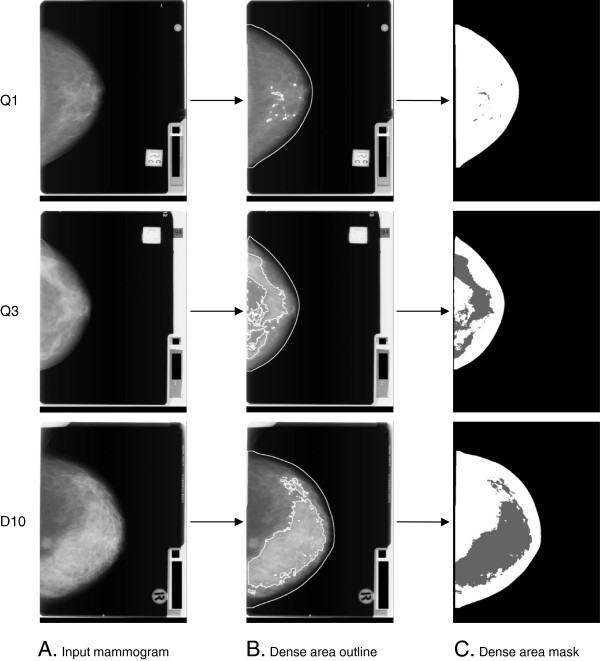
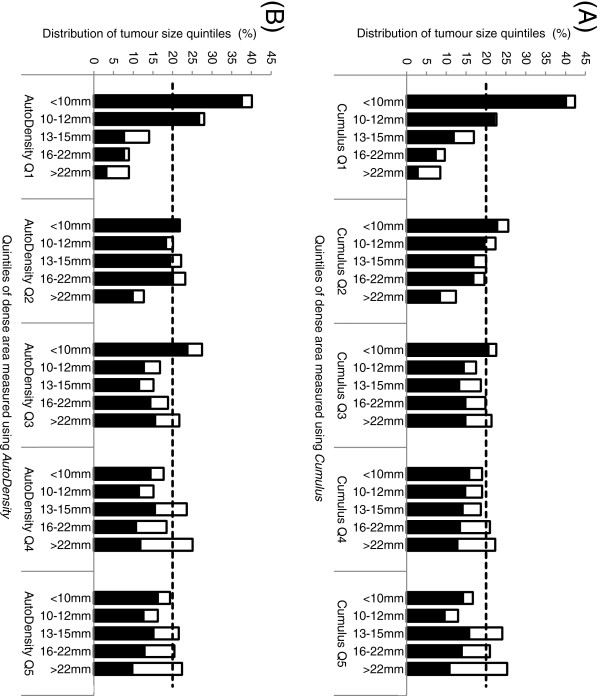
AutoDensity automatically identifies the breast area in the mammogram and classifies breast density in a similar way to Cumulus, through a fast, stand-alone Windows or Linux program. Our sample comprised 985 women with screen-detected cancers, 367 women with interval cancers and 4,975 controls (women who did not have cancer), sampled from first and subsequent screening rounds of a film mammography screening programme. To test the validity of AutoDensity, we compared the effect estimates using AutoDensity with those using Cumulus from logistic regression models that tested the association between breast density and breast cancer risk, risk of small and large screen-detected cancers and interval cancers, and screening programme sensitivity (the proportion of cancers that are screen-detected). As a secondary analysis, we report on correlation between AutoDensity and Cumulus measures.
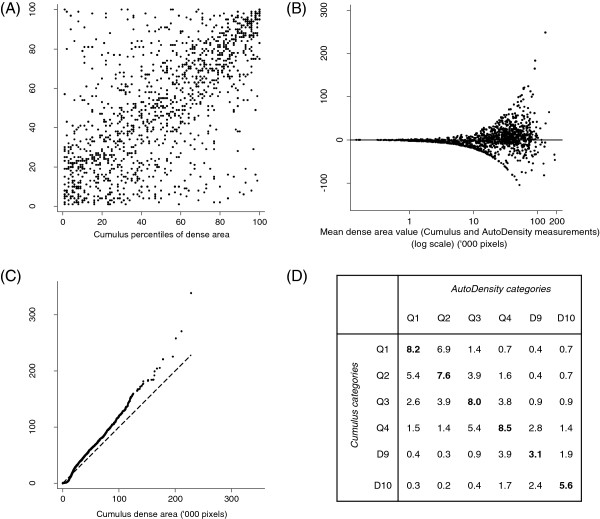
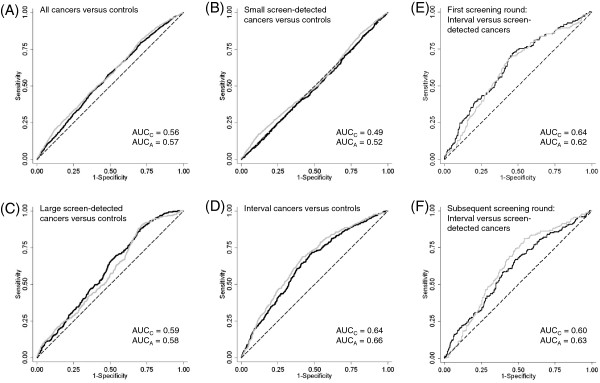
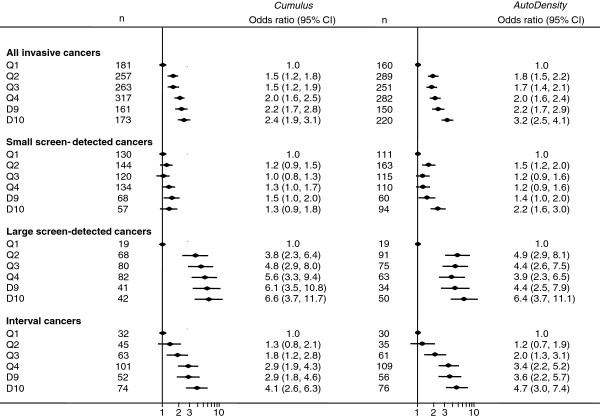
AutoDensity performed similarly to Cumulus in all associations tested. For example, using AutoDensity, the odds ratios for women in the highest decile of breast density compared to women in the lowest quintile for invasive breast cancer, interval cancers, large and small screen-detected cancers were 3.2 (95% CI 2.5 to 4.1), 4.7 (95% CI 3.0 to 7.4), 6.4 (95% CI 3.7 to 11.1) and 2.2 (95% CI 1.6 to 3.0) respectively. For Cumulus the corresponding odds ratios were: 2.4 (95% CI 1.9 to 3.1), 4.1 (95% CI 2.6 to 6.3), 6.6 (95% CI 3.7 to 11.7) and 1.3 (95% CI 0.9 to 1.8). Correlation between Cumulus and AutoDensity measures was 0.63 (P < 0.001).
Based on the similarity of the effect estimates for AutoDensity and Cumulus inmodels of breast density and breast cancer risk and screening outcomes, we conclude that AutoDensity is a valid automated method for measuring breast density from digitised film mammograms.
虽然积云法(Cumulus)——一种测量乳房密度的半自动方法——在研究中被广泛使用,但它劳动强度大,不适用于需要高效且有效测量方法以制定筛查建议的筛查项目。我们开发了一种自动测量乳房密度的方法(自动密度法,AutoDensity),并在与乳腺癌风险及乳腺癌筛查结果的关联方面将其与积云法进行比较。
自动密度法通过一个快速的独立Windows或Linux程序,自动识别乳腺钼靶片中的乳房区域,并以与积云法类似的方式对乳房密度进行分类。我们的样本包括985名经筛查发现患有癌症的女性、367名患有间期癌的女性以及4975名对照者(未患癌症的女性),这些样本取自一个乳腺钼靶筛查项目的首次及后续筛查轮次。为了测试自动密度法的有效性,我们将使用自动密度法得到的效应估计值与使用积云法从逻辑回归模型中得到的效应估计值进行比较,这些逻辑回归模型测试了乳房密度与乳腺癌风险、大小不同的经筛查发现的癌症及间期癌的风险以及筛查项目敏感性(经筛查发现的癌症比例)之间的关联。作为一项次要分析,我们报告了自动密度法与积云法测量值之间的相关性。
在所有测试的关联中,自动密度法的表现与积云法相似。例如,使用自动密度法时,与乳房密度最低五分位数的女性相比,乳房密度最高十分位数的女性患浸润性乳腺癌、间期癌、大小不同的经筛查发现的癌症的优势比分别为3.2(95%可信区间2.5至4.1)、4.7(95%可信区间3.0至7.4)、6.4(95%可信区间3.7至11.1)和2.2(95%可信区间1.6至3.0)。对于积云法,相应的优势比分别为:2.4(95%可信区间1.9至3.1)、4.1(95%可信区间2.6至6.3)、6.6(95%可信区间3.7至11.7)和1.3(95%可信区间0.9至1.8)。积云法与自动密度法测量值之间的相关性为0.63(P<0.001)。
基于自动密度法和积云法在乳房密度及乳腺癌风险和筛查结果模型中的效应估计值的相似性,我们得出结论,自动密度法是一种从数字化乳腺钼靶片中测量乳房密度的有效自动化方法。