Keller Brad, Nathan Diane, Wang Yan, Zheng Yuanjie, Gee James, Conant Emily, Kontos Despina
Department of Radiology, University of Pennsylvania, Philadelphia, PA, USA.
Med Image Comput Comput Assist Interv. 2011;14(Pt 3):562-9. doi: 10.1007/978-3-642-23626-6_69.
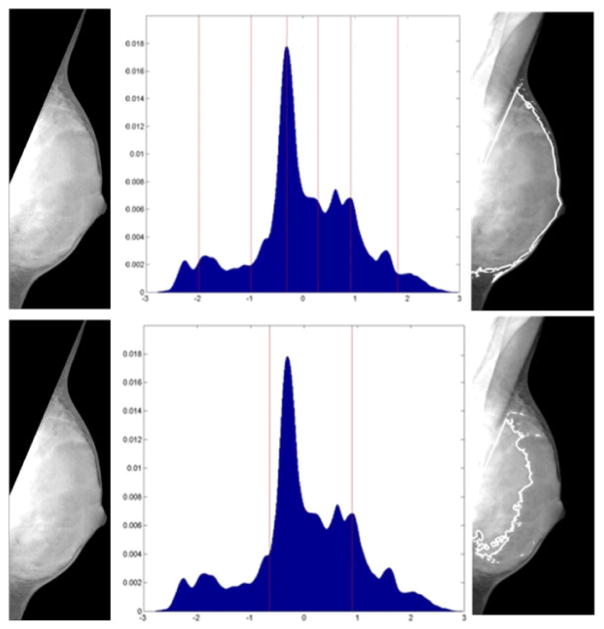
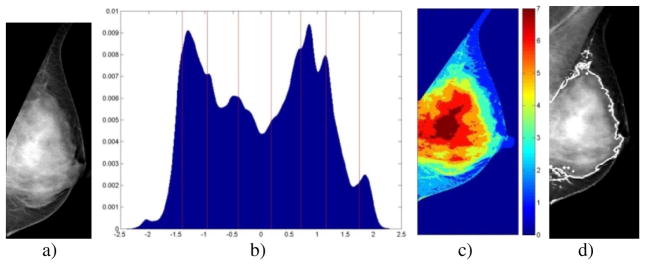
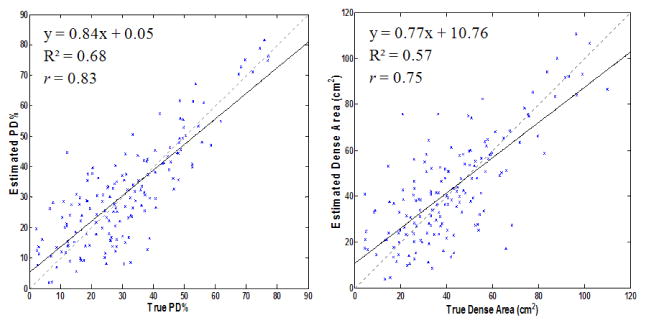
The relative fibroglandular tissue content in the breast, commonly referred to as breast density, has been shown to be the most significant risk factor for breast cancer after age. Currently, the most common approaches to quantify density are based on either semi-automated methods or visual assessment, both of which are highly subjective. This work presents a novel multi-class fuzzy c-means (FCM) algorithm for fully-automated identification and quantification of breast density, optimized for the imaging characteristics of digital mammography. The proposed algorithm involves adaptive FCM clustering based on an optimal number of clusters derived by the tissue properties of the specific mammogram, followed by generation of a final segmentation through cluster agglomeration using linear discriminant analysis. When evaluated on 80 bilateral screening digital mammograms, a strong correlation was observed between algorithm-estimated PD% and radiological ground-truth of r=0.83 (p<0.001) and an average Jaccard spatial similarity coefficient of 0.62. These results show promise for the clinical application of the algorithm in quantifying breast density in a repeatable manner.
乳房中的相对纤维腺体组织含量,通常称为乳房密度,已被证明是年龄增长后乳腺癌最重要的风险因素。目前,量化密度最常用的方法是基于半自动方法或视觉评估,这两种方法都具有高度主观性。这项工作提出了一种新颖的多类模糊c均值(FCM)算法,用于全自动识别和量化乳房密度,并针对数字乳腺摄影的成像特性进行了优化。所提出的算法包括基于特定乳房X光片的组织特性得出的最佳聚类数进行自适应FCM聚类,然后使用线性判别分析通过聚类合并生成最终分割。在80幅双侧筛查数字乳腺摄影图像上进行评估时,观察到算法估计的PD%与放射学真值之间存在很强的相关性,r = 0.83(p < 0.001),平均杰卡德空间相似系数为0.62。这些结果表明该算法在以可重复的方式量化乳房密度方面具有临床应用前景。