Department of Geriatric Medicine, Graduate School of Medicine, The University of Tokyo, Tokyo, Japan.
BMJ Open. 2013 Sep 10;3(9):e002870. doi: 10.1136/bmjopen-2013-002870.
Dementia with Lewy bodies (DLB) is the second most common form of neurodegenerative dementia after Alzheimer's disease (AD). DLB is characterised by intracytoplasmic inclusions called Lewy bodies that are often seen in the brainstem. Because modulation of the respiratory rhythm is one of the most important functions of the brainstem, patients with DLB may exhibit dysrhythmic breathing. This hypothesis has not yet been systematically studied. Therefore, we evaluated the association between DLB and dysrhythmic breathing.
In this cross-sectional study consecutive inpatients who were admitted for the evaluation of progressive cognitive impairment were enrolled. We assessed breathing irregularity using polysomnographic recordings on bed rest with closed eyes, without reference to the clinical differentiation among DLB, AD and having no dementia.
Single centre in Japan.
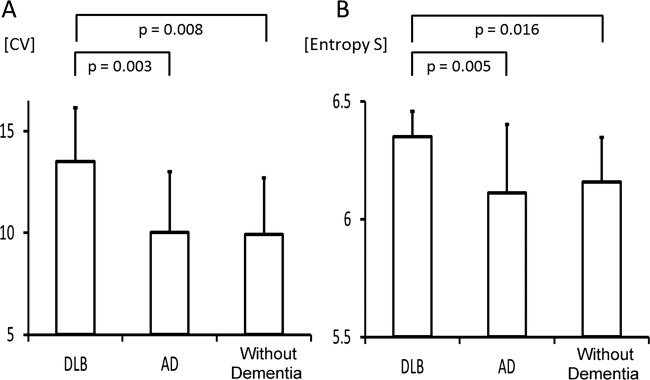
14 patients with DLB , 21 with AD and 12 without dementia were enrolled in this study.
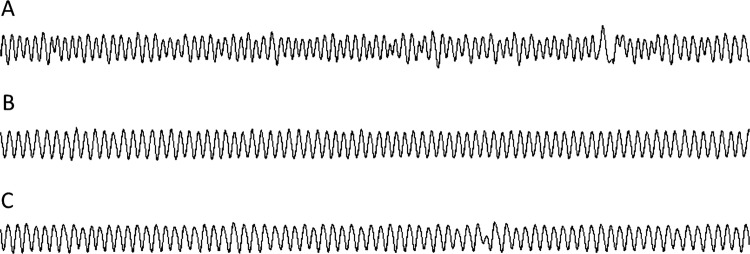
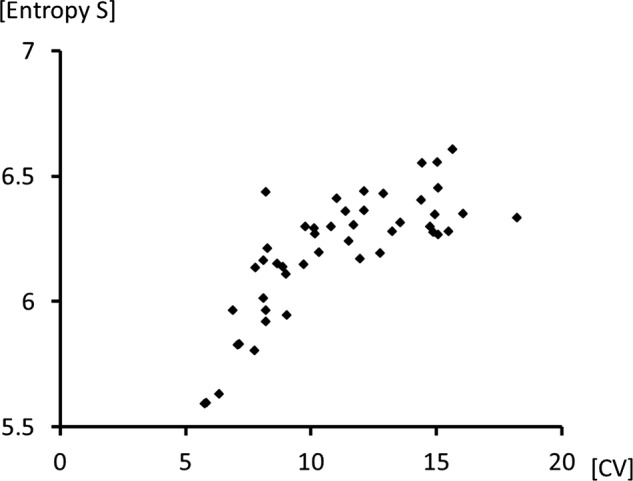
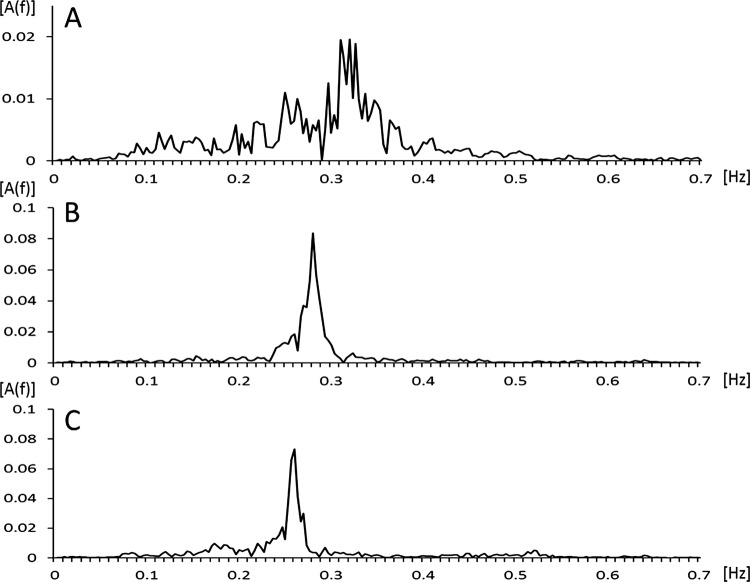
The coefficient of variation (CV) of the breath-to-breath time was calculated. We also examined the amplitude spectrum A(f) obtained using the fast Fourier transform and Shannon entropy S of A(f) in patients with DLB compared with patients with AD and patients without dementia.
The values of CV and entropy S were significantly higher in patients with DLB than in patients with AD and patients without dementia. No significant differences were observed between patients with AD and patients without dementia.
Patients with DLB exhibit dysrhythmic breathing compared with patients with AD and patients without dementia. Dysrhythmic breathing is a new clinical feature of DLB and the spectral analysis of breathing patterns can be clinically useful for the diagnostic differentiation of DLB from AD.
路易体痴呆(DLB)是仅次于阿尔茨海默病(AD)的第二大常见神经退行性痴呆。DLB 的特征是存在称为路易体的细胞质内包涵体,这些包涵体通常在脑干中可见。由于呼吸节律的调节是脑干最重要的功能之一,因此 DLB 患者可能表现出呼吸节律不齐。这一假说尚未得到系统研究。因此,我们评估了 DLB 与呼吸节律不齐之间的关系。
在这项横断面研究中,我们连续纳入了因进行性认知障碍而住院评估的患者。我们使用闭眼卧床多导睡眠图记录评估呼吸不规则性,而不参考 DLB、AD 和无痴呆之间的临床差异。
日本的一个单一中心。
本研究纳入了 14 例 DLB 患者、21 例 AD 患者和 12 例无痴呆患者。
计算呼吸时间的变异系数(CV)。我们还比较了 DLB 患者与 AD 患者和无痴呆患者的快傅里叶变换得到的幅度谱 A(f)和 A(f)的香农熵 S。
DLB 患者的 CV 和熵 S 值明显高于 AD 患者和无痴呆患者。AD 患者和无痴呆患者之间无显著差异。
与 AD 患者和无痴呆患者相比,DLB 患者存在呼吸节律不齐。呼吸节律不齐是 DLB 的一个新的临床特征,呼吸模式的频谱分析可能对 DLB 与 AD 的诊断鉴别具有临床意义。