Department of Psychiatry, The Catholic University of Korea College of Medicine, Seoul, Korea.
Clin Psychopharmacol Neurosci. 2013 Aug;11(2):96-102. doi: 10.9758/cpn.2013.11.2.96. Epub 2013 Aug 26.
Several studies have suggested that repetitive transcranial magnetic stimulation (rTMS) of the right prefrontal cortex may be useful in the treatment of posttraumatic stress disorder (PTSD). The aim of this study was to compare the effect of rTMS on the right prefrontal cortex with that of sham stimulation among patients with PTSD.
In total, 18 patients with PTSD were randomly assigned to the 1-Hz low-frequency rTMS group or the sham group for 3 weeks. Primary efficacy measures were the Clinician-Administered PTSD Scale (CAPS) and its subscales, assessed at baseline and at 2, 4, and 8 weeks.
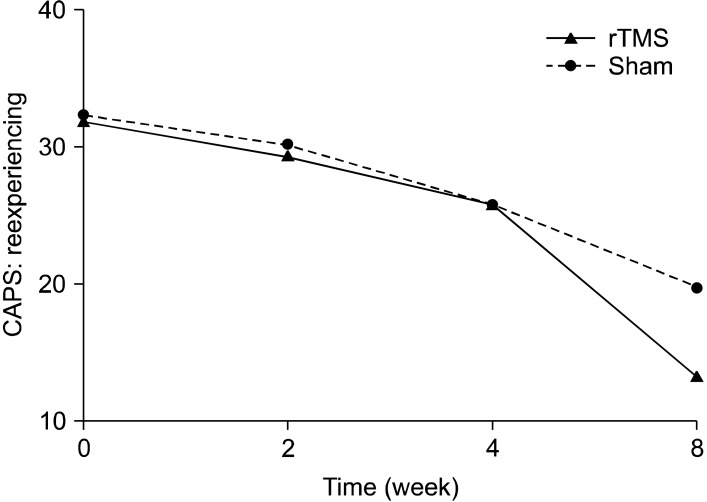
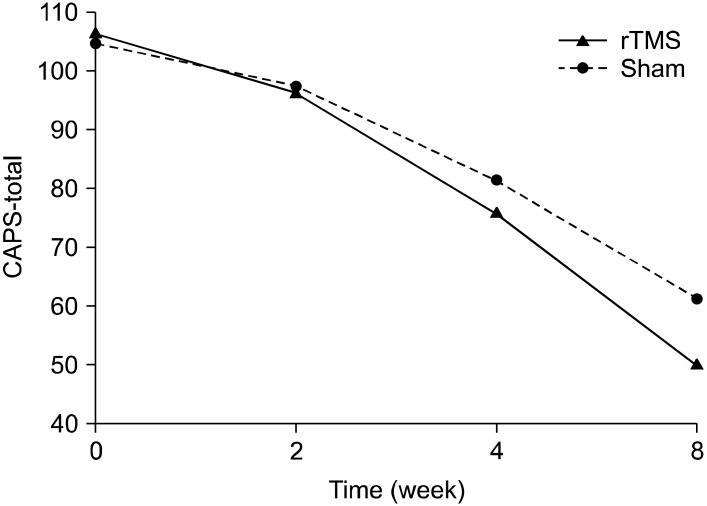
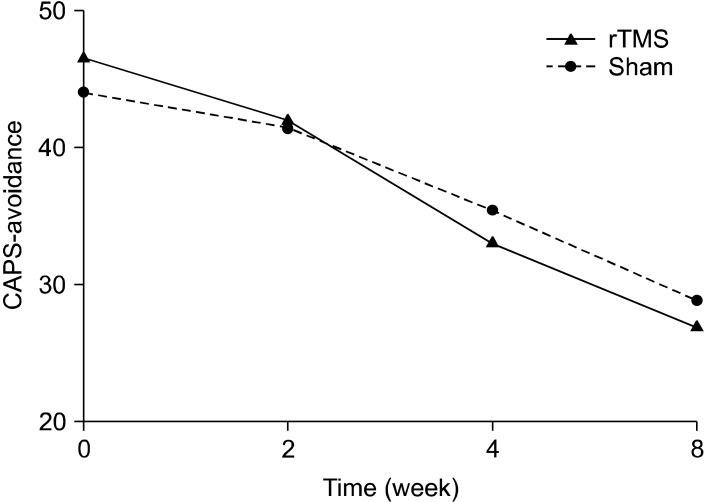
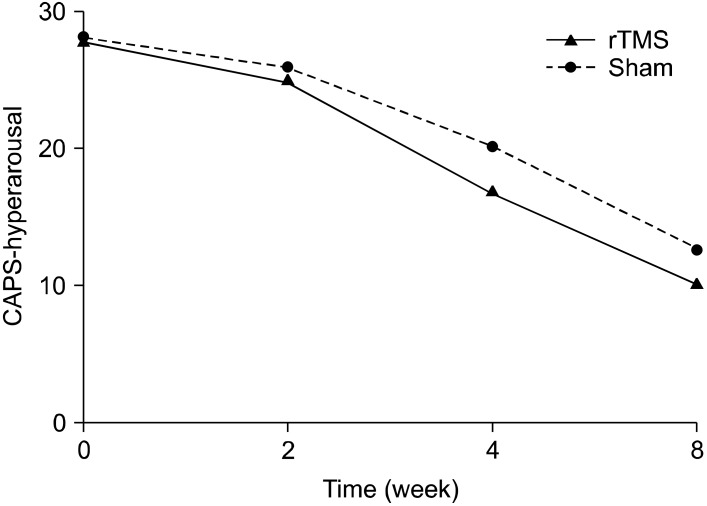
All CAPS scores improved significantly over the study period. We found significant differences in the re-experiencing scores (F=7.47, p=0.004) and total scores (F=6.45, p=0.008) on the CAPS. The CAPS avoidance scores showed a trend toward significance (F=2.74, p=0.055), but no significant differences in the CAPS hyperarousal scores were observed.
The present study showed low-frequency rTMS to be an effective and tolerable option for the treatment of PTSD. Trials using variable indices of rTMS to the right prefrontal cortex and explorations of the differences in the effects on specific symptom clusters may be promising avenues of research regarding the use of rTMS for PTSD.
几项研究表明,重复经颅磁刺激(rTMS)右前额皮质可能对创伤后应激障碍(PTSD)的治疗有用。本研究的目的是比较 rTMS 对右前额皮质的影响与 PTSD 患者假刺激的影响。
共有 18 名 PTSD 患者被随机分为 1Hz 低频 rTMS 组或假刺激组,治疗 3 周。主要疗效指标为临床医生管理 PTSD 量表(CAPS)及其子量表,在基线和第 2、4、8 周进行评估。
所有 CAPS 评分在研究期间均显著改善。我们发现 CAPS 中的再体验评分(F=7.47,p=0.004)和总评分(F=6.45,p=0.008)存在显著差异。CAPS 回避评分有显著趋势(F=2.74,p=0.055),但 CAPS 警觉性评分无显著差异。
本研究表明,低频 rTMS 是治疗 PTSD 的有效且可耐受的选择。使用不同 rTMS 指数对右前额皮质进行试验,并探索对特定症状群的影响差异,可能是研究 rTMS 治疗 PTSD 的有前途的途径。