Research Institute of Internal Medicine, Oslo University Hospital Rikshospitalet, Oslo, Norway ; Faculty of Medicine, University of Oslo, Oslo, Norway.
PLoS One. 2013 Aug 30;8(8):e72769. doi: 10.1371/journal.pone.0072769. eCollection 2013.
Atherosclerosis is a chronic inflammatory disorder that involves a range of inflammatory mediators. Although interleukin (IL)-9 has been related to inflammation, there are at present no data on its role in atherosclerosis. Here we have examined IL-9 and IL-9 receptor (IL-9R) systemically and locally in patients with coronary and carotid atherosclerosis.
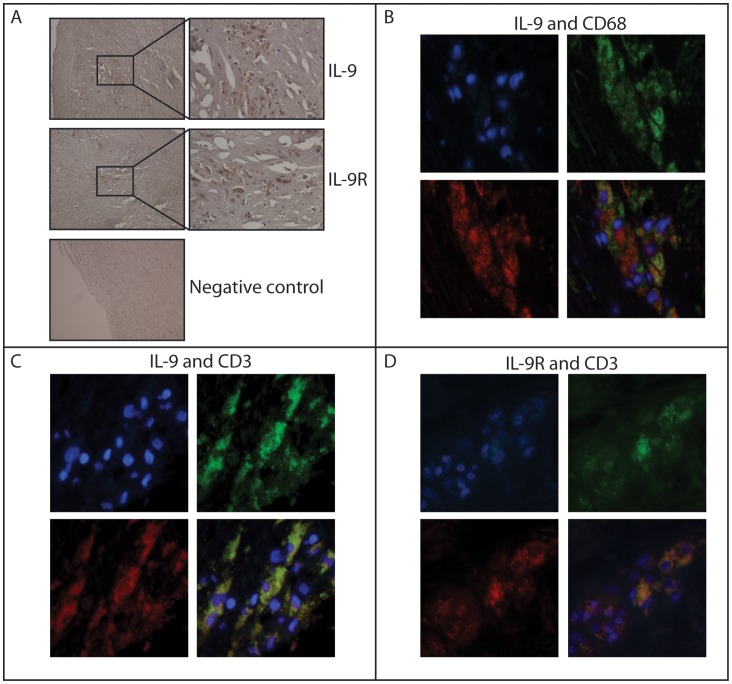
Plasma IL-9 was quantified by enzyme immunoassay and multiplex technology. IL-9 and IL-9R mRNA were quantified by real-time RT-PCR, and their localization within the lesion was assessed by immunohistochemistry.
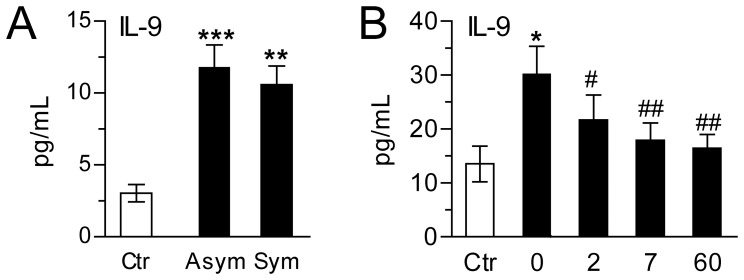
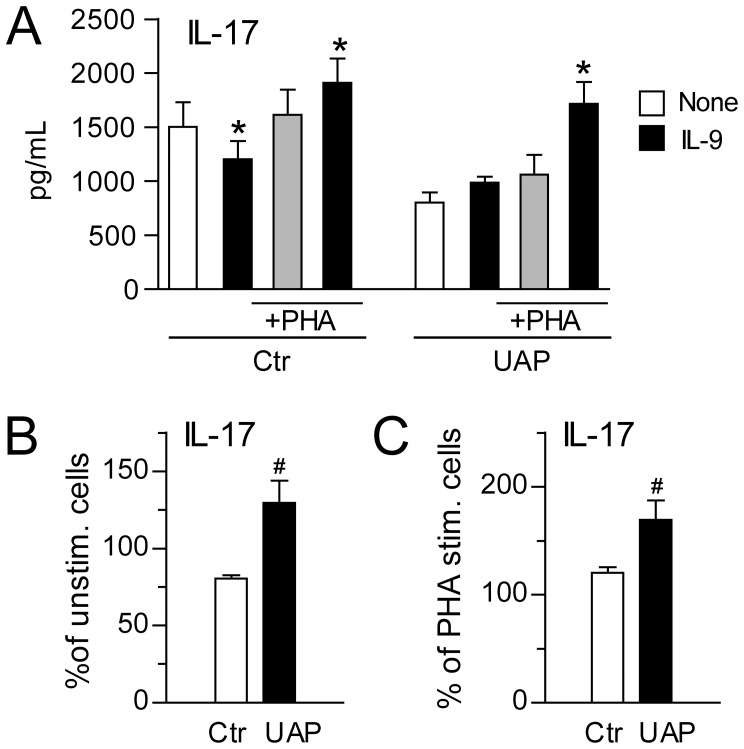
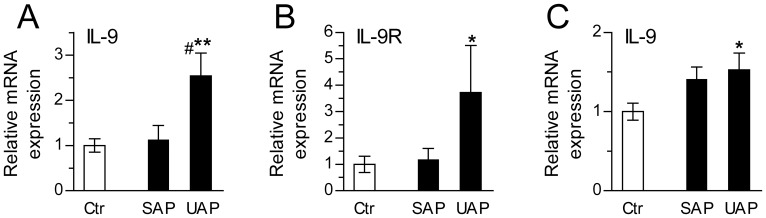
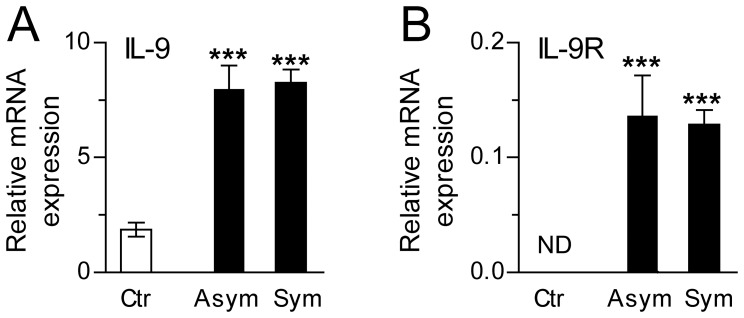
THE MAIN FINDINGS WERE: (i) Patients with carotid atherosclerosis had significantly raised IL-9 plasma levels compared with healthy controls (n = 28), with no differences between asymptomatic (n = 56) and symptomatic (n = 88) patients. (ii) On admission, patients with acute ST-elevation myocardial infarction (STEMI) (n = 42) had markedly raised IL-9 plasma levels which gradually declined during the first week post-MI. (iii) T cells and monocytes from patients with unstable angina (n = 17) had increased mRNA levels of IL-9 as compared with controls (n = 11). (iv) Carotid plaques (n = 68) showed increased mRNA levels of IL-9 and IL-9R compared to non-atherosclerotic vessels (n = 10). Co-localization to T cells (IL-9 and IL-9R) and macrophages (IL-9) were shown by immunohistochemistry. (v) IL-9 increased IL-17 release in peripheral blood mononuclear cells from patients with unstable angina (n = 5) and healthy controls (n = 5) with a particularly enhancing effect in cells from the patient group.
Our findings show increased IL-9 levels in different atherosclerotic disorders both systemically and within the lesion, suggesting a role for the IL-9/IL-9R axis in the atherosclerotic process, potentially involving IL-17 mediated mechanisms. However, the functional consequences of these findings should be further investigated.
动脉粥样硬化是一种慢性炎症性疾病,涉及多种炎症介质。虽然白细胞介素(IL)-9 与炎症有关,但目前尚无其在动脉粥样硬化中的作用的数据。在这里,我们系统地和局部地检查了冠状动脉和颈动脉粥样硬化患者的 IL-9 和 IL-9 受体(IL-9R)系统。
通过酶联免疫吸附试验和多重技术定量测定血浆 IL-9。通过实时 RT-PCR 定量测定 IL-9 和 IL-9R mRNA,并通过免疫组织化学评估其在病变内的定位。
主要发现如下:(i)与健康对照组(n=28)相比,颈动脉粥样硬化患者的 IL-9 血浆水平显着升高,无症状(n=56)和有症状(n=88)患者之间无差异。(ii)入院时,急性 ST 段抬高型心肌梗死(STEMI)患者(n=42)的 IL-9 血浆水平显着升高,在 MI 后第一周逐渐下降。(iii)与对照组(n=11)相比,不稳定型心绞痛患者(n=17)的 T 细胞和单核细胞的 IL-9 mRNA 水平升高。(iv)与非动脉粥样硬化血管(n=10)相比,颈动脉斑块(n=68)显示 IL-9 和 IL-9R 的 mRNA 水平升高。免疫组织化学显示 T 细胞(IL-9 和 IL-9R)和巨噬细胞(IL-9)的共定位。(v)IL-9 增加了不稳定型心绞痛患者(n=5)和健康对照组(n=5)外周血单个核细胞中 IL-17 的释放,在患者组的细胞中具有特别增强的作用。
我们的研究结果表明,在不同的动脉粥样硬化疾病中,无论是系统性还是病变内,IL-9 水平均升高,提示 IL-9/IL-9R 轴在动脉粥样硬化过程中起作用,可能涉及 IL-17 介导的机制。但是,应该进一步研究这些发现的功能后果。