Instituto de Ortopedia e Traumatologia, Hospital das Clínicas, Faculdade de Medicina, Universidade de São Paulo (IOT-HCFMUSP), São Paulo, SP, Brazil.
Instituto de Ortopedia e Traumatologia, Hospital das Clínicas, Faculdade de Medicina, Universidade de São Paulo (IOT-HCFMUSP), São Paulo, SP, Brazil.
Braz J Infect Dis. 2014 Jan-Feb;18(1):28-33. doi: 10.1016/j.bjid.2013.04.010. Epub 2013 Sep 9.
Septic arthritis is an infrequent disease although very important due to the possibility of disastrous outcomes if treatment is not adequately established. Adequate information concerning the epidemiology of septic arthritis is still lacking due to the uncommon nature of the disease as well as the struggle to establish a correct case-definition.
To epidemiologically characterize the population seen at Hospital das Clínicas, University of São Paulo with a diagnosis of septic arthritis between 2006 and 2011.
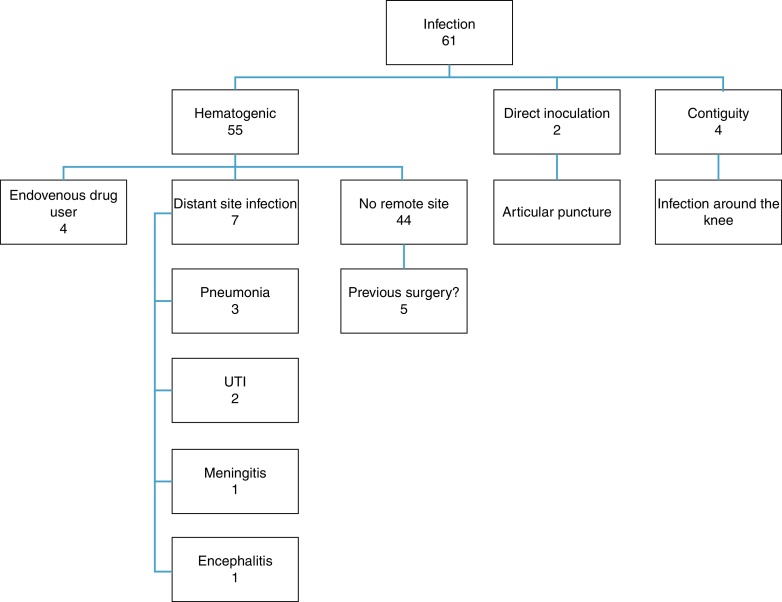
Sixty-one patients diagnosed with septic arthritis of the knee between 2006 and 2011 were retrospectively evaluated. The patients' clinical and epidemiological characteristics, the microorganisms that caused the infection and the patients' treatment and evolution were analyzed.
Septic arthritis of the knee was more common among men, with distribution across a variety of age ranges. Most diagnoses were made through positive synovial fluid cultures. The most prevalent clinical comorbidities were systemic arterial hypertension and diabetes mellitus, and the most commonly reported joint disease was osteoarthritis. Staphylococcus aureus was the prevailing pathogen. Fever was present in 36% of the cases. All patients presented elevation in inflammatory tests. Gram staining was positive in only 50.8% of the synovial fluid samples analyzed. Six patients presented complications and unfavorable evolution of their condition.
S. aureus is still the most common pathogen in acute knee infections in our environment. Gram staining, absence of fever and normal leukocyte count cannot be used to rule out septic arthritis.
尽管治疗不充分可能会导致灾难性后果,但由于疾病罕见以及难以确定正确的病例定义,关于脓毒性关节炎的流行病学信息仍然不足。
描述 2006 年至 2011 年期间在圣保罗大学临床医院就诊的诊断为脓毒性关节炎的患者的流行病学特征。
对 2006 年至 2011 年间诊断为膝关节脓毒性关节炎的 61 例患者进行回顾性评估。分析了患者的临床和流行病学特征、引起感染的微生物以及患者的治疗和转归。
膝关节脓毒性关节炎更常见于男性,分布于各种年龄段。大多数诊断是通过阳性关节液培养做出的。最常见的合并症是系统性动脉高血压和糖尿病,最常见的关节疾病是骨关节炎。金黄色葡萄球菌是主要病原体。36%的病例存在发热。所有患者均出现炎症试验升高。只有 50.8%分析的关节液样本革兰氏染色阳性。6 例患者出现并发症和病情恶化。
在我们的环境中,金黄色葡萄球菌仍然是急性膝关节感染的最常见病原体。不能仅依靠革兰氏染色、无发热和正常白细胞计数来排除脓毒性关节炎。