Chen Yu, Lippincott-Schwartz Jennifer
The Eugene Kennedy Shriver National Institute of Child Health and Human Development; National Institutes of Health; Bethesda, MD USA.
Small GTPases. 2013 Jul-Sep;4(3):193-7. doi: 10.4161/sgtp.26471. Epub 2013 Sep 12.
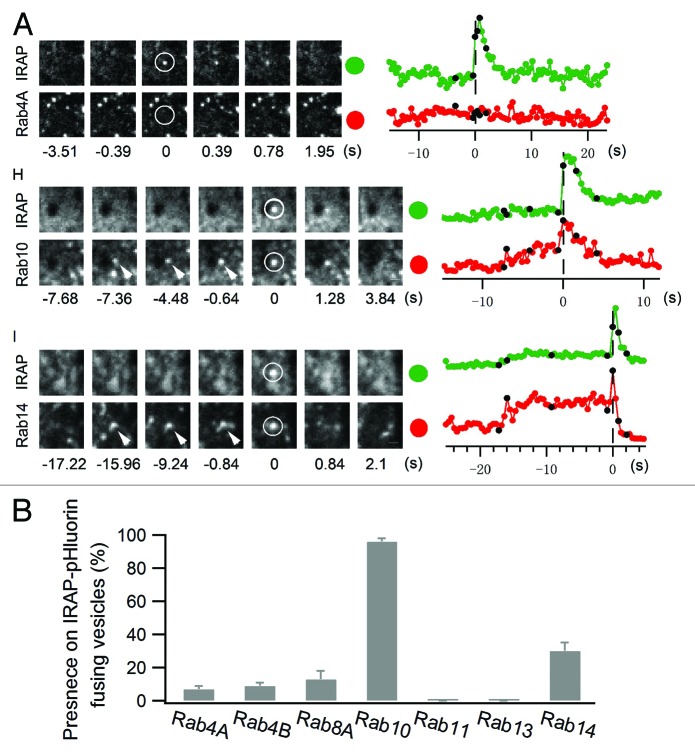
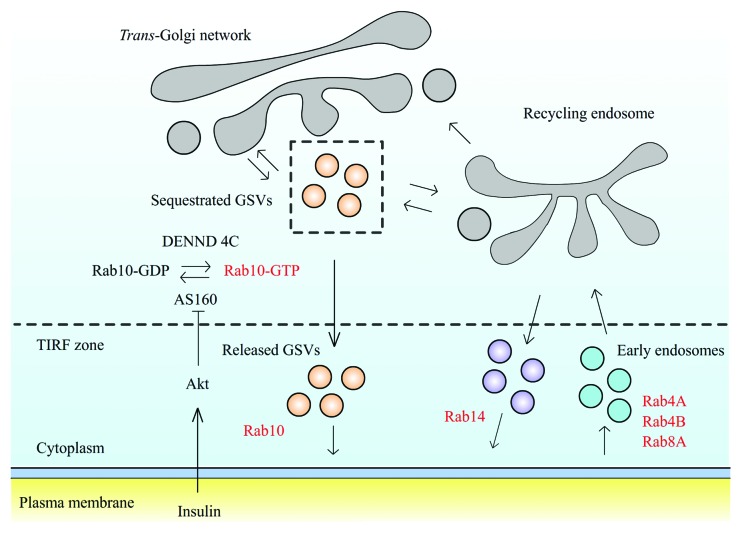
Understanding how glucose transporter isoform 4 (GLUT4) redistributes to the plasma membrane during insulin stimulation is a major goal of glucose transporter research. GLUT4 molecules normally reside in numerous intracellular compartments, including specialized storage vesicles and early/recycling endosomes. It is unclear how these diverse compartments respond to insulin stimulation to deliver GLUT4 molecules to the plasma membrane. For example, do they fuse with each other first or remain as separate compartments with different trafficking characteristics? Our recent live cell imaging studies are helping to clarify these issues. Using Rab proteins as specific markers to distinguish between storage vesicles and endosomes containing GLUT4, we demonstrate that it is primarily internal GLUT4 storage vesicles (GSVs) marked by Rab10 that approach and fuse at the plasma membrane and GSVs don't interact with endosomes on their way to the plasma membrane. These new findings add strong support to the model that GSV release from intracellular retention plays a major role in supplying GLUT4 molecules onto the PM under insulin stimulation.
了解葡萄糖转运蛋白4(GLUT4)在胰岛素刺激下如何重新分布到质膜是葡萄糖转运蛋白研究的一个主要目标。GLUT4分子通常存在于众多细胞内区室中,包括特殊的储存囊泡和早期/循环内体。目前尚不清楚这些不同的区室如何响应胰岛素刺激,将GLUT4分子递送至质膜。例如,它们是先相互融合,还是作为具有不同运输特性的独立区室存在?我们最近的活细胞成像研究有助于阐明这些问题。使用Rab蛋白作为区分含有GLUT4的储存囊泡和内体的特异性标记,我们证明主要是由Rab10标记的细胞内GLUT4储存囊泡(GSV)接近并在质膜处融合,并且GSV在前往质膜的途中不与内体相互作用。这些新发现为以下模型提供了有力支持:在胰岛素刺激下,细胞内滞留的GSV释放对向质膜供应GLUT4分子起主要作用。