Hygiene, Faculty of Pharmacy and Biochemistry , University of Buenos Aires , Argentina.
Braz J Microbiol. 2012 Oct;43(4):1255-60. doi: 10.1590/S1517-83822012000400003. Epub 2012 Jun 1.
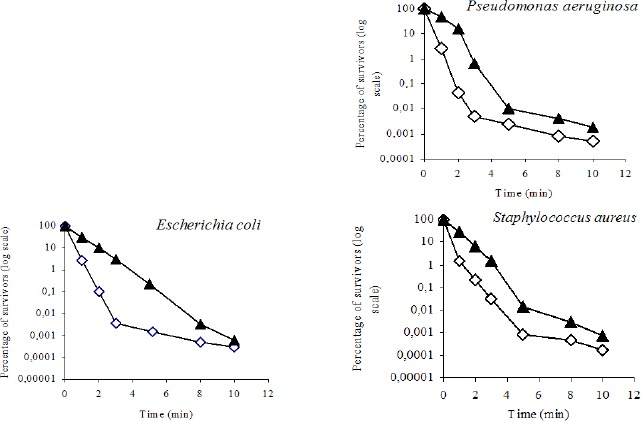
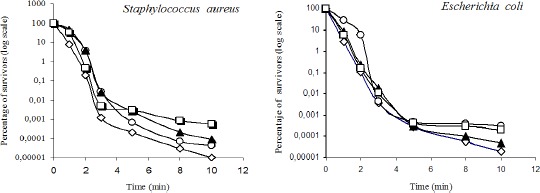
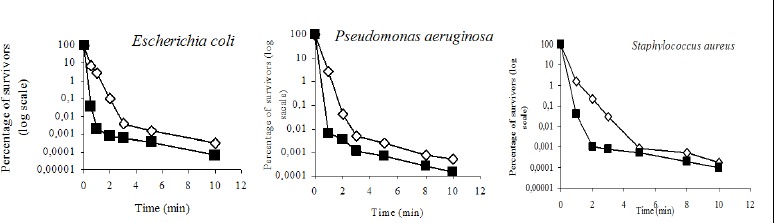
Clove essential oil, used as an antiseptic in oral infections, inhibits Gram-negative and Gram-positive bacteria as well as yeast. The influence of clove essential oil concentration, temperature and organic matter, in the antimicrobial activity of clove essential oil, was studied in this paper, through the determination of bacterial death kinetics. Escherichia coli, Staphylococcus aureus and Pseudomonas aeruginosa were the microorganisms selected for a biological test. To determine the temperature effect, they were assayed at 21° and 37° C. The concentration coefficient was determined with 0.4%, and 0.2% of essential oil. The influence of the presence of organic matter was determined with 0.4% of essential oil. The results obtained demonstrated that Escherichia coli were more sensitive even though the essential oil exerted a satisfactory action in three cases. In the three microbial species, 0.4% of essential oil at 21° C have reduced the bacterial population in 5 logarithmic orders. Organic matter reduces the antibacterial activity even though the bactericide efficacy was not lost. Clove essential oil can be considered as a potential antimicrobial agent for external use.
丁香精油作为口腔感染的防腐剂,能抑制革兰氏阴性和革兰氏阳性菌以及酵母菌。本文通过测定细菌死亡动力学,研究了丁香精油浓度、温度和有机物对丁香精油抗菌活性的影响。选择大肠杆菌、金黄色葡萄球菌和铜绿假单胞菌进行生物试验。为了确定温度的影响,在 21°C 和 37°C 下进行了检测。用 0.4%和 0.2%的精油确定了浓度系数。用 0.4%的精油测定了有机物存在的影响。结果表明,尽管精油在三种情况下都有令人满意的作用,但大肠杆菌更为敏感。在三种微生物中,21°C 时 0.4%的精油使细菌数量减少了 5 个对数级。有机物降低了抗菌活性,但杀菌效果并未丧失。丁香精油可被视为一种有潜力的外用抗菌剂。