Authors' Affiliations: Department of Pharmaceutics, Rutgers, The State University of New Jersey, Piscataway; Rutgers Cancer Institute of New Jersey and Department of Obstetrics and Gynecology, Robert Wood Johnson Medical School, Rutgers, The State University of New Jersey, New Brunswick, New Jersey; and Department of Pharmaceutical Sciences, Oregon State University, Corvallis, Oregon.
Clin Cancer Res. 2013 Nov 15;19(22):6193-204. doi: 10.1158/1078-0432.CCR-13-1536. Epub 2013 Sep 13.
The proposed project is aimed at enhancing the efficiency of epithelial ovarian cancer treatment and reducing adverse side effects of chemotherapy using nanotechnology. Overexpression of the CD44 membrane receptor results in tumor initiation, growth, cancer stem cells' specific behavior, development of drug resistance, and metastases. We hypothesize that a developed cancer-targeted delivery system that combines CD44 siRNA with paclitaxel would successfully deliver its payload inside cancer cells, effectively induce cell death, and prevent metastases.
We synthesized, characterized, and tested a nanoscale-based drug delivery system (DDS) containing a modified polypropylenimine (PPI) dendrimer as a carrier; anticancer drug paclitaxel as a cell death inducer; a synthetic analog of luteinizing hormone-releasing hormone (LHRH) peptide as a tumor-targeting moiety; and siRNA targeted to CD44 mRNA. The proposed DDS was tested in vitro and in vivo using metastatic ovarian cancer cells isolated from patients with malignant ascites.
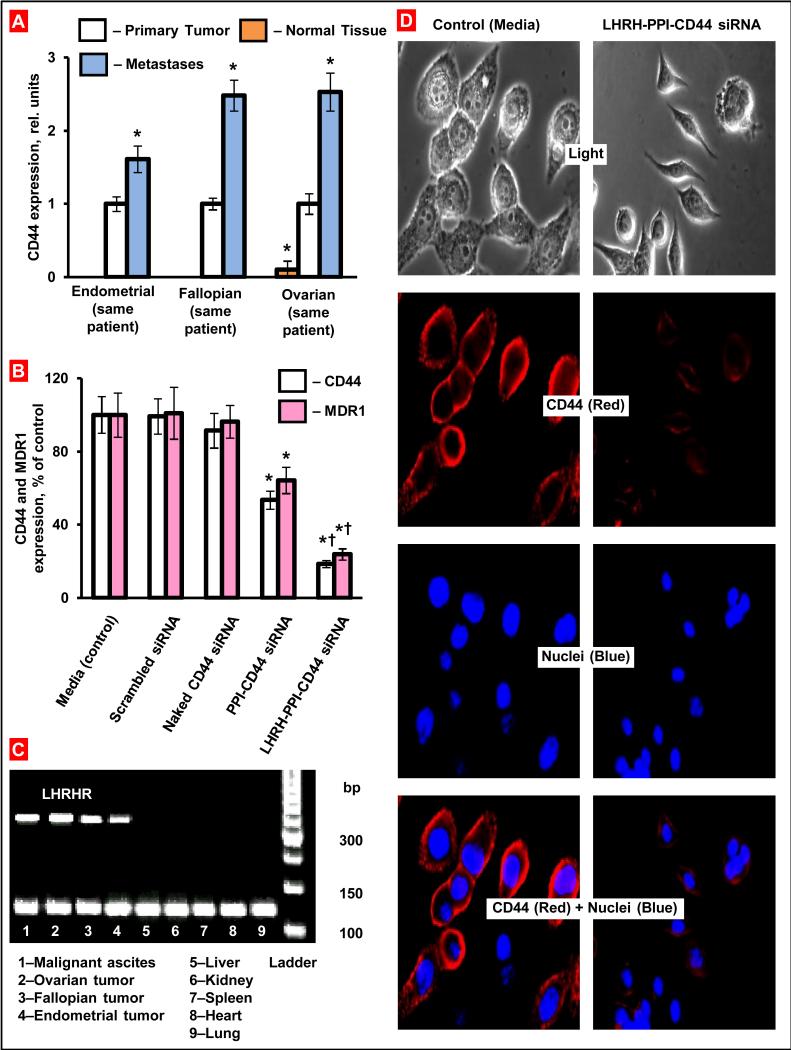
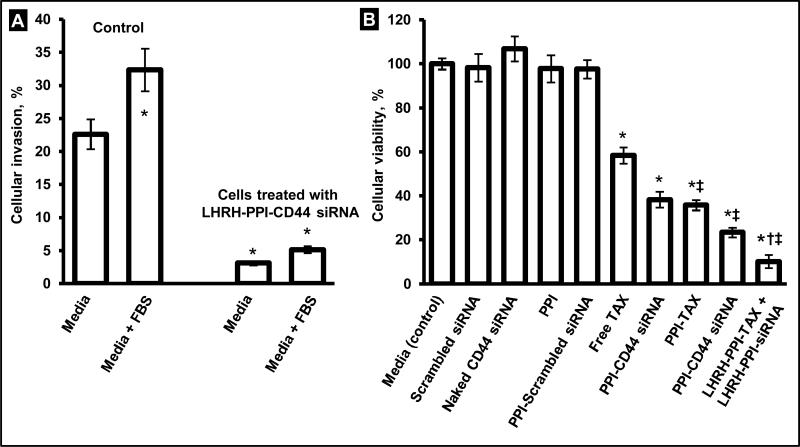
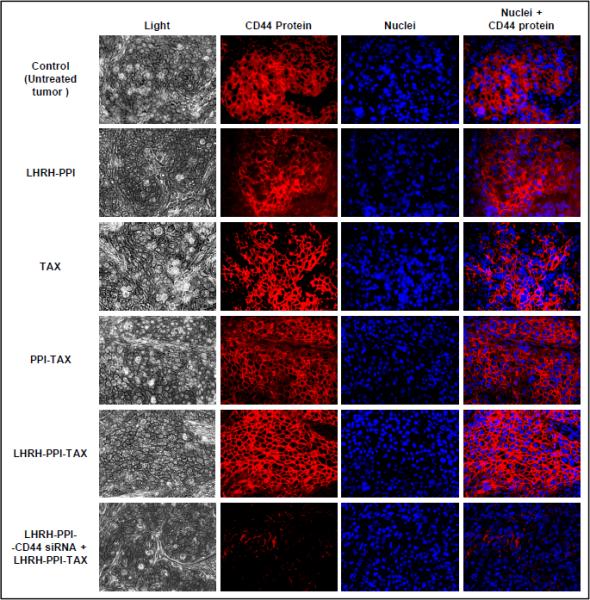
We found that in contrast with cells isolated from primary tumors, CD44 was highly overexpressed in metastatic cancer cells. Treatment with the proposed tumor-targeted nanoscale-based nucleic acid and DDS led to the suppression of CD44 mRNA and protein, efficient induction of cell death, effective tumor shrinkage, and prevention of adverse side effects on healthy organs.
We show a high therapeutic potential for combinatorial treatment of ovarian carcinoma with a novel DDS that effectively transports siRNA targeting to CD44 mRNA simultaneously with cytotoxic agents. Clin Cancer Res; 19(22); 6193-204. ©2013 AACR.
本研究拟通过纳米技术提高上皮性卵巢癌治疗效率,减少化疗的不良反应。CD44 膜受体的过度表达导致肿瘤起始、生长、癌症干细胞的特定行为、耐药性的发展和转移。我们假设,开发的靶向癌症的递送系统将 CD44siRNA 与紫杉醇结合,可成功地将其有效载荷递送到癌细胞内,有效诱导细胞死亡,并防止转移。
我们合成、表征并测试了一种基于纳米的药物递送系统(DDS),其中包含作为载体的改性聚丙亚胺(PPI)树枝状大分子;抗癌药物紫杉醇作为细胞死亡诱导剂;促黄体激素释放激素(LHRH)肽的合成类似物作为肿瘤靶向部分;以及靶向 CD44mRNA 的 siRNA。该提议的 DDS 已在使用来自恶性腹水患者的转移性卵巢癌细胞的体外和体内进行了测试。
与源自原发性肿瘤的细胞相比,我们发现 CD44 在转移性癌细胞中高度过表达。用所提议的肿瘤靶向纳米核酸和 DDS 治疗可抑制 CD44mRNA 和蛋白的表达,有效诱导细胞死亡,有效缩小肿瘤,并防止对健康器官产生不良反应。
我们展示了一种联合治疗卵巢癌的新方法的高治疗潜力,该方法通过同时输送针对 CD44mRNA 的 siRNA 和细胞毒性药物来有效运输。临床癌症研究;19(22);6193-204。©2013AACR。