Mashhad University of Medical Sciences.
J Appl Clin Med Phys. 2013 Sep 6;14(5):52-67. doi: 10.1120/jacmp.v14i5.4253.
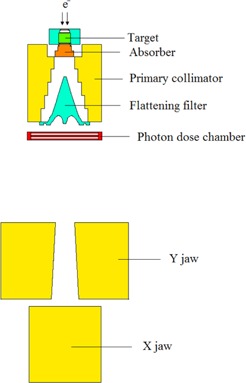
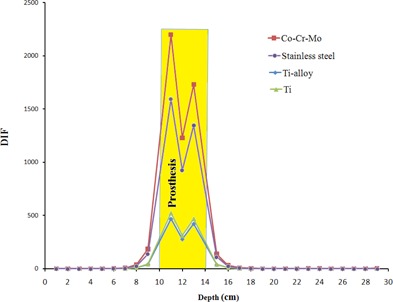
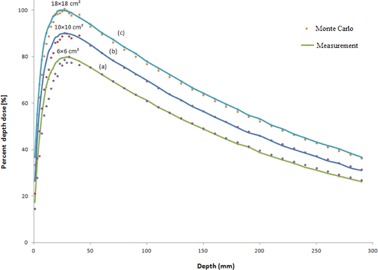
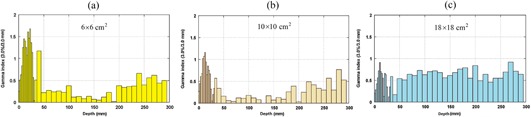
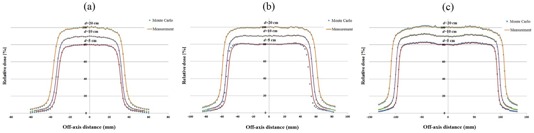
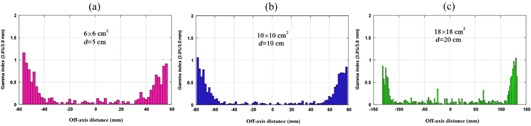
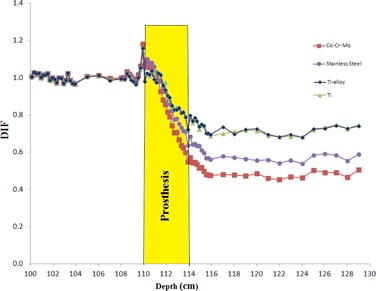
Several investigators have pointed out that electron and neutron contamination from high-energy photon beams are clinically important. The aim of this study is to assess electron and neutron contamination production by various prostheses in a high-energy photon beam of a medical linac. A 15 MV Siemens PRIMUS linac was simulated by MCNPX Monte Carlo (MC) code and the results of percentage depth dose (PDD) and dose profile values were compared with the measured data. Electron and neutron contaminations were calculated on the beam's central axis for Co-Cr-Mo, stainless steel, Ti-alloy, and Ti hip prostheses through MC simulations. Dose increase factor (DIF) was calculated as the ratio of electron (neutron) dose at a point for 10 × 10 cm² field size in presence of prosthesis to that at the same point in absence of prosthesis. DIF was estimated at different depths in a water phantom. Our MC-calculated PDD and dose profile data are in good agreement with the corresponding measured values. Maximum dose increase factor for electron contamination for Co-Cr-Mo, stainless steel, Ti-alloy, and Ti prostheses were equal to 1.18, 1.16, 1.16, and 1.14, respectively. The corresponding values for neutron contamination were respectively equal to: 184.55, 137.33, 40.66, and 43.17. Titanium-based prostheses are recommended for the orthopedic practice of hip junction replacement. When treatment planning for a patient with hip prosthesis is performed for a high-energy photon beam, attempt should be made to ensure that the prosthesis is not exposed to primary photons.
几位研究人员指出,高能光子束中的电子和中子污染具有重要的临床意义。本研究旨在评估各种假体在医用直线加速器高能光子束中的电子和中子污染产生情况。采用 MCNPX 蒙特卡罗(MC)代码模拟了 15MV 西门子 PRIMUS 直线加速器,将百分深度剂量(PDD)和剂量分布值的模拟结果与测量数据进行了比较。通过 MC 模拟,计算了 Co-Cr-Mo、不锈钢、钛合金和钛髋关节假体在光束中心轴上的电子和中子污染。剂量增加因子(DIF)定义为存在假体时 10×10cm²射野大小在某点的电子(中子)剂量与不存在假体时同一位置的电子(中子)剂量的比值。在水模体的不同深度处估算了 DIF。我们的 MC 计算的 PDD 和剂量分布数据与相应的测量值吻合良好。Co-Cr-Mo、不锈钢、钛合金和钛假体的电子污染最大剂量增加因子分别为 1.18、1.16、1.16 和 1.14。中子污染的相应值分别为:184.55、137.33、40.66 和 43.17。建议在髋关节置换的矫形实践中使用基于钛的假体。当对带有髋关节假体的患者进行高能光子束治疗计划时,应尽量确保假体不暴露于初级光子。