Department of Ophthalmology, Jiménez Díaz Foundation, Madrid, Spain.
Clin Interv Aging. 2013;8:1133-8. doi: 10.2147/CIA.S48955. Epub 2013 Aug 30.
Dysfunction of the meibomian gland (MG) is among the most frequent causes of ophthalmological symptoms. The inflammation seen in meibomian gland dysfunction (MGD) is part of its pathogenesis, and evidence of the antioxidant-inflammatory properties of omega-3 fatty acids suggests this to be an appropriate treatment for MGD.
We aimed to assess the effectiveness of omega-3 fatty acids versus placebo, in improving the symptoms and signs of MGD.
We conducted a randomized and double-mask trial of 3 months duration. We enrolled 61 patients who presented with symptomatic MGD and no tear instability (defined as tear breakup time [TBUT] <10 seconds). Participants were randomly assigned to two homogeneous subgroups. For patients in group A, the study treatment included cleaning the lid margins with neutral baby shampoo and use of artificial tears without preservatives, plus a placebo oral agent. For patients in group B, the study treatment included cleaning the lid margins with neutral baby shampoo and use of artificial tears without preservatives, plus oral supplementation with omega-3 fatty acids. We performed the following tests: (1) TBUT; (2) Schirmer I test; (3) Ocular Surface Disease Index© (OSDI©; Allergan, Inc., Irvine, CA, USA); (4) MG expression; (5) evaluation of lid margin inflammation; and (6) interpalpebral and corneal dye staining.
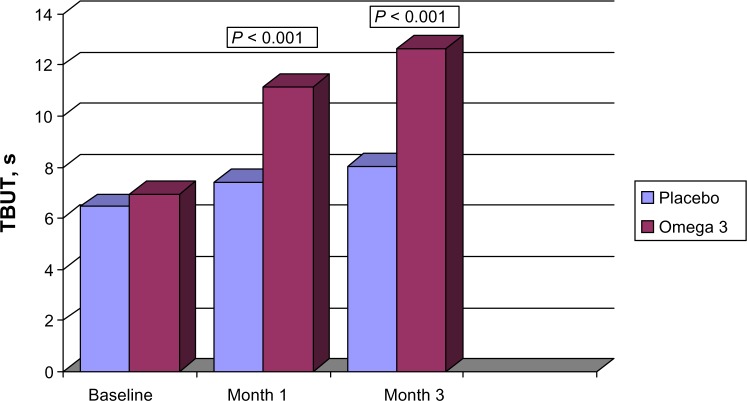
After 3 months of evaluation, the mean OSDI, TBUT, lid margin inflammation, and MG expression presented improvement from the baseline values, in group B (P < 0.01, P < 0.001, P < 0.0001, P < 0.0001, respectively). The Schirmer test results were also improved and statistically significant (P < 0.01).
Oral omega-3 fatty acids, 1.5 grams per day, may be beneficial in the treatment of MGD, mainly by improving tear stability.
睑板腺(MG)功能障碍是眼科症状最常见的原因之一。MGD 中观察到的炎症是其发病机制的一部分,并且有证据表明 ω-3 脂肪酸具有抗氧化-抗炎特性,这表明其是治疗 MGD 的一种合适方法。
我们旨在评估 ω-3 脂肪酸与安慰剂相比,在改善 MGD 的症状和体征方面的效果。
我们进行了一项为期 3 个月的随机双盲试验。我们招募了 61 名出现症状性 MGD 且泪液不稳定(定义为泪膜破裂时间 [TBUT] <10 秒)的患者。参与者被随机分为两个同质亚组。对于 A 组患者,研究治疗包括使用中性婴儿洗发水清洁睑缘和使用不含防腐剂的人工泪液,同时服用安慰剂口服药物。对于 B 组患者,研究治疗包括使用中性婴儿洗发水清洁睑缘和使用不含防腐剂的人工泪液,同时口服 ω-3 脂肪酸补充剂。我们进行了以下测试:(1)TBUT;(2)Schirmer I 测试;(3)眼表面疾病指数©(OSDI©;Allergan,Inc.,Irvine,CA,USA);(4)MG 表达;(5)睑缘炎症评估;(6)睑裂和角膜染色。
经过 3 个月的评估,B 组的 OSDI、TBUT、睑缘炎症和 MG 表达的平均值与基线值相比均有所改善(P < 0.01、P < 0.001、P < 0.0001、P < 0.0001,分别)。Schirmer 测试结果也得到改善且具有统计学意义(P < 0.01)。
每天 1.5 克口服 ω-3 脂肪酸可能有益于 MGD 的治疗,主要通过改善泪液稳定性来实现。