Department of Cardiology, Ruijin Hospital, Shanghai Jiao Tong University School of Medicine, Shanghai, China.
PLoS One. 2013 Sep 5;8(9):e70885. doi: 10.1371/journal.pone.0070885. eCollection 2013.
Observational and experimental studies have thus far been unable to resolve whether the CYBA C242T polymorphism is associated with coronary artery disease (CAD). Therefore, we undertook a comprehensive meta-analysis to more precisely evaluate the influence of this polymorphism on CAD and potential biases.
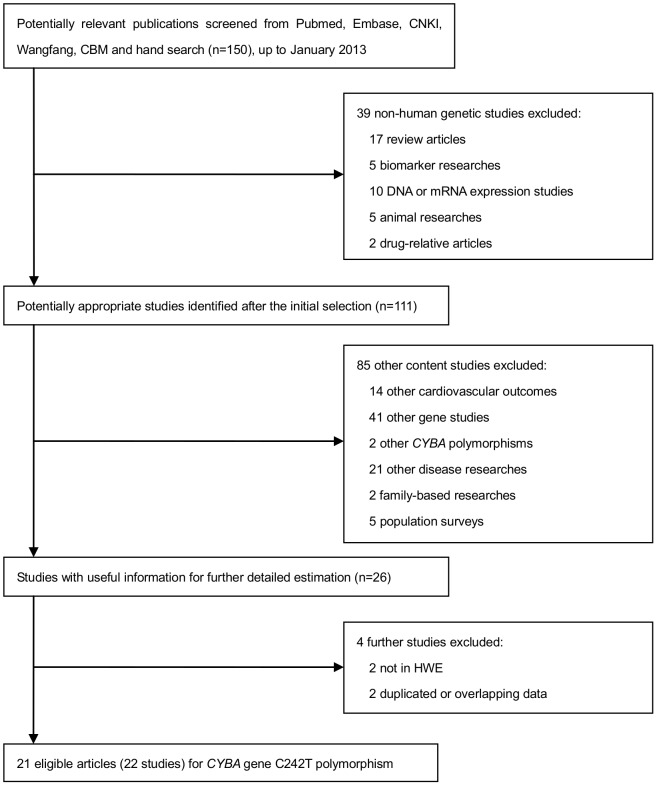
We screened MEDLINE, Embase, CNKI, Wanfang and CBM up to January 2013 and extracted data from 22 studies with 9,279 CAD patients and 9,349 controls. A random-effects model was exploited to synthesize the inconsistent outcomes of the individual studies, while addressing between-study heterogeneity and publication bias.
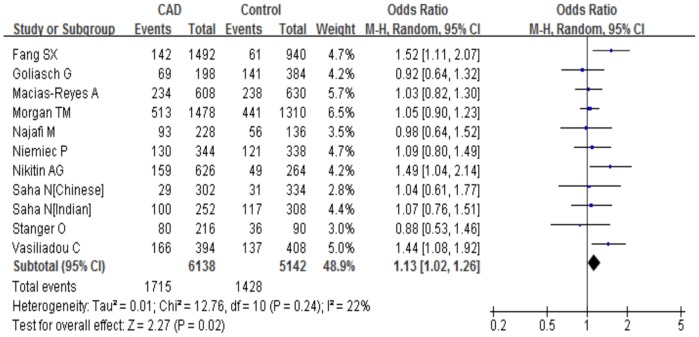
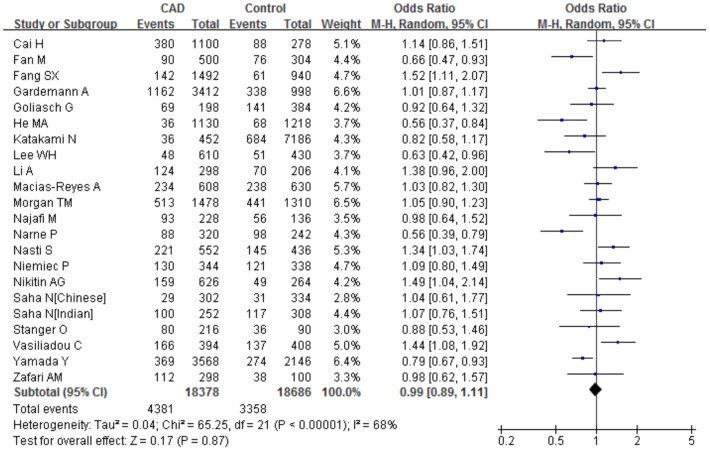
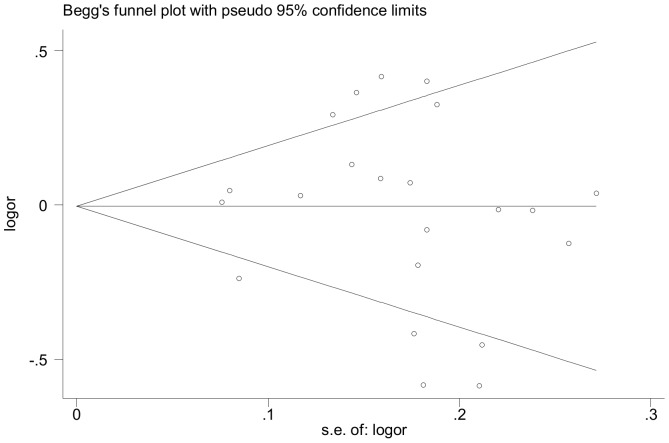
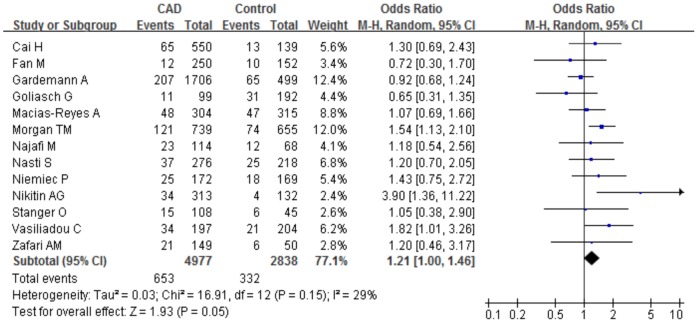
The CYBA C242T polymorphism conformed to Hard-Weinberg Equilibrium for all studies (P>0.05). Overall comparison of the T allele with the C allele produced a non-significant risk estimate for CAD but with striking heterogeneity (T versus C: P = 0.87, OR = 0.99, 95%CI 0.89-1.11, P(heterogeneity)<0.0001, I² = 67.8%). However, subgroup analysis by ethnicity documented that the T allele carriers had a marginal risk increase (21%) of CAD among Caucasians (recessive genetic model: P = 0.05, 95%CI 1.00-1.46, P(heterogeneity) = 0.15, I² = 29.1%). Then data were divided into study design, the significance of CAD risk increase was substantially strengthened in matched case-control studies (allele comparison: P = 0.02, OR = 1.13, 95%CI 1.02-1.26, P(heterogeneity) = 0.24, I² = 21.6%).Further meta-regression analysis identified that a large proportion of heterogeneity was explained by body mass index (BMI) (P = 0.03, OR = 1.07, 95%CI 1.01-1.15) and study design (P = 0.03, OR = 1.30, 95%CI 1.02-1.64).There was no obvious publication bias as verified by funnel plot and Egger's linear regression test (t = -0.25, P = 0.81 for allele comparison).
Taken together, our results suggested the CYBA C242T polymorphism might be a risk-conferring factor on developing CAD and BMI and study design were probable sources of between-study heterogeneity.
迄今为止,观察性和实验性研究均未能确定 CYBA C242T 多态性是否与冠状动脉疾病(CAD)相关。因此,我们进行了一项综合荟萃分析,以更精确地评估该多态性对 CAD 的影响及其潜在偏倚。
我们检索了 MEDLINE、Embase、CNKI、万方和 CBM,截至 2013 年 1 月,纳入了 22 项研究,共包含 9279 例 CAD 患者和 9349 例对照。采用随机效应模型综合各研究间的异质性和发表偏倚,对不一致的结果进行合并。
所有研究的 CYBA C242T 多态性均符合 Hardy-Weinberg 平衡(P>0.05)。总体比较 T 等位基因与 C 等位基因对 CAD 的风险估计无统计学意义,但存在显著异质性(T 对 C:P=0.87,OR=0.99,95%CI 0.89-1.11,P(异质性)<0.0001,I²=67.8%)。然而,按种族进行的亚组分析表明,T 等位基因携带者患 CAD 的风险略有增加(21%)(隐性遗传模型:P=0.05,95%CI 1.00-1.46,P(异质性)=0.15,I²=29.1%)。进一步按研究设计进行分层分析,匹配病例对照研究中 CAD 风险增加的意义明显增强(等位基因比较:P=0.02,OR=1.13,95%CI 1.02-1.26,P(异质性)=0.24,I²=21.6%)。进一步的 Meta 回归分析表明,大部分异质性可以由体重指数(BMI)(P=0.03,OR=1.07,95%CI 1.01-1.15)和研究设计(P=0.03,OR=1.30,95%CI 1.02-1.64)来解释。漏斗图和 Egger 线性回归检验均未发现明显的发表偏倚(等位基因比较:t=-0.25,P=0.81)。
综合来看,我们的结果提示 CYBA C242T 多态性可能是 CAD 的致病因素,BMI 和研究设计可能是造成研究间异质性的原因。