Cognitive Neuroscience, Tilburg University, Tilburg, The Netherlands.
PLoS One. 2013 Sep 6;8(9):e71408. doi: 10.1371/journal.pone.0071408. eCollection 2013.
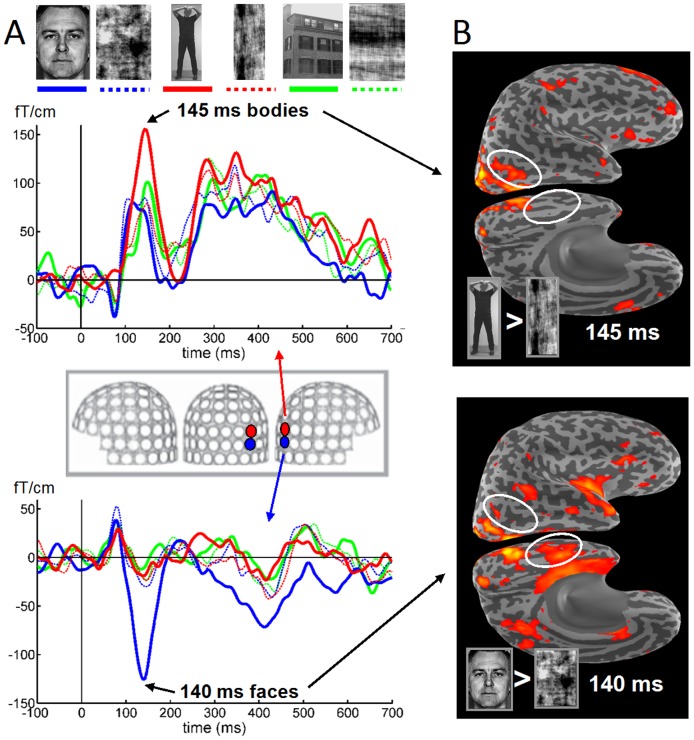
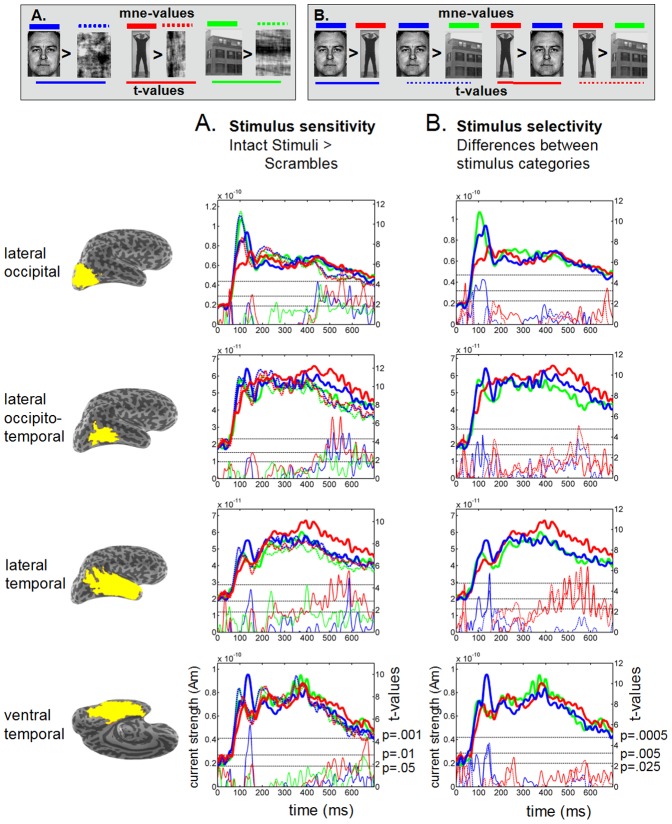
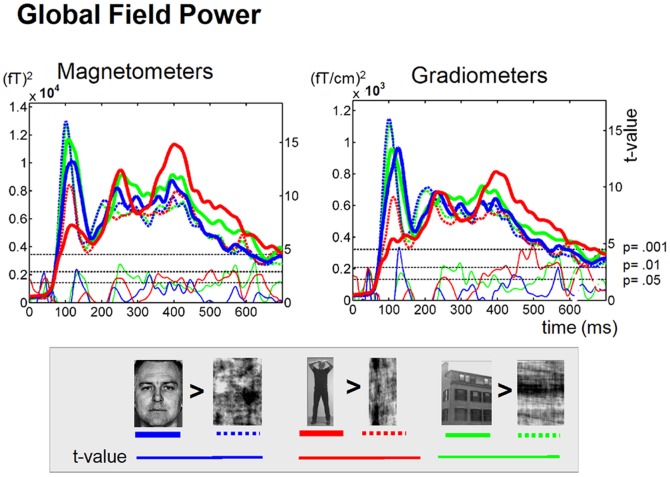
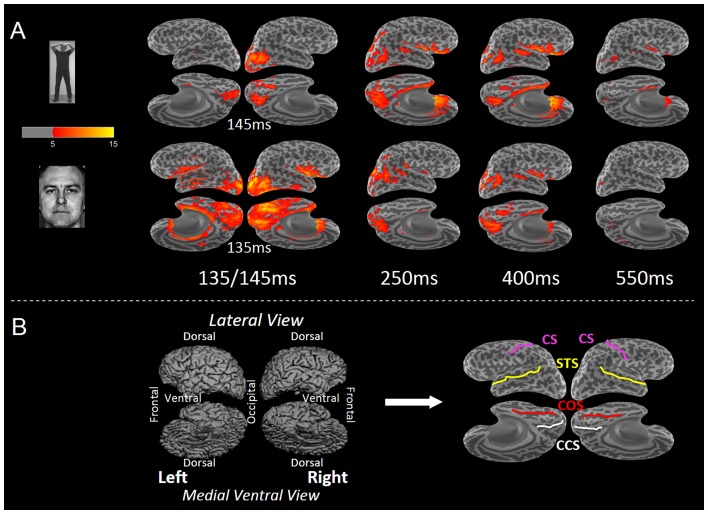
Evidence from functional neuroimaging indicates that visual perception of human faces and bodies is carried out by distributed networks of face and body-sensitive areas in the occipito-temporal cortex. However, the dynamics of activity in these areas, needed to understand their respective functional roles, are still largely unknown. We monitored brain activity with millisecond time resolution by recording magnetoencephalographic (MEG) responses while participants viewed photographs of faces, bodies, and control stimuli. The cortical activity underlying the evoked responses was estimated with anatomically-constrained noise-normalised minimum-norm estimate and statistically analysed with spatiotemporal cluster analysis. Our findings point to distinct spatiotemporal organization of the neural systems for face and body perception. Face-selective cortical currents were found at early latencies (120-200 ms) in a widespread occipito-temporal network including the ventral temporal cortex (VTC). In contrast, early body-related responses were confined to the lateral occipito-temporal cortex (LOTC). These were followed by strong sustained body-selective responses in the orbitofrontal cortex from 200-700 ms, and in the lateral temporal cortex and VTC after 500 ms latency. Our data suggest that the VTC region has a key role in the early processing of faces, but not of bodies. Instead, the LOTC, which includes the extra-striate body area (EBA), appears the dominant area for early body perception, whereas the VTC contributes to late and post-perceptual processing.
功能性神经影像学的证据表明,人类面孔和身体的视觉感知是由枕颞皮质中面部和身体敏感区域的分布式网络来进行的。然而,这些区域的活动动态,对于理解它们各自的功能角色,仍然在很大程度上是未知的。我们通过记录参与者观看面孔、身体和对照刺激的照片时的脑磁图(MEG)反应,以毫秒级的时间分辨率监测大脑活动。用解剖约束的噪声归一化最小范数估计来估计诱发反应下的皮质活动,并通过时空聚类分析进行统计分析。我们的研究结果表明,面孔和身体感知的神经系统具有独特的时空组织。在包括腹侧颞叶皮层(VTC)在内的广泛的枕颞网络中,发现了早期潜伏期(120-200ms)的选择性面孔皮质电流。相比之下,早期与身体相关的反应局限于外侧枕颞叶皮层(LOTC)。随后,在 200-700ms 时,眶额皮层出现强烈的持续的身体选择性反应,而在 500ms 后,在外侧颞叶皮层和 VTC 也出现了这种反应。我们的数据表明,VTC 区域在面孔的早期处理中具有关键作用,但不是身体。相反,包括额下回(EBA)的 LOTC 似乎是早期身体感知的主导区域,而 VTC 则有助于后期和感知后的处理。