Laboratorio de Genética Molecular, Centro de Investigaciones Biológicas del Noroeste (CIBNOR), La Paz, Baja California Sur, México.
PLoS One. 2013 Sep 10;8(9):e72323. doi: 10.1371/journal.pone.0072323. eCollection 2013.
Crassostrea gigas accumulates paralytic shellfish toxins (PST) associated with red tide species as Gymnodinium catenatum. Previous studies demonstrated bivalves show variable feeding responses to toxic algae at physiological level; recently, only one study has reported biochemical changes in the transcript level of the genes involved in C. gigas stress response.
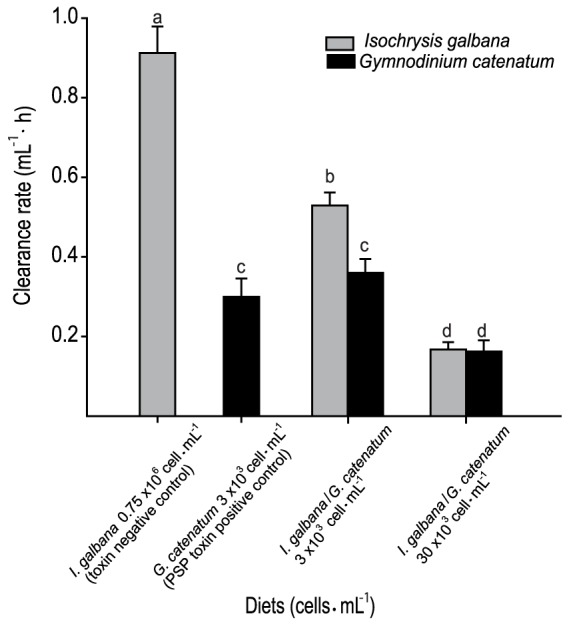
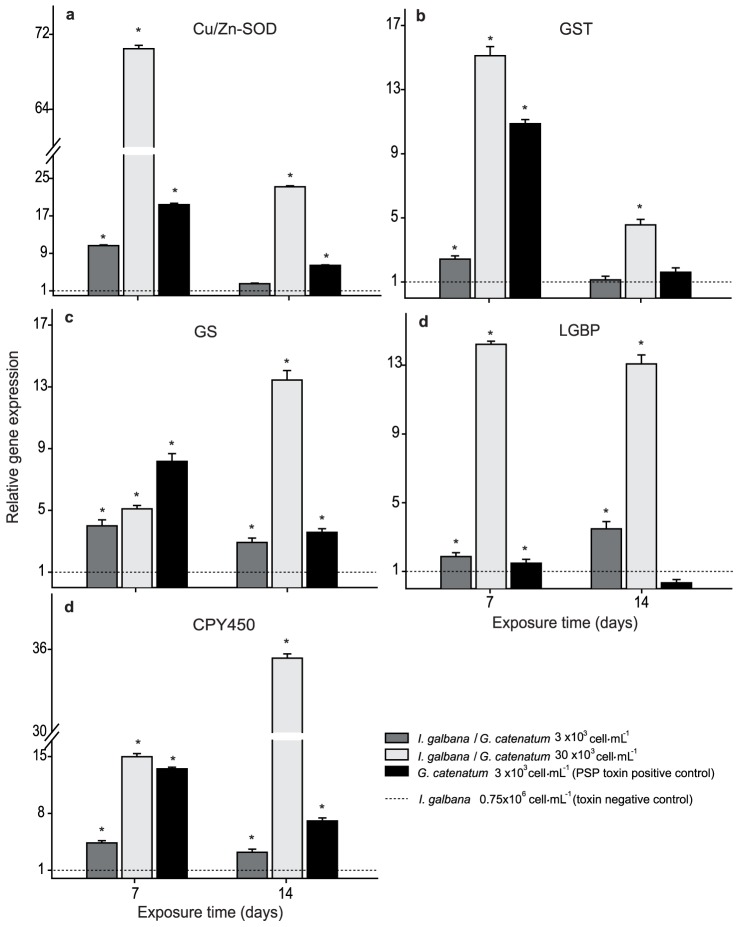
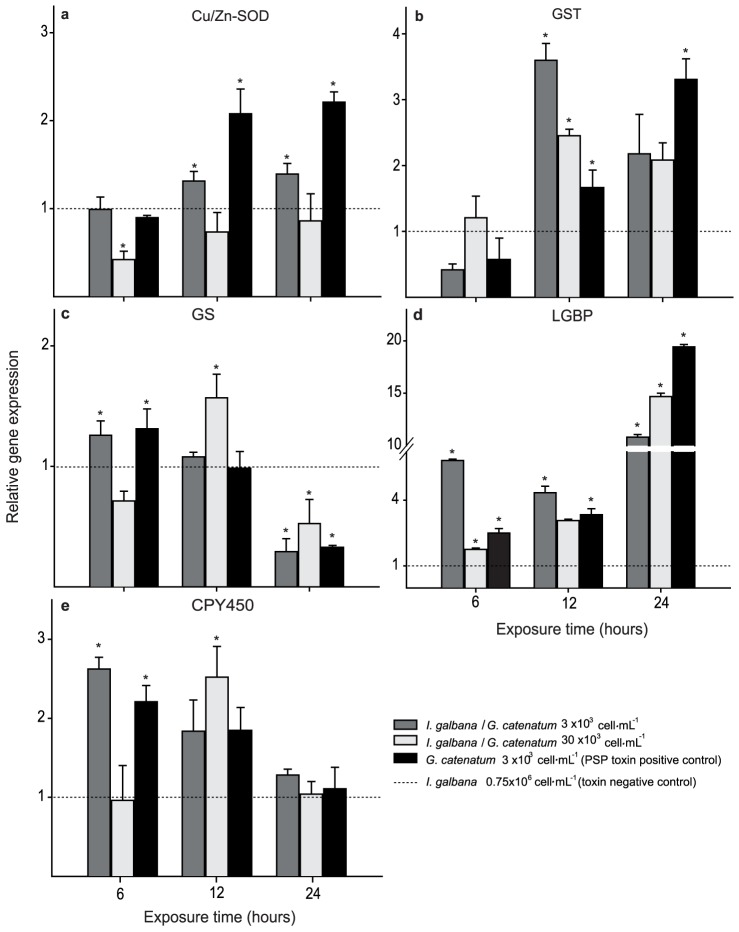
We found that 24 h feeding on toxic dinoflagellate cells (acute exposure) induced a significant decrease in clearance rate and expression level changes of the genes involved in antioxidant defense (copper/zinc superoxide dismutase, Cu/Zn-SOD), cell detoxification (glutathione S-transferase, GST and cytochrome P450, CPY450), intermediate immune response activation (lipopolysaccharide and beta glucan binding protein, LGBP), and stress responses (glutamine synthetase, GS) in Pacific oysters compared to the effects with the non-toxic microalga Isochrysis galbana. A sub-chronic exposure feeding on toxic dinoflagellate cells for seven and fourteen days (30×10³ cells mL⁻¹) showed higher gene expression levels. A significant increase was observed in Cu/Zn-SOD, GST, and LGBP at day 7 and a major increase in GS and CPY450 at day 14. We also observed that oysters fed only with G. catenatum (3×10³ cells mL⁻¹ produced a significant increase on the transcription level than in a mixed diet (3×10³ cells mL⁻¹ of G. catenatum+0.75×10⁶ cells mL⁻¹ I. galbana) in all the analyzed genes.
Our results provide gene expression data of PST producer dinoflagellate G. catenatum toxic effects on C. gigas, a commercially important bivalve. Over expressed genes indicate the activation of a potent protective mechanism, whose response depends on both cell concentration and exposure time against these toxic microalgae. Given the importance of dinoflagellate blooms in coastal environments, these results provide a more comprehensive overview of how oysters respond to stress generated by toxic dinoflagellate exposure.
太平洋牡蛎(Crassostrea gigas)会积累与赤潮物种(如链状亚历山大藻)相关的麻痹性贝类毒素(PST)。先前的研究表明,贝类在生理水平上对有毒藻类表现出不同的摄食反应;最近,仅有一项研究报道了贝类在应对压力时,其参与胁迫反应的基因在转录水平上发生了生化变化。
我们发现,在急性暴露于有毒甲藻细胞 24 小时(急性暴露)后,太平洋牡蛎的清除率显著降低,同时参与抗氧化防御(铜/锌超氧化物歧化酶,Cu/Zn-SOD)、细胞解毒(谷胱甘肽 S-转移酶,GST 和细胞色素 P450,CPY450)、中间免疫反应激活(脂多糖和β-葡聚糖结合蛋白,LGBP)和应激反应(谷氨酰胺合成酶,GS)的基因表达水平发生变化。与无毒微藻等鞭毛藻类(新月菱形藻)相比,这些基因表达水平发生了显著变化。在慢性暴露于有毒甲藻细胞 7 天和 14 天(30×10³细胞 mL⁻¹)时,基因表达水平更高。在第 7 天观察到 Cu/Zn-SOD、GST 和 LGBP 显著增加,而在第 14 天则主要增加了 GS 和 CPY450。此外,仅投喂链状亚历山大藻(3×10³细胞 mL⁻¹)会导致所有分析基因的转录水平显著增加,而投喂混合饵料(3×10³细胞 mL⁻¹的链状亚历山大藻+0.75×10⁶细胞 mL⁻¹的新月菱形藻)时则没有这种效果。
本研究提供了 PST 产生甲藻(链状亚历山大藻)对商业上重要的贝类太平洋牡蛎产生毒性影响的基因表达数据。过表达的基因表明激活了一种有效的保护机制,该机制的反应取决于细胞浓度和暴露时间,以及贝类对这些有毒微藻的适应能力。鉴于赤潮在沿海环境中的重要性,这些结果更全面地说明了牡蛎对有毒甲藻暴露产生的胁迫的反应。