School of Social and Behavioral Sciences, Arizona State University, Tempe, Arizona, United States of America.
PLoS One. 2013 Sep 5;8(9):e74449. doi: 10.1371/journal.pone.0074449. eCollection 2013.
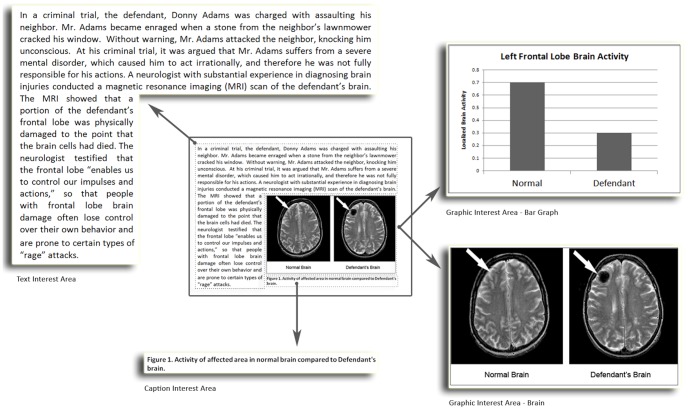
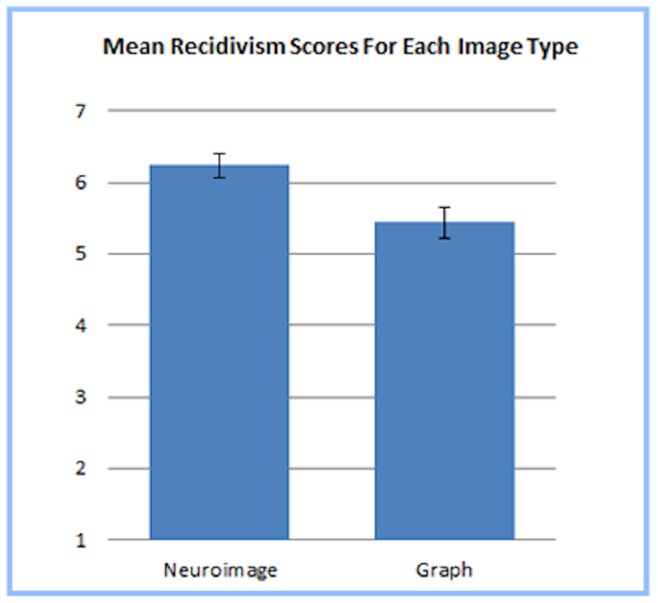
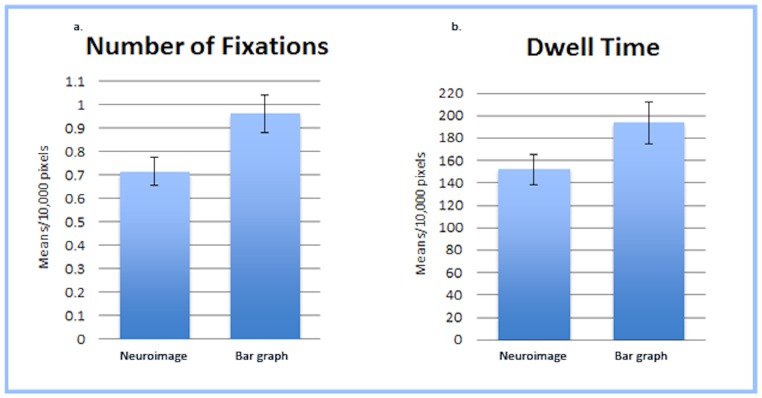
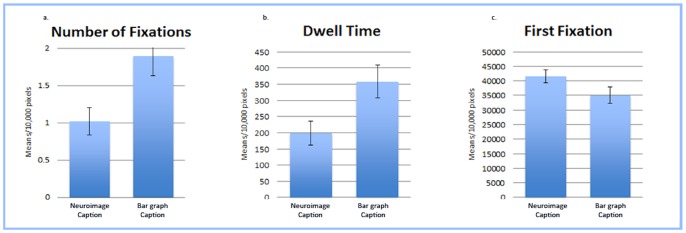
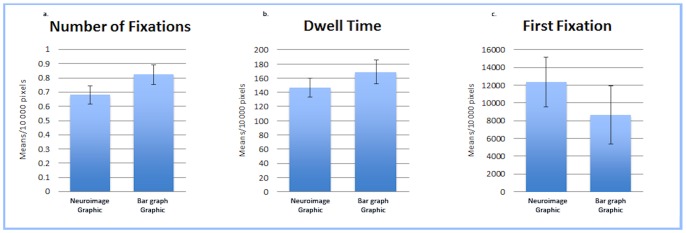
Several highly-cited experiments have presented evidence suggesting that neuroimages may unduly bias laypeople's judgments of scientific research. This finding has been especially worrisome to the legal community in which neuroimage techniques may be used to produce evidence of a person's mental state. However, a more recent body of work that has looked directly at the independent impact of neuroimages on layperson decision-making (both in legal and more general arenas), and has failed to find evidence of bias. To help resolve these conflicting findings, this research uses eye tracking technology to provide a measure of attention to different visual representations of neuroscientific data. Finding an effect of neuroimages on the distribution of attention would provide a potential mechanism for the influence of neuroimages on higher-level decisions. In the present experiment, a sample of laypeople viewed a vignette that briefly described a court case in which the defendant's actions might have been explained by a neurological defect. Accompanying these vignettes was either an MRI image of the defendant's brain, or a bar graph depicting levels of brain activity-two competing visualizations that have been the focus of much of the previous research on the neuroimage bias. We found that, while laypeople differentially attended to neuroimagery relative to the bar graph, this did not translate into differential judgments in a way that would support the idea of a neuroimage bias.
一些备受关注的实验提供了证据,表明神经影像可能会不当地影响非专业人士对科学研究的判断。这一发现尤其令法律界担忧,因为神经影像技术可能被用于提供一个人的精神状态的证据。然而,最近的一批研究直接着眼于神经影像对非专业人士决策的独立影响(无论是在法律领域还是更广泛的领域),并且没有发现偏见的证据。为了帮助解决这些相互矛盾的发现,本研究使用眼动追踪技术提供了一种衡量对神经科学数据不同视觉表现的关注度的方法。如果发现神经影像对注意力分布有影响,那么这将为神经影像对更高层次决策的影响提供一个潜在的机制。在本实验中,一组非专业人士观看了一个简短描述一个法庭案件的情景,其中被告的行为可能可以用神经缺陷来解释。这些情景伴随着被告大脑的磁共振成像(MRI)图像或显示大脑活动水平的条形图——这两种竞争的可视化效果是之前关于神经影像偏见的大部分研究的焦点。我们发现,虽然非专业人士相对于条形图对神经影像有不同的关注度,但这并没有转化为在支持神经影像偏见的想法的方式上的不同判断。