Department of Psychiatry, McGill University Montreal, QC, Canada.
Integrated Program in Neuroscience, McGill University Montreal, QC, Canada.
Front Hum Neurosci. 2014 May 27;8:357. doi: 10.3389/fnhum.2014.00357. eCollection 2014.
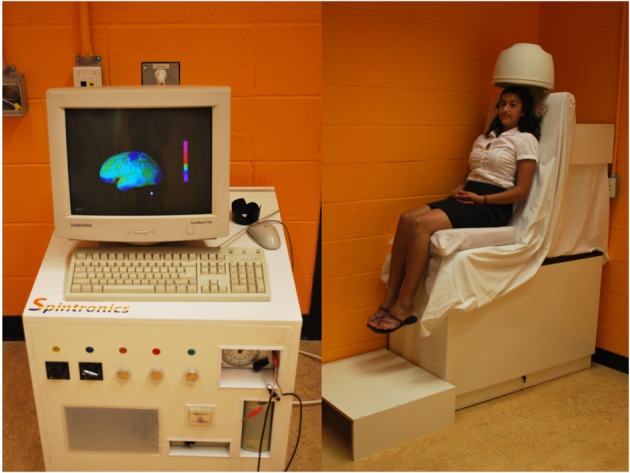
While most experts agree on the limitations of neuroimaging, the unversed public-and indeed many a scholar-often valorizes brain imaging without heeding its shortcomings. Here we test the boundaries of this phenomenon, which we term neuroenchantment. How much are individuals ready to believe when encountering improbable information through the guise of neuroscience? We introduced participants to a crudely-built mock brain scanner, explaining that the machine would measure neural activity, analyze the data, and then infer the content of complex thoughts. Using a classic magic trick, we crafted an illusion whereby the imaging technology seemed to decipher the internal thoughts of participants. We found that most students-even undergraduates with advanced standing in neuroscience and psychology, who have been taught the shortcomings of neuroimaging-deemed such unlikely technology highly plausible. Our findings highlight the influence neuro-hype wields over critical thinking.
虽然大多数专家都认同神经影像学的局限性,但未接触过该领域的公众——甚至包括许多学者——往往会忽视其缺点,而对脑成像技术加以重视。在这里,我们将测试这一现象的界限,我们称之为神经迷思。当人们通过神经科学的幌子看到不太可能的信息时,他们会在多大程度上愿意相信呢?我们向参与者介绍了一个粗制滥造的模拟脑扫描仪,解释说该机器将测量神经活动、分析数据,然后推断参与者复杂思维的内容。我们使用了一个经典的魔术技巧,制造了一种假象,使成像技术似乎能够解读参与者的内心想法。我们发现,大多数学生——即使是在神经科学和心理学方面具有高级学历的本科生,他们已经了解了神经影像学的局限性——也认为这种不太可能的技术非常可信。我们的研究结果突出了神经炒作对批判性思维的影响。