Centro Andaluz de Biología Molecular y Medicina Regenerativa, Sevilla, Spain.
Diabetes. 2013 Dec;62(12):4266-9. doi: 10.2337/db13-0896. Epub 2013 Sep 16.
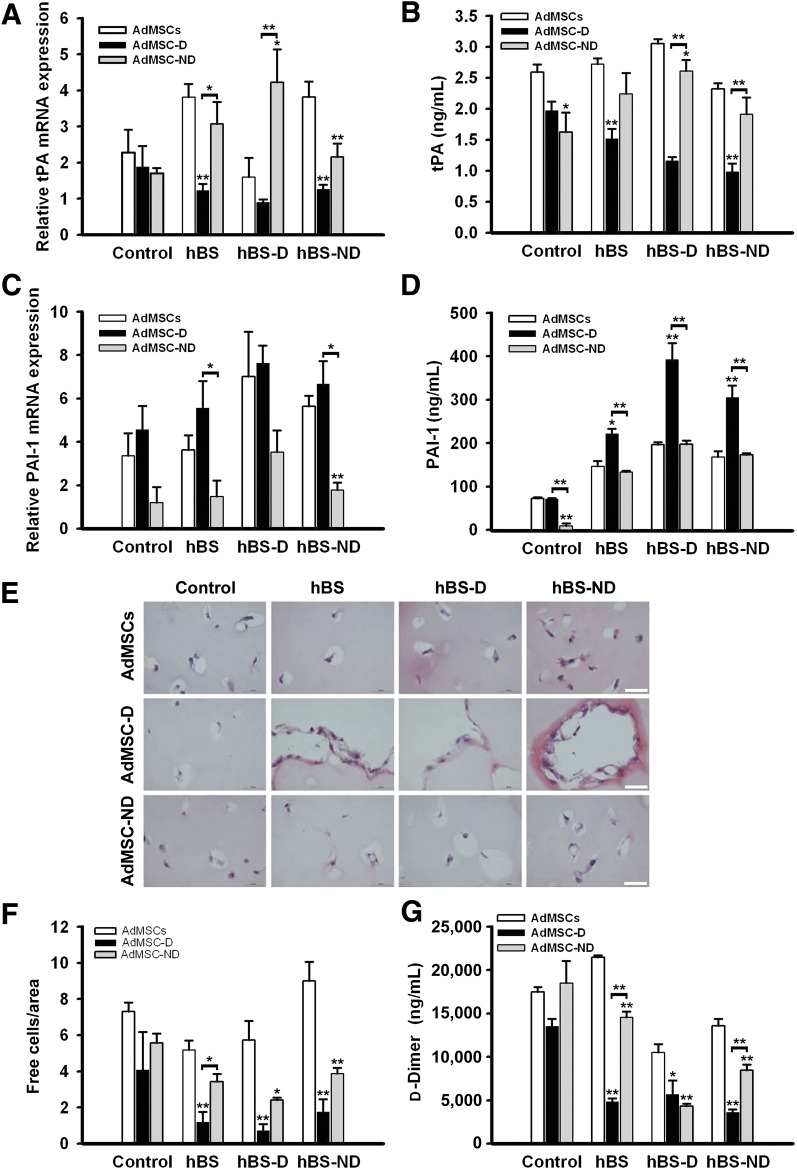
Stem cells have been successfully used for the treatment of critical limb ischemia (CLI). We conducted a clinical trial to determine the feasibility of using autologous adipose-derived mesenchymal stromal cells (AdMSCs) for the treatment of CLI. Unexpectedly, two diabetic patients developed peripheral microthrombosis. This adverse effect, which contrasts with the reported antithrombotic properties of MSCs, may stem from the diabetic environment that alters the fibrinolytic activity of AdMSCs, thereby increasing the probability of developing thrombosis. Here, we confirm this premise by demonstrating that diabetic AdMSCs cultured in the presence of blood sera expressed and released higher levels of plasminogen activator inhibitor type 1, reduced levels of tissue plasminogen activator, and lower d-dimer formation compared with nondiabetic AdMSCs. Thus, to establish an appropriate cell therapy for diabetic patients, we recommend including new preclinical safety tests, such as the d-dimer and/or the tissue plasminogen activator-to-plasminogen activator inhibitor type 1 ratio tests, to assess fibrinolytic activity of cells before implantation.
干细胞已成功用于治疗严重肢体缺血(CLI)。我们进行了一项临床试验,以确定使用自体脂肪来源的间充质基质细胞(AdMSCs)治疗 CLI 的可行性。出乎意料的是,两名糖尿病患者出现了外周微血栓形成。这种与 MSC 报道的抗血栓特性相反的不良作用可能源于改变 AdMSC 纤维蛋白溶解活性的糖尿病环境,从而增加血栓形成的可能性。在这里,我们通过证明在存在血清的情况下培养的糖尿病 AdMSCs 表达和释放更高水平的纤溶酶原激活物抑制剂 1、组织型纤溶酶原激活物水平降低以及 d-二聚体形成减少,证实了这一前提,与非糖尿病 AdMSCs 相比。因此,为了为糖尿病患者建立适当的细胞治疗,我们建议在植入前包括新的临床前安全性测试,例如 d-二聚体和/或组织型纤溶酶原激活物-纤溶酶原激活物抑制剂 1 比值测试,以评估细胞的纤维蛋白溶解活性。