Jang Ji-Young, Lee Jong-Kuen, Jeon Yoon-Kyung, Kim Chul-Woo
Tumor Immunity Medical Research Center, Cancer Research Institute, Seoul National University College of Medicine, 28 Yongon-dong, Jongno-gu, Seoul 110-799, Korea.
BMC Cancer. 2013 Sep 17;13:421. doi: 10.1186/1471-2407-13-421.
Tumor-associated macrophages (TAM) play an important role in tumor microenvironment. Particularly, M2 macrophages contribute to tumor progression, depending on the expression of NF-κB. Tumor-derived exosomes can modulate tumor microenvironment by transferring miRNAs to immune cells. Epigallocatechin gallate (EGCG) has well known anti-tumor effects; however, no data are available on the influence of EGCG on communication with cancer cells and TAM.
Murine breast cancer cell lines, 4T1, was used for in vivo and ex vivo studies. Exosome was extracted from EGCG-treated 4T1 cells, and the change of miRNAs was screened using microarray. Tumor cells or TAM isolated from murine tumor graft were incubated with exosomes derived from EGCG-treated and/or miR-16 inhibitor-transfected 4T1 cells. Chemokines for monocytes (CSF-1 and CCL-2), cytokines both with high (IL-6 and TGF-β) and low (TNF-α) expression in M2 macrophages, and molecules in NF-κB pathway (IKKα and Iκ-B) were evaluated by RT-qPCR or western blot.
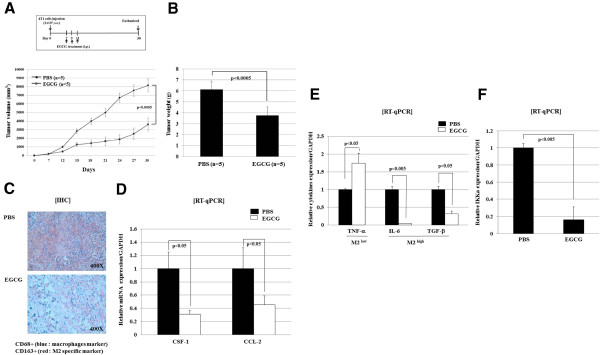
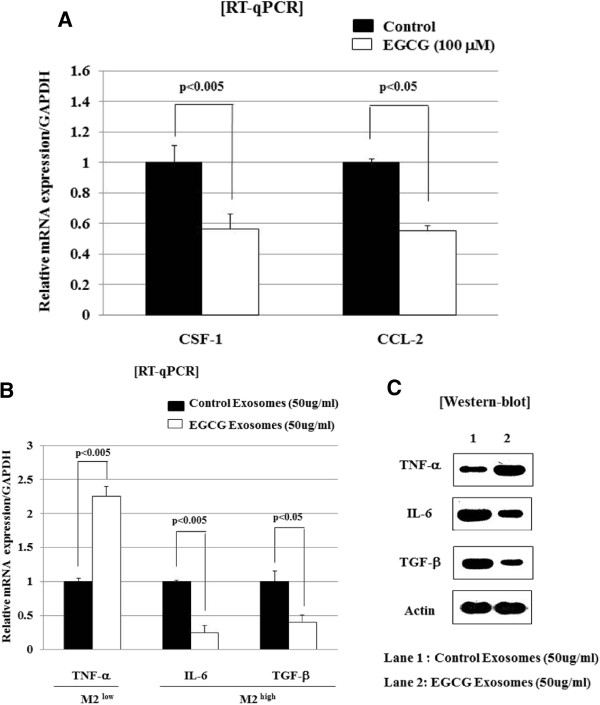
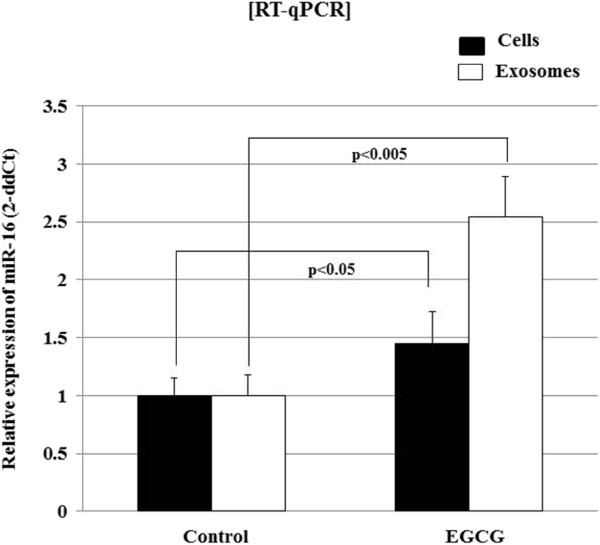
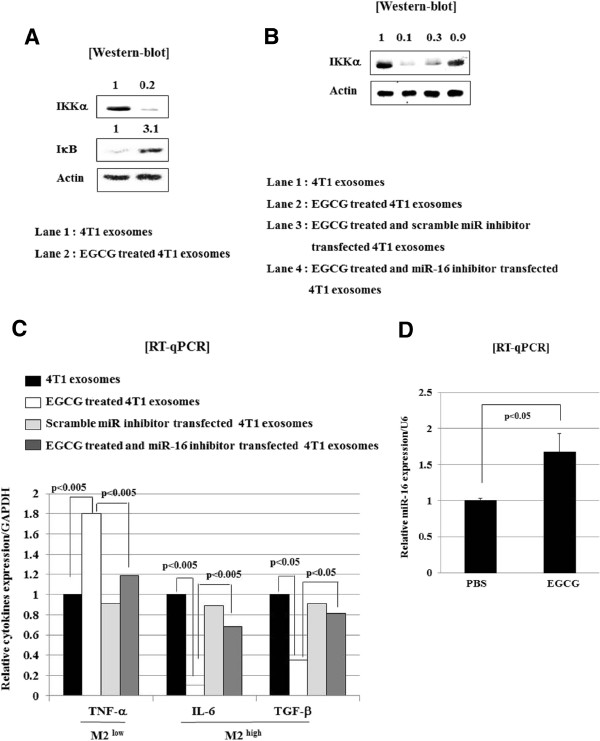
EGCG suppressed tumor growth in murine breast cancer model, which was associated with decreased TAM and M2 macrophage infiltration. Expression of chemokine for monocytes (CSF-1 and CCL-2) were low in tumor cells from EGCG-treated mice, and cytokines of TAM was skewed from M2- into M1-like phenotype by EGCG as evidenced by decreased IL-6 and TGF-β and increased TNF-α. Ex vivo incubation of isolated tumor cells with EGCG inhibited the CSF-1 and CCL-2 expression. Ex vivo incubation of TAM with exosomes from EGCG-treated 4T1 cells led to IKKα suppression and concomitant I-κB accumulation; increase of IL-6 and TGF-β; and, decrease of TNF-α. EGCG up-regulated miR-16 in 4T1 cells and in the exosomes. Treatment of tumor cells or TAM with exosomes derived from EGCG-treated and miR-16-knock-downed 4T1 cells restored the above effects on chemokines, cytokines, and NF-κB pathway elicited by EGCG-treated exosomes.
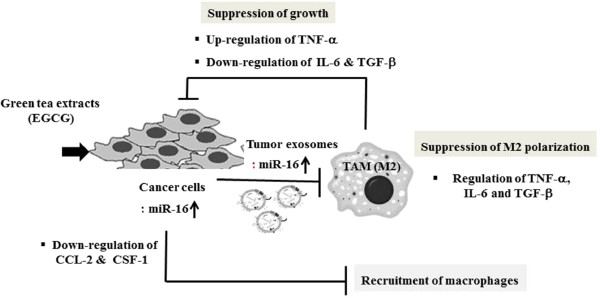
Our data demonstrate that EGCG up-regulates miR-16 in tumor cells, which can be transferred to TAM via exosomes and inhibits TAM infiltration and M2 polarization. We suggest a novel mechanism by which EGCG exerts anti-tumor activity via regulation of TAM in tumor microenvironment.
肿瘤相关巨噬细胞(TAM)在肿瘤微环境中发挥重要作用。特别是,M2巨噬细胞依赖于NF-κB的表达促进肿瘤进展。肿瘤来源的外泌体可通过将微小RNA(miRNA)转移至免疫细胞来调节肿瘤微环境。表没食子儿茶素没食子酸酯(EGCG)具有众所周知的抗肿瘤作用;然而,关于EGCG对癌细胞与TAM之间通讯的影响尚无数据。
小鼠乳腺癌细胞系4T1用于体内和体外研究。从经EGCG处理的4T1细胞中提取外泌体,使用微阵列筛选miRNA的变化。将从小鼠肿瘤移植瘤中分离的肿瘤细胞或TAM与来自经EGCG处理和/或转染了miR-16抑制剂的4T1细胞的外泌体一起孵育。通过逆转录定量聚合酶链反应(RT-qPCR)或蛋白质免疫印迹法检测单核细胞趋化因子(CSF-1和CCL-2)、M2巨噬细胞中高表达(IL-6和TGF-β)和低表达(TNF-α)的细胞因子以及NF-κB途径中的分子(IKKα和Iκ-B)。
EGCG抑制小鼠乳腺癌模型中的肿瘤生长,这与TAM和M2巨噬细胞浸润减少有关。经EGCG处理的小鼠肿瘤细胞中单核细胞趋化因子(CSF-1和CCL-2)的表达较低,EGCG使TAM的细胞因子从M2样表型转变为M1样表型,表现为IL-6和TGF-β减少以及TNF-α增加。将分离的肿瘤细胞与EGCG在体外孵育可抑制CSF-1和CCL-2的表达。将TAM与来自经EGCG处理的4T1细胞的外泌体在体外孵育导致IKKα受到抑制并伴随I-κB积累;IL-6和TGF-β增加;以及TNF-α减少。EGCG上调4T1细胞及其外泌体中miR-16的表达。用来自经EGCG处理但敲低miR-16的4T1细胞的外泌体处理肿瘤细胞或TAM可恢复上述由经EGCG处理的外泌体对趋化因子、细胞因子和NF-κB途径产生的影响。
我们的数据表明,EGCG上调肿瘤细胞中miR-16的表达,其可通过外泌体转移至TAM并抑制TAM浸润和M2极化。我们提出了一种新机制,即EGCG通过调节肿瘤微环境中的TAM发挥抗肿瘤活性。