INRA-UMR 1062 CBGP (INRA, IRD, CIRAD, Montpellier SupAgro), Centre de Biologie pour la Gestion des Populations, Campus International de Baillarguet CS 30 016, F-34 988, Montferrier-sur-Lez, France.
Front Zool. 2013 Sep 18;10(1):56. doi: 10.1186/1742-9994-10-56.
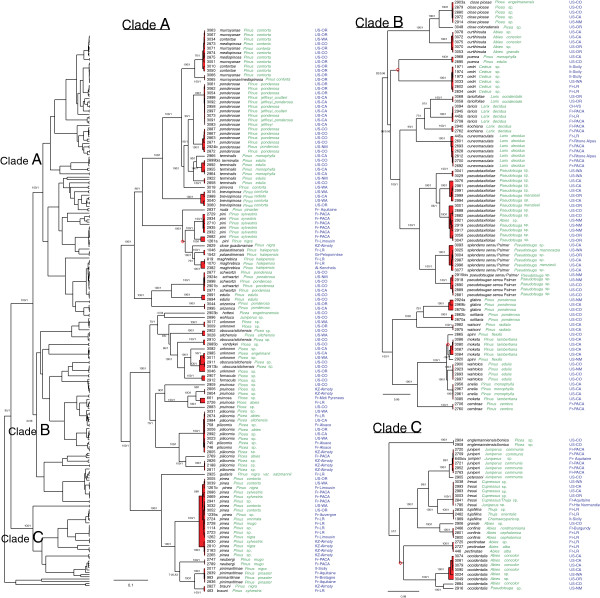
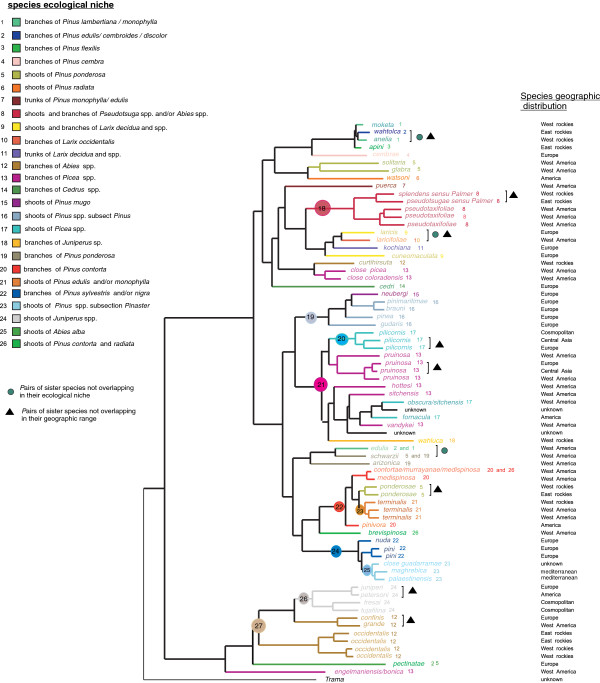
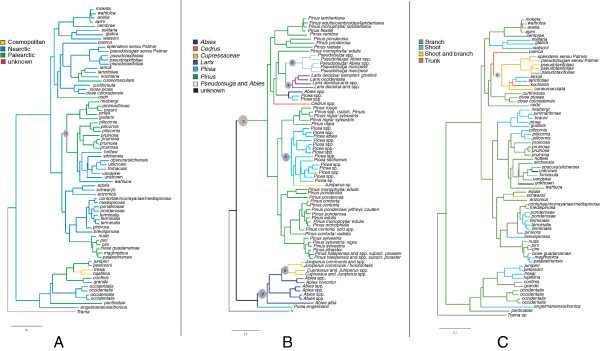
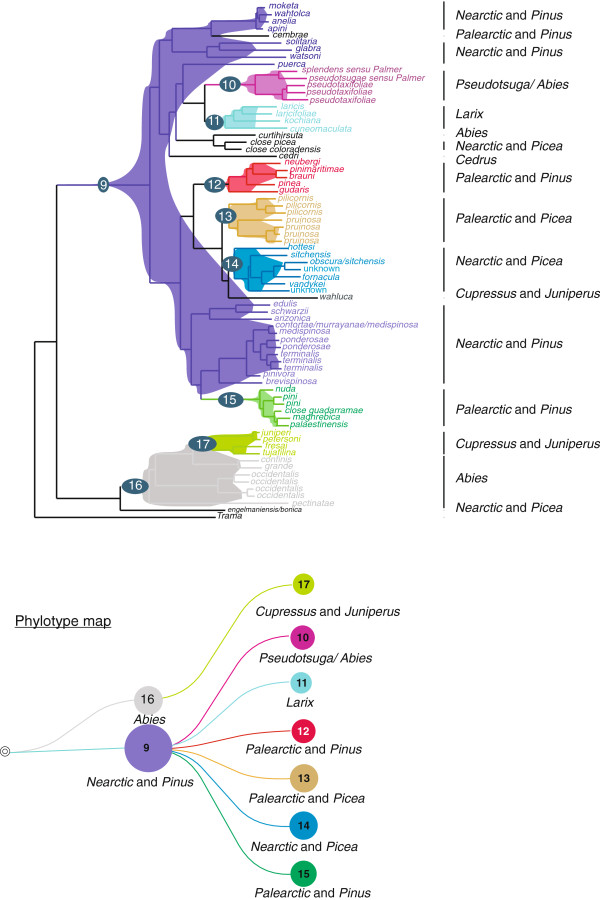
In the past decade ecological speciation has been recognized as having an important role in the diversification of plant-feeding insects. Aphids are host-specialised phytophagous insects that mate on their host plants and, as such, they are prone to experience reproductive isolation linked with host plant association that could ultimately lead to species formation. The generality of such a scenario remains to be tested through macroevolutionary studies. To explore the prevalence of host-driven speciation in the diversification of the aphid genus Cinara and to investigate alternative modes of speciation, we reconstructed a phylogeny of this genus based on mitochondrial, nuclear and Buchnera aphidicola DNA sequence fragments and applied a DNA-based method of species delimitation. Using a recent software (PhyloType), we explored evolutionary transitions in host-plant genera, feeding sites and geographic distributions in the diversification of Cinara and investigated how transitions in these characters have accompanied speciation events.
The diversification of Cinara has been constrained by host fidelity to conifer genera sometimes followed by sequential colonization onto different host species and by feeding-site specialisation. Nevertheless, our analyses suggest that, at the most, only half of the speciation events were accompanied by ecological niche shifts. The contribution of geographical isolation in the speciation process is clearly apparent in the occurrence of species from two continents in the same clades in relatively terminal positions in our phylogeny. Furthermore, in agreement with predictions from scenarios in which geographic isolation accounts for speciation events, geographic overlap between species increased significantly with time elapsed since their separation.
The history of Cinara offers a different perspective on the mode of speciation of aphids than that provided by classic models such as the pea aphid. In this genus of aphids, the role of climate and landscape history has probably been as important as host-plant specialisation in having shaped present-day diversity.
在过去的十年中,生态物种形成已被认为在植物食性昆虫的多样化中起着重要作用。蚜虫是专性宿主的植食性昆虫,它们在宿主植物上交配,因此,它们容易经历与宿主植物相关的生殖隔离,这最终可能导致物种形成。这种情况的普遍性仍有待通过宏观进化研究来检验。为了探索宿主驱动的物种形成在Cinara 蚜虫属多样化中的普遍性,并研究物种形成的替代模式,我们基于线粒体、核和 Buchnera aphidicola DNA 序列片段重建了该属的系统发育,并应用了基于 DNA 的物种界定方法。我们使用最近的软件(PhyloType),探索了 Cinara 多样化过程中宿主属、取食部位和地理分布的进化转变,并研究了这些特征的转变如何伴随着物种形成事件。
Cinara 的多样化受到对针叶树属宿主的保真度的限制,有时随后是对不同宿主物种的连续定殖,以及取食部位的特化。然而,我们的分析表明,最多只有一半的物种形成事件伴随着生态位的转变。地理隔离在物种形成过程中的贡献在我们的系统发育中相对末端位置的同一进化枝中出现来自两个大陆的物种时明显可见。此外,与地理隔离导致物种形成事件的情景预测一致,物种之间的地理重叠随着它们分离以来时间的流逝而显著增加。
Cinara 的历史为蚜虫的物种形成模式提供了不同于经典模式(如豌豆蚜)的视角。在这个蚜虫属中,气候和景观历史的作用可能与宿主植物特化一样重要,塑造了当今的多样性。