Bock Beth, Lopes Cheryl E, van den Berg Jacob J, Roberts Mary B, Stein L A R, Martin Rosemarie A, Martin Stephen A, Clarke Jennifer G
Alpert Medical School - Brown University, Centers for Behavioral and Preventive Medicine, The Miriam Hospital, 167 Point Street, Providence, RI 02903, USA.
BMC Public Health. 2013 Sep 17;13:859. doi: 10.1186/1471-2458-13-859.
In the United States, tobacco use among prisoners is nearly three times that of the general population. While many American prisons and jails are now tobacco-free, nearly all inmates return to smoking as soon as they are released back into the community.
To better understand the role that personal relationships may play in enabling return to smoking, we enrolled former-smokers who were inmates in a tobacco-free prison. Baseline assessments were conducted six weeks prior to inmates' scheduled release and included measures of smoking prior to incarceration, motivation, confidence and plans for remaining quit after release. We also assessed global social support (ISEL) and a measure of social support specific to quitting smoking (SSQ). Smoking status was assessed three weeks after prison release and included 7-day point-prevalence abstinence validated by urine cotinine, days to first cigarette and smoking rate.
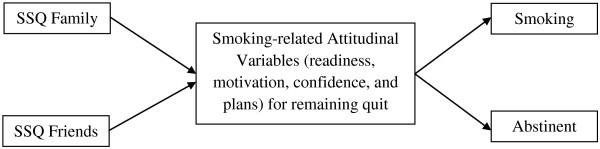
A diverse sample comprised of 35% women, 20% Hispanic, and 29% racial minorities (average age 35.5 years) provided baseline data (n = 247). Over 90% of participants provided follow up data at 3-weeks post-release. Prior to incarceration participants had smoked an average of 21.5 (SD = 11.7) cigarettes per day. Only 29.2% had definite plans to remain smoking-abstinent after release. Approximately half of all participants reported that "most" or "all" of their family (42.2%) and friends (68%) smoked, and 58.8% reported their spouse or romantic partner smoked.SSQ scores were not significantly predictive of smoking outcomes at three weeks, however, social support from family and friends were each significantly and positively correlated with motivation, confidence, and plans for remaining abstinent (all p values <0.05). These smoking-related attitudinal variables were significantly predictive of smoking outcomes (all p values <0.01). General social support (ISEL) was not associated with smoking-related attitudinal variables or smoking outcomes.
Inmates of smoke-free prisons have a head-start on being smoke-free for life. They have been abstinent well past the duration of nicotine withdrawal and have great financial incentive not to begin smoking again. However, this advantage may be offset by a lack of non-smoking role models among their family and friends, and perceived lack of support for remaining smoke-free.
ClinicalTrials.gov Identifier: NCT01684995.
在美国,囚犯中的烟草使用率几乎是普通人群的三倍。虽然现在许多美国监狱都已无烟,但几乎所有囚犯一旦获释回到社区就会重新开始吸烟。
为了更好地理解人际关系在促使重新吸烟方面可能发挥的作用,我们招募了在无烟监狱服刑的曾经吸烟者。在囚犯预定获释前六周进行基线评估,评估内容包括入狱前的吸烟情况、动机、信心以及获释后保持戒烟的计划。我们还评估了总体社会支持(ISEL)和一项针对戒烟的社会支持指标(SSQ)。在囚犯出狱三周后评估吸烟状况,包括通过尿可替宁验证的7天点患病率戒烟情况、首次吸烟天数和吸烟率。
一个由35%为女性、20%为西班牙裔和29%为少数族裔(平均年龄35.5岁)组成的多样化样本提供了基线数据(n = 247)。超过90%的参与者在出狱后三周提供了随访数据。入狱前参与者平均每天吸烟21.5支(标准差 = 11.7)。只有29.2%的人有明确的计划在获释后保持戒烟。大约一半的参与者报告说他们的家人(42.2%)和朋友(68%)“大多数”或“全部”吸烟,58.8%的人报告他们的配偶或恋爱伴侣吸烟。SSQ得分在三周时对吸烟结果没有显著预测作用,然而,来自家人和朋友的社会支持与动机、信心以及保持戒烟的计划均呈显著正相关(所有p值<0.05)。这些与吸烟相关的态度变量对吸烟结果有显著预测作用(所有p值<0.01)。总体社会支持(ISEL)与吸烟相关的态度变量或吸烟结果无关。
无烟监狱的囚犯在终身戒烟方面有一个良好的开端。他们已经度过了尼古丁戒断期,并且有很大的经济动机不再开始吸烟。然而,这种优势可能会被他们的家人和朋友中缺乏不吸烟榜样以及认为缺乏对保持无烟的支持所抵消。
ClinicalTrials.gov标识符:NCT01684995。