Brown University Center for Primary Care and Prevention, Pawtucket, Rhode Island, USA.
JAMA Intern Med. 2013 May 13;173(9):789-94. doi: 10.1001/jamainternmed.2013.197.
Millions of Americans are forced to quit smoking as they enter tobacco-free prisons and jails, but most return to smoking within days of release. Interventions are needed to sustain tobacco abstinence after release from incarceration.
To evaluate the extent to which the WISE intervention (Working Inside for Smoking Elimination), based on motivational interviewing (MI) and cognitive behavioral therapy (CBT), decreases relapse to smoking after release from a smoke-free prison.
Participants were recruited approximately 8 weeks prior to their release from a smoke-free prison and randomized to 6 weekly sessions of either education videos (control) or the WISE intervention.
A tobacco-free prison in the United States.
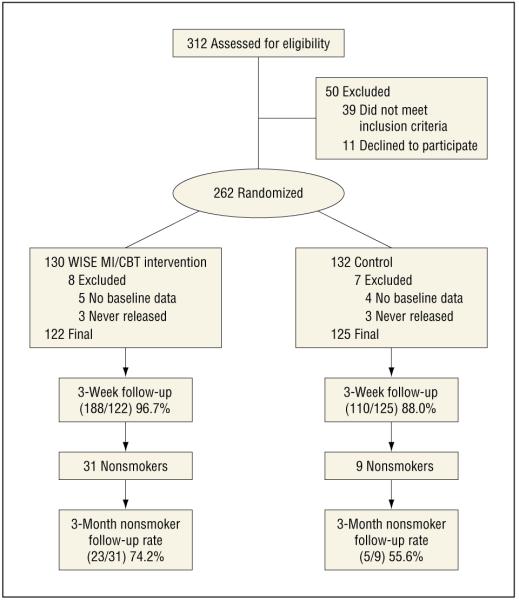
A total of 262 inmates (35% female).
Continued smoking abstinence was defined as 7-day point-prevalence abstinence validated by urine cotinine measurement.
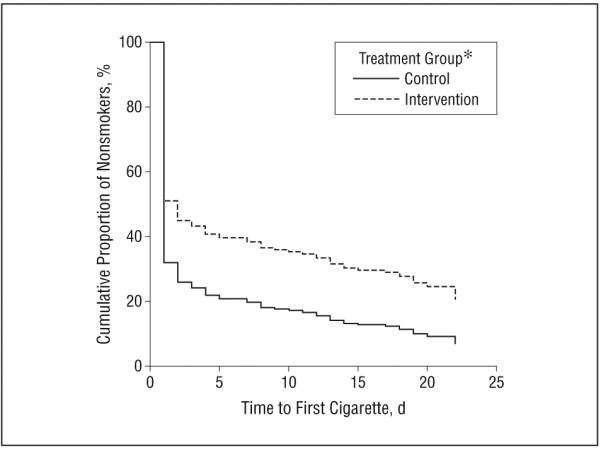
At the 3-week follow-up, 25% of participants in the WISE intervention (31 of 122) and 7% of the control participants (9 of 125) continued to be tobacco abstinent (odds ratio [OR], 4.4; 95% CI, 2.0-9.7). In addition to the intervention, Hispanic ethnicity, a plan to remain abstinent, and being incarcerated for more than 6 months were all associated with increased likelihood of remaining abstinent. In the logistic regression analysis, participants randomized to the WISE intervention were 6.6 times more likely to remain tobacco abstinent at the 3-week follow up than those randomized to the control condition (95% CI, 2.5-17.0). Nonsmokers at the 3-week follow-up had an additional follow-up 3 months after release, and overall 12% of the participants in the WISE intervention (14 of 122) and 2% of the control participants (3 of 125) were tobacco free at 3 months, as confirmed by urine cotinine measurement (OR, 5.3; 95% CI, 1.4-23.8).
Forced tobacco abstinence alone during incarceration has little impact on postrelease smoking status. A behavioral intervention provided prior to release greatly improves cotinine-confirmed smoking cessation in the community.
clinicaltrials.gov Identifier: NCT01122589.
数以百万计的美国人在进入无烟监狱和监狱时被迫戒烟,但大多数人在获释后几天内又重新开始吸烟。需要采取干预措施,以维持监禁释放后的烟草戒断。
评估基于动机访谈(MI)和认知行为疗法(CBT)的 WISE 干预(工作以消除吸烟)在减少从无烟监狱获释后复吸的程度。
参与者大约在从无烟监狱获释前 8 周被招募,并随机分配到每周 6 次接受教育视频(对照组)或 WISE 干预。
美国一家无烟监狱。
共 262 名囚犯(35%为女性)。
持续吸烟戒断定义为通过尿液可替宁测量验证的 7 天点患病率戒断。
在 3 周的随访中,WISE 干预组(122 人中有 31 人)的 25%和对照组(125 人中有 9 人)的参与者继续保持吸烟戒断(优势比[OR],4.4;95%置信区间,2.0-9.7)。除了干预措施外,西班牙裔、保持戒断的计划和被监禁超过 6 个月,这些因素都与增加保持戒断的可能性有关。在逻辑回归分析中,与随机分配到对照组的参与者相比,随机分配到 WISE 干预组的参与者在 3 周随访时更有可能保持烟草戒断(95%置信区间,2.5-17.0)。在 3 周随访时不吸烟的参与者在释放后又进行了另外 3 个月的随访,在 WISE 干预组(122 人中有 14 人)和对照组(125 人中有 3 人)中,总体有 12%的参与者在 3 个月时通过尿液可替宁测量确认不再吸烟(OR,5.3;95%置信区间,1.4-23.8)。
监禁期间强制戒烟对释放后的吸烟状况影响不大。在释放前提供的行为干预大大提高了社区中经可替宁确认的戒烟率。
clinicaltrials.gov 标识符:NCT01122589。