EA3279, Self-perceived Health Assessment Research Unit, School of Medicine, Université de la Méditerranée, 27 bd Jean Moulin, Marseille 13385, France.
Health Qual Life Outcomes. 2013 Sep 19;11:158. doi: 10.1186/1477-7525-11-158.
The development in therapeutic strategies has increased survival of children affected by inborn errors of metabolism with restricted diet (IEMRD). These diseases have mild- and long-term consequences on the health. Little is known about the impact on the quality of life (QoL) of children and their families. The aims of this study were: to compare the QoL of the children and parents affected by IEMRD with the QoL of the general population and one pathology associated with long-term consequences.
This cross-sectional study was performed at the French Reference Center for inborn metabolic disorders (Marseille, France). Inclusion criteria were: a child with a diagnosis of organic aciduria, urea cycle defect, or maple syrups urine disease (MSUD). Socio-demographics, clinical data, and QoL were recorded.
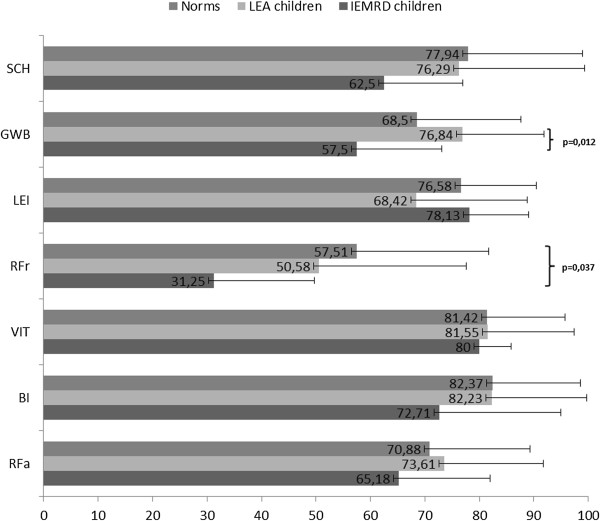
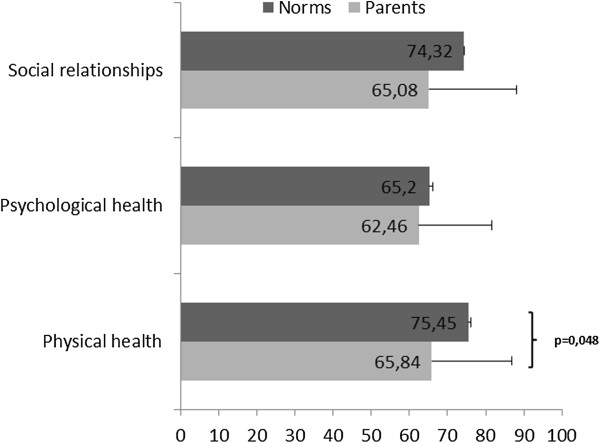
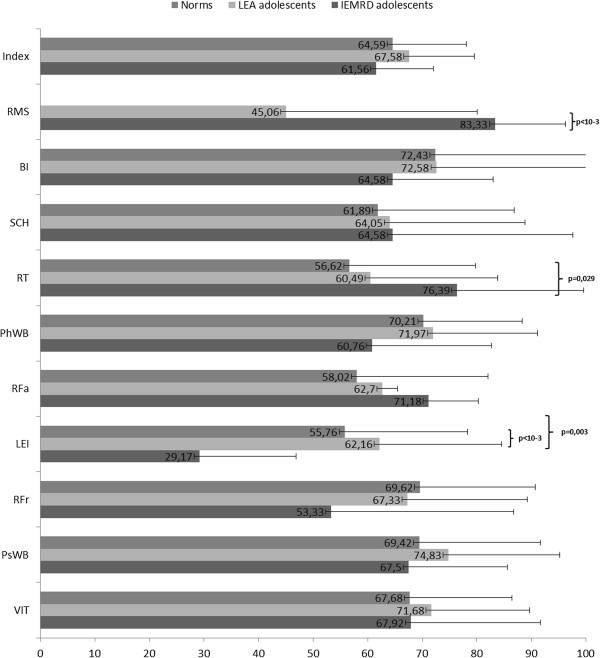
Twenty-one of 32 eligible families were included during a planned routine visit. Ten (47%, 95% CI 27-69%) children were affected by organic aciduria, six (29%, 95% CI 10-48%) by urea cycle defects, and five (24%, 95% CI 6-42%) by MSUD. Among the younger children, the general well-being was significantly lower in the children with IEMRD than in the leukemia children (58 ± 16 versus 76 ± 15, p = 0.012), and among the older children, the leisure activities were significantly lower in the children with IEMRD than in the leukemia children (29 ± 18 versus 62 ± 22, p < 10-3), while the relationships with teachers were better (76 ± 23 versus 60 ± 23, p = 0.01). The physical QoL score was lower in the parents than in the French norms (66 ± 21 versus 75 ± 1, p = 0.05). Factors modulating QoL were: eating and neurologic disorders, enteral nutrition, and feeding modalities.
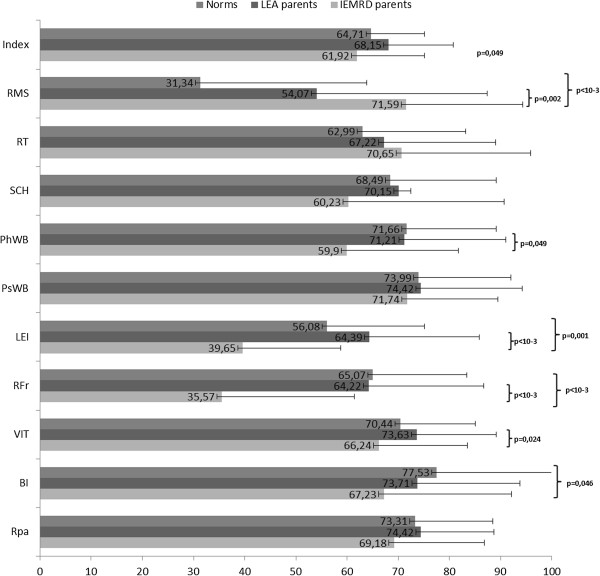
The children and the parents of children affected presented altered 'physical' and 'social' QoL scores compared with the norms and patients with leukemia and their families. Future studies based on larger cohort studies should determine the different weights of potential predictive factors of QoL.
治疗策略的发展提高了患有饮食限制型先天性代谢缺陷(IEMRD)儿童的生存率。这些疾病对儿童的健康有轻度和长期的影响。但对于这些儿童及其家庭的生活质量(QoL)的影响知之甚少。本研究的目的是:比较患有 IEMRD 的儿童及其父母与一般人群以及一种与长期后果相关的疾病的 QoL。
这是一项在法国先天性代谢紊乱参考中心(马赛,法国)进行的横断面研究。纳入标准为:诊断为有机酸血症、尿素循环缺陷或枫糖尿症(MSUD)的儿童。记录了社会人口统计学、临床数据和 QoL。
在计划的常规就诊期间,32 个符合条件的家庭中有 21 个家庭入选。10 名(47%,95%CI 27-69%)儿童患有有机酸血症,6 名(29%,95%CI 10-48%)患有尿素循环缺陷,5 名(24%,95%CI 6-42%)患有 MSUD。在年龄较小的儿童中,患有 IEMRD 的儿童的总体幸福感明显低于白血病儿童(58 ± 16 与 76 ± 15,p = 0.012),在年龄较大的儿童中,患有 IEMRD 的儿童的休闲活动明显低于白血病儿童(29 ± 18 与 62 ± 22,p < 10-3),而与老师的关系则更好(76 ± 23 与 60 ± 23,p = 0.01)。父母的生理 QoL 评分低于法国常模(66 ± 21 与 75 ± 1,p = 0.05)。调节 QoL 的因素有:饮食和神经障碍、肠内营养和喂养方式。
与常模和白血病患者及其家庭相比,患有 IEMRD 的儿童及其父母的“生理”和“社会”QoL 评分较差。未来的研究应基于更大的队列研究来确定 QoL 的潜在预测因素的不同权重。