Max Planck Institute for Polymer Research, Ackermannweg 10, D-55128, Mainz, Germany.
Nat Commun. 2013;4:2512. doi: 10.1038/ncomms3512.
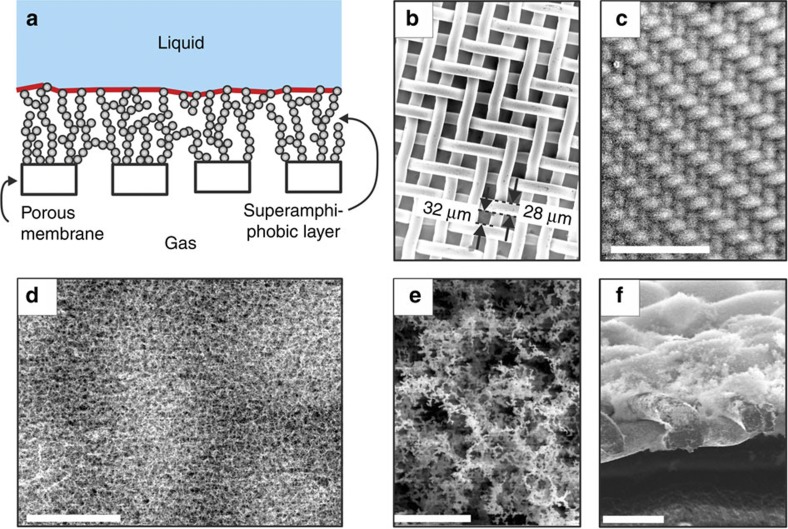
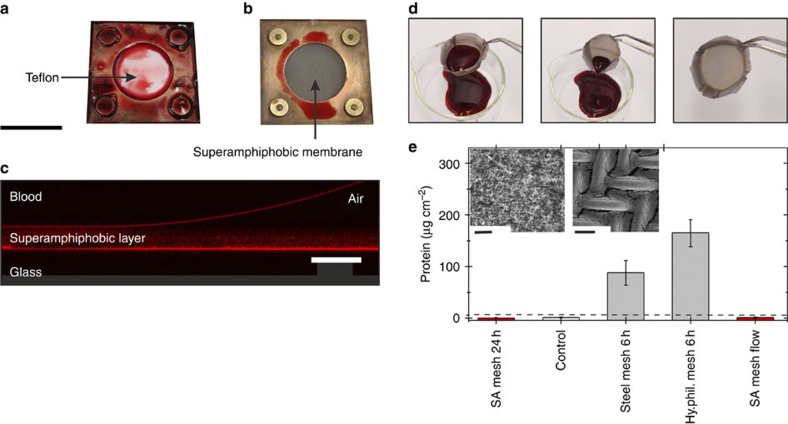
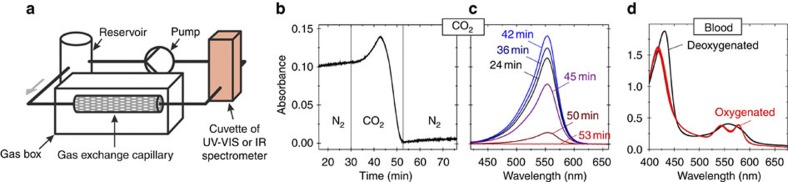
In a gas membrane, gas is transferred between a liquid and a gas through a microporous membrane. The main challenge is to achieve a high gas transfer while preventing wetting and clogging. With respect to the oxygenation of blood, haemocompatibility is also required. Here we coat macroporous meshes with a superamphiphobic-or liquid repellent-layer to meet this challenge. The superamphiphobic layer consists of a fractal-like network of fluorinated silicon oxide nanospheres; gas trapped between the nanospheres keeps the liquid from contacting the wall of the membrane. We demonstrate the capabilities of the membrane by capturing carbon dioxide gas into a basic aqueous solution and in addition use it to oxygenate blood. Usually, blood tends to clog membranes because of the abundance of blood cells, platelets, proteins and lipids. We show that human blood stored in a superamphiphobic well for 24 h can be poured off without leaving cells or adsorbed protein behind.
在气体膜中,气体通过微孔膜在液体和气体之间传递。主要挑战是在防止润湿和堵塞的同时实现高气体传递。就血液的氧合作用而言,还需要血液相容性。在这里,我们用超疏水性或抗液性层涂覆大孔网来应对这一挑战。超疏水性层由氟化硅纳米球的分形状网络组成;纳米球之间捕获的气体可防止液体与膜壁接触。我们通过将二氧化碳气体捕获到碱性水溶液中来证明膜的功能,此外还将其用于血液的氧合。通常,由于血细胞、血小板、蛋白质和脂质丰富,血液会使膜堵塞。我们表明,储存在超疏水性井中的人类血液可以在 24 小时内倒出,而不会留下细胞或吸附的蛋白质。