School of Postgraduate Studies, International Medical University, Kuala Lumpur 57000, Malaysia.
Department of Life Sciences, School of Pharmacy, International Medical University, Kuala Lumpur 57000, Malaysia.
Int J Mol Sci. 2021 Mar 24;22(7):3341. doi: 10.3390/ijms22073341.
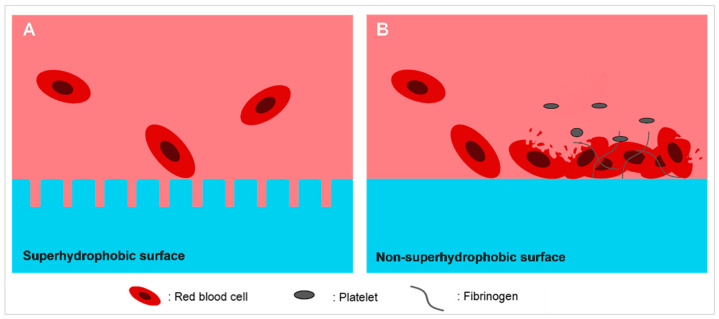
Medical devices are indispensable in the healthcare setting, ranging from diagnostic tools to therapeutic instruments, and even supporting equipment. However, these medical devices may be associated with life-threatening complications when exposed to blood. To date, medical device-related infections have been a major drawback causing high mortality. Device-induced hemolysis, albeit often neglected, results in negative impacts, including thrombotic events. Various strategies have been approached to overcome these issues, but the outcomes are yet to be considered as successful. Recently, superhydrophobic materials or coatings have been brought to attention in various fields. Superhydrophobic surfaces are proposed to be ideal blood-compatible biomaterials attributed to their beneficial characteristics. Reports have substantiated the blood repellence of a superhydrophobic surface, which helps to prevent damage on blood cells upon cell-surface interaction, thereby alleviating subsequent complications. The anti-biofouling effect of superhydrophobic surfaces is also desired in medical devices as it resists the adhesion of organic substances, such as blood cells and microorganisms. In this review, we will focus on the discussion about the potential contribution of superhydrophobic surfaces on enhancing the hemocompatibility of blood-contacting medical devices.
医疗器械在医疗保健环境中是不可或缺的,包括诊断工具、治疗仪器,甚至是支持设备。然而,当这些医疗器械接触到血液时,可能会引发危及生命的并发症。迄今为止,医疗器械相关感染一直是导致高死亡率的主要缺陷。器械诱导性溶血虽然常常被忽视,但却会产生负面影响,包括血栓事件。已经提出了各种策略来解决这些问题,但结果尚未被认为是成功的。最近,超疏水材料或涂层在各个领域引起了关注。超疏水表面被认为是理想的血液相容性生物材料,因为它们具有有益的特性。有报道证实了超疏水表面的血液排斥性,这有助于防止细胞表面相互作用时对血细胞造成损伤,从而减轻随后的并发症。超疏水表面在医疗器械中的抗生物污损效果也是理想的,因为它可以抵抗血细胞和微生物等有机物质的粘附。在这篇综述中,我们将重点讨论超疏水表面在增强与血液接触的医疗器械的血液相容性方面的潜在贡献。