Al-Quds Cognitive Neuroscience Lab, Faculty of Medicine, Al-Quds University Abu Dis, Palestinian Territories ; Center for Molecular and Behavioral Neuroscience, Rutgers University Newark, NJ, USA.
Front Integr Neurosci. 2013 Sep 23;7:67. doi: 10.3389/fnint.2013.00067. eCollection 2013.
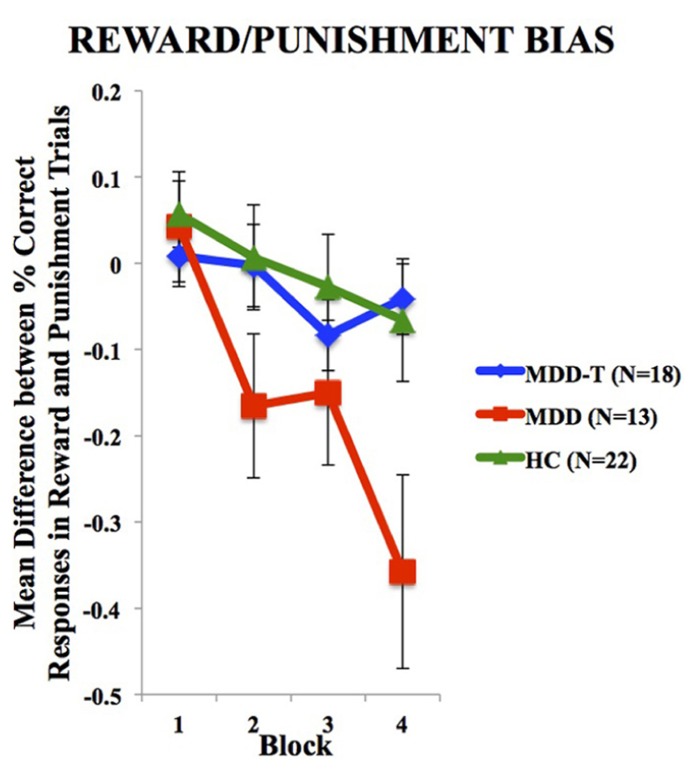
One barrier to interpreting past studies of cognition and major depressive disorder (MDD) has been the failure in many studies to adequately dissociate the effects of MDD from the potential cognitive side effects of selective serotonin reuptake inhibitors (SSRIs) use. To better understand how remediation of depressive symptoms affects cognitive function in MDD, we evaluated three groups of subjects: medication-naïve patients with MDD, medicated patients with MDD receiving the SSRI paroxetine, and healthy control (HC) subjects. All were administered a category-learning task that allows for dissociation between learning from positive feedback (reward) vs. learning from negative feedback (punishment). Healthy subjects learned significantly better from positive feedback than medication-naïve and medicated MDD groups, whose learning accuracy did not differ significantly. In contrast, medicated patients with MDD learned significantly less from negative feedback than medication-naïve patients with MDD and healthy subjects, whose learning accuracy was comparable. A comparison of subject's relative sensitivity to positive vs. negative feedback showed that both the medicated MDD and HC groups conform to Kahneman and Tversky's (1979) Prospect Theory, which expects losses (negative feedback) to loom psychologically slightly larger than gains (positive feedback). However, medicated MDD and HC profiles are not similar, which indicates that the state of medicated MDD is not "normal" when compared to HC, but rather balanced with less learning from both positive and negative feedback. On the other hand, medication-naïve patients with MDD violate Prospect Theory by having significantly exaggerated learning from negative feedback. This suggests that SSRI antidepressants impair learning from negative feedback, while having negligible effect on learning from positive feedback. Overall, these findings shed light on the importance of dissociating the cognitive consequences of MDD from those of SSRI treatment, and from cognitive evaluation of MDD subjects in a medication-naïve state before the administration of antidepressants. Future research is needed to correlate the mood-elevating effects and the cognitive balance between reward- and punishment-based learning related to SSRIs.
一个解释过去认知和重度抑郁症(MDD)研究的障碍是,许多研究未能充分将 MDD 的影响与选择性 5-羟色胺再摄取抑制剂(SSRIs)使用的潜在认知副作用区分开来。为了更好地理解如何减轻抑郁症状会影响 MDD 患者的认知功能,我们评估了三组对象:未经药物治疗的 MDD 患者、接受 SSRI 帕罗西汀治疗的 MDD 患者和健康对照(HC)受试者。所有受试者均接受类别学习任务,该任务允许将从正反馈(奖励)中学习与从负反馈(惩罚)中学习区分开来。健康受试者从正反馈中学到的知识明显优于未经药物治疗的 MDD 患者和接受药物治疗的 MDD 患者,后两组的学习准确性没有显著差异。相比之下,接受药物治疗的 MDD 患者从负反馈中学到的知识明显少于未经药物治疗的 MDD 患者和健康受试者,而后两组的学习准确性相当。对受试者对正反馈和负反馈的相对敏感性进行比较表明,接受药物治疗的 MDD 患者和 HC 组均符合卡尼曼和特沃斯基(1979)的前景理论,该理论预期损失(负反馈)在心理上比收益(正反馈)略大。然而,接受药物治疗的 MDD 患者和 HC 组的情况并不相似,这表明与 HC 相比,接受药物治疗的 MDD 状态并不“正常”,而是与从正反馈和负反馈中学习的平衡状态相当。另一方面,未经药物治疗的 MDD 患者对负反馈的学习存在显著夸大,这违反了前景理论。这表明 SSRI 抗抑郁药会损害从负反馈中学习的能力,而对从正反馈中学习的能力影响甚微。总的来说,这些发现阐明了将 MDD 的认知后果与 SSRIs 治疗的认知后果以及在开始使用抗抑郁药之前未接受药物治疗的 MDD 患者的认知评估区分开来的重要性。需要进一步的研究来确定与 SSRIs 相关的与情绪提升效应和基于奖励和惩罚的学习之间的认知平衡相关的关系。