Leitenmaier Barbara, Küpper Hendrik
Fachbereich Biologie, Universität Konstanz Konstanz, Germany.
Front Plant Sci. 2013 Sep 20;4:374. doi: 10.3389/fpls.2013.00374.
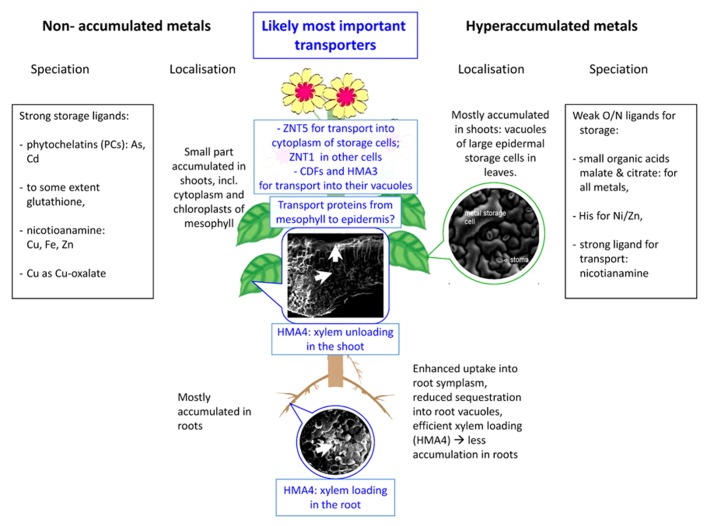
Hyperaccumulators are being intensely investigated. They are not only interesting in scientific context due to their "strange" behavior in terms of dealing with high concentrations of metals, but also because of their use in phytoremediation and phytomining, for which understanding the mechanisms of hyperaccumulation is crucial. Hyperaccumulators naturally use metal accumulation as a defense against herbivores and pathogens, and therefore deal with accumulated metals in very specific ways of complexation and compartmentation, different from non-hyperaccumulator plants and also non-hyperaccumulated metals. For example, in contrast to non-hyperaccumulators, in hyperaccumulators even the classical phytochelatin-inducing metal, cadmium, is predominantly not bound by such sulfur ligands, but only by weak oxygen ligands. This applies to all hyperaccumulated metals investigated so far, as well as hyperaccumulation of the metalloid arsenic. Stronger ligands, as they have been shown to complex metals in non-hyperaccumulators, are in hyperaccumulators used for transient binding during transport to the storage sites (e.g., nicotianamine) and possibly for export of Cu in Cd/Zn hyperaccumulators [metallothioneins (MTs)]. This confirmed that enhanced active metal transport, and not metal complexation, is the key mechanism of hyperaccumulation. Hyperaccumulators tolerate the high amount of accumulated heavy metals by sequestering them into vacuoles, usually in large storage cells of the epidermis. This is mediated by strongly elevated expression of specific transport proteins in various tissues from metal uptake in the shoots up to the storage sites in the leaf epidermis. However, this mechanism seems to be very metal specific. Non-hyperaccumulated metals in hyperaccumulators seem to be dealt with like in non-hyperaccumulator plants, i.e., detoxified by binding to strong ligands such as MTs.
超富集植物正受到深入研究。它们不仅在科学背景下因其在处理高浓度金属方面的“奇特”行为而备受关注,还因其在植物修复和植物采矿中的应用,而了解超富集机制对于这些应用至关重要。超富集植物自然地利用金属积累作为抵御食草动物和病原体的防御机制,因此以非常特殊的络合和区室化方式处理积累的金属,这与非超富集植物以及非超富集金属不同。例如,与非超富集植物相比,在超富集植物中,即使是经典的诱导植物螯合肽的金属镉,也主要不是与这类硫配体结合,而是仅与弱氧配体结合。这适用于迄今为止研究的所有超富集金属,以及类金属砷的超富集。在非超富集植物中已显示能络合金属的更强配体,在超富集植物中用于在运输到储存部位(如烟草胺)期间的短暂结合,并且可能用于镉/锌超富集植物中铜的输出[金属硫蛋白(MTs)]。这证实了增强的活性金属运输而非金属络合是超富集的关键机制。超富集植物通过将大量积累的重金属隔离到液泡中,通常是在表皮的大型储存细胞中,来耐受这些重金属。这是由从地上部的金属吸收到叶片表皮储存部位的各种组织中特定转运蛋白的强烈上调表达介导的。然而,这种机制似乎非常具有金属特异性。超富集植物中的非超富集金属似乎像在非超富集植物中一样被处理,即通过与MTs等强配体结合进行解毒。