Department of Statistics and Population Studies, University of Namibia, Windhoek, Namibia.
PLoS One. 2013 Sep 16;8(9):e73500. doi: 10.1371/journal.pone.0073500. eCollection 2013.
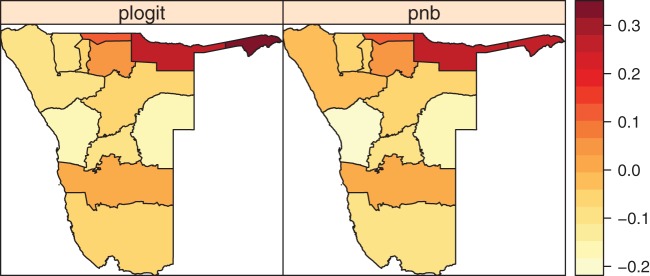
Despite remarkable gains in life expectancy and declining mortality in the 21st century, in many places mostly in developing countries, adult mortality has increased in part due to HIV/AIDS or continued abject poverty levels. Moreover many factors including behavioural, socio-economic and demographic variables work simultaneously to impact on risk of mortality. Understanding risk factors of adult mortality is crucial towards designing appropriate public health interventions. In this paper we proposed a structured additive two-part random effects regression model for adult mortality data. Our proposal assumed two processes: (i) whether death occurred in the household (prevalence part), and (ii) number of reported deaths, if death did occur (severity part). The proposed model specification therefore consisted of two generalized linear mixed models (GLMM) with correlated random effects that permitted structured and unstructured spatial components at regional level. Specifically, the first part assumed a GLMM with a logistic link and the second part explored a count model following either a Poisson or negative binomial distribution. The model was used to analyse adult mortality data of 25,793 individuals from the 2006/2007 Namibian DHS data. Inference is based on the Bayesian framework with appropriate priors discussed.
尽管在 21 世纪,人们的预期寿命显著延长,死亡率也有所下降,但在许多地方,主要是在发展中国家,成年人死亡率却有所上升,部分原因是艾滋病毒/艾滋病或持续的赤贫水平。此外,许多因素,包括行为、社会经济和人口变量,同时作用于死亡率的风险。了解成年人死亡率的风险因素对于设计适当的公共卫生干预措施至关重要。本文提出了一种针对成年人死亡率数据的结构化加性两部分随机效应回归模型。我们的建议假设了两个过程:(i) 死亡是否发生在家庭中(流行部分),以及 (ii) 死亡发生时报告的死亡人数(严重程度部分)。因此,所提出的模型规范由两个具有相关随机效应的广义线性混合模型 (GLMM) 组成,允许在区域一级进行结构化和非结构化的空间成分。具体来说,第一部分假设使用具有逻辑链接的 GLMM,第二部分探索遵循泊松或负二项分布的计数模型。该模型用于分析 2006/2007 年纳米比亚 DHS 数据中 25793 名成年人的死亡率数据。推理基于贝叶斯框架,并讨论了适当的先验。