Ajaero Chukwuedozie K, Wet-Billings Nicole De, Atama Chiemezie, Agwu Prince, Eze Eberechukwu J
Department of Geography, University of Nigeria Nsukka, Nsukka, Nigeria.
Demography and Population Studies Programme, Schools of Public Health and Social Sciences, University of the Witwatersrand, Johannesburg, South Africa.
BMC Public Health. 2021 May 27;21(1):999. doi: 10.1186/s12889-021-11044-9.
The socioeconomic conditions of different environments manifest in varying experiences of illnesses. Even as migrants do transit across these different environments for various reasons, including settlement, they are bound to have peculiar experiences of diseases, which could be traced to lifestyle, gender, adaptation, and reactions to specific social, economic, psychological and climatic conditions. Paying attention to such unique scenarios, our study examines the prevalence and contextual correlates of non-communicable diseases among inter-provincial migrants and non-migrants in South Africa.
Data was from the National Income Dynamics Study (NIDS), waves 5 of 2017, which comprised of 28,055 respondents aged 15-64 years made up of 22,849 inter-provincial non-migrants and 5206 inter-provincial migrants. A composite dependent/outcome variable of non-communicable diseases (NCDs) was generated for the study and data analysis involved descriptive statistics, chi Square analysis and multilevel logistic regression analysis.
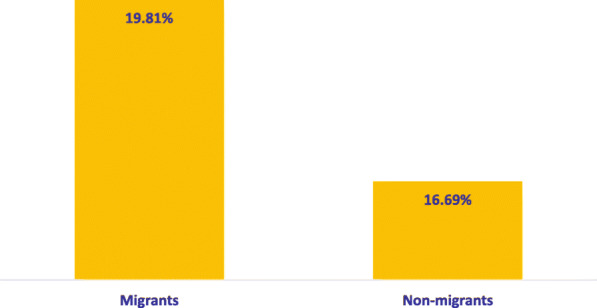
More migrants (19.81%) than non-migrants (16.69%) reported prevalence of NCDs. With the exception of household size for migrants and smoking for non-migrants, the prevalence of NCDs showed significant differences in all the community, behavioral, and individual variables. The factors in the full model, which significantly increased odds of NCDs among the migrants and the non-migrants, were older populations, the non-Blacks, and those with higher education levels. On the one hand, being married, having a household with 4-6 persons, and being residents of urban areas significantly increased odds of NCDs among the migrant population. While on the other, living in coastal provinces, being a female, and belonging to the category of those who earn more than 10,000 Rands were significantly associated with increased odds of NCDs among the non-migrants.
These findings, therefore, among other things underscore the need for increased education and awareness campaigns, especially among the older populations on the preventive and mitigative strategies for NCDs. In addition, changes in lifestyles with regard to smoking and physical exercises should be more emphasized in specific contextual situations for the migrant and non-migrant populations, as highlighted by the results of this study.
不同环境的社会经济状况表现为不同的疾病经历。即使移民因各种原因(包括定居)穿越这些不同环境,他们必然会有独特的疾病经历,这可能归因于生活方式、性别、适应能力以及对特定社会、经济、心理和气候条件的反应。关注此类独特情况,我们的研究调查了南非省际移民和非移民中非传染性疾病的患病率及其相关背景因素。
数据来自2017年第5轮全国收入动态研究(NIDS),该研究包含28,055名年龄在15 - 64岁的受访者,其中包括22,849名省际非移民和5206名省际移民。为该研究生成了一个非传染性疾病(NCDs)的综合因变量/结果变量,数据分析包括描述性统计、卡方分析和多级逻辑回归分析。
报告患有非传染性疾病的移民(19.81%)多于非移民(16.69%)。除了移民的家庭规模和非移民的吸烟情况外,非传染性疾病的患病率在所有社区、行为和个体变量中均存在显著差异。完整模型中的因素,即显著增加移民和非移民中非传染性疾病患病几率的因素,包括老年人群、非黑人以及受过高等教育的人群。一方面,已婚、家庭中有4 - 6人以及居住在城市地区显著增加了移民人群中非传染性疾病的患病几率。另一方面,居住在沿海省份、女性以及属于收入超过10,000兰特的人群与非移民中非传染性疾病患病几率的增加显著相关。
因此,这些发现尤其强调了加强教育和提高认识运动的必要性,特别是在老年人群中开展关于非传染性疾病预防和缓解策略的教育。此外,正如本研究结果所强调的,应在针对移民和非移民人群的特定背景情况下,更加强调在吸烟和体育锻炼方面改变生活方式。