Leproux Anaïs, Durkin Amanda, Compton Montana, Cerussi Albert E, Gratton Enrico, Tromberg Bruce J
Breast Cancer Res. 2013;15(5):R89. doi: 10.1186/bcr3485.
Radiographic density adversely affects the performance of X-ray mammography and can be particularly problematic in younger and high-risk women. Because of this limitation, there is significant ongoing effort to develop alternative cancer screening and detection strategies for this population. This pilot study evaluates the potential of Diffuse Optical Spectroscopic Imaging (DOSI) to image known tumors in dense breast tissue.
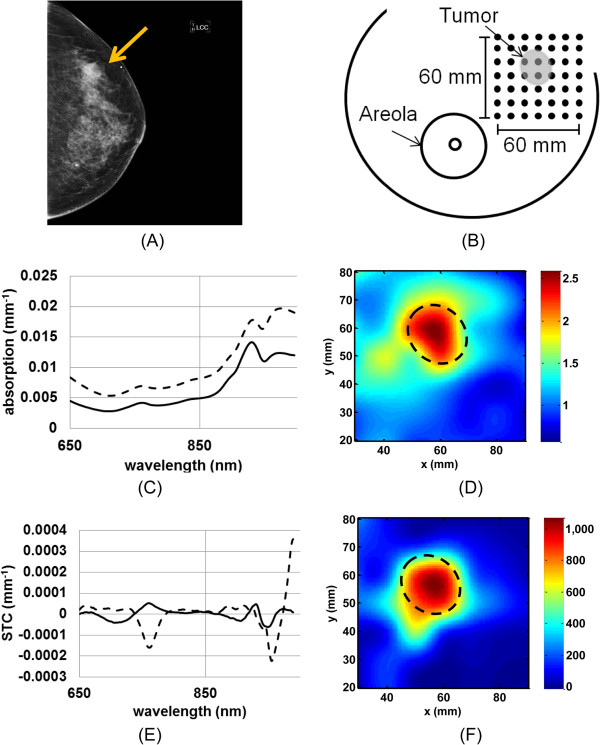
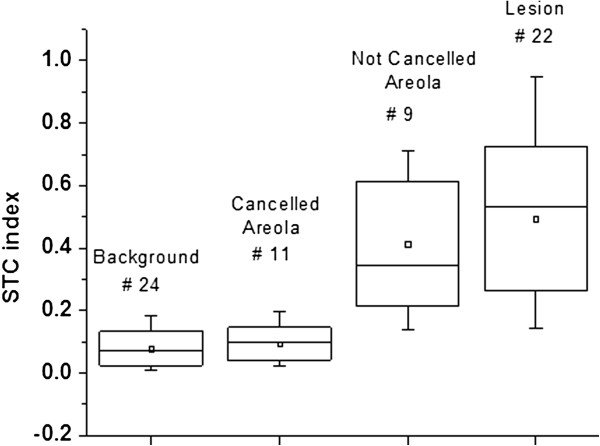
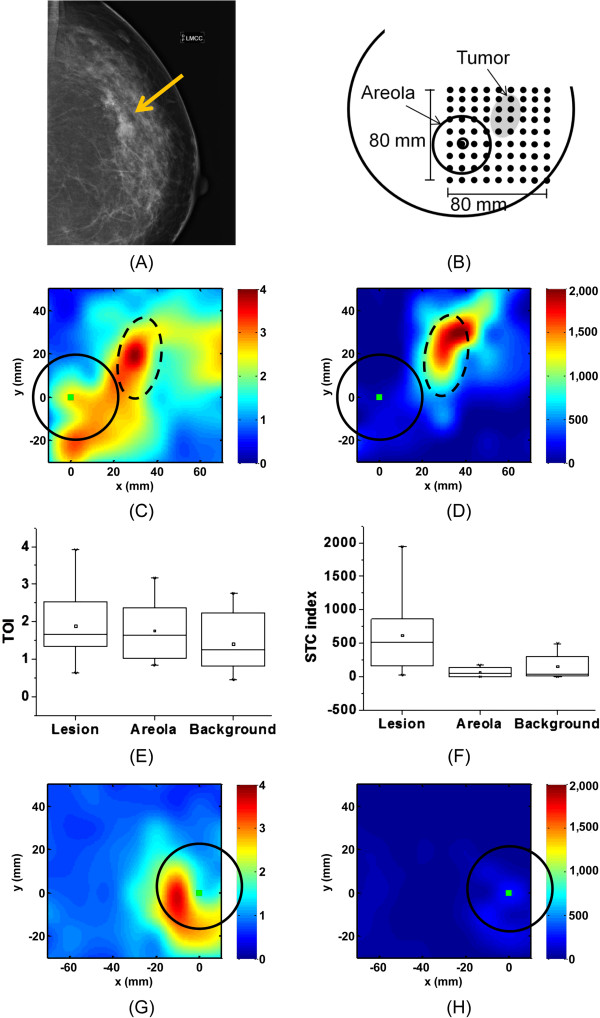
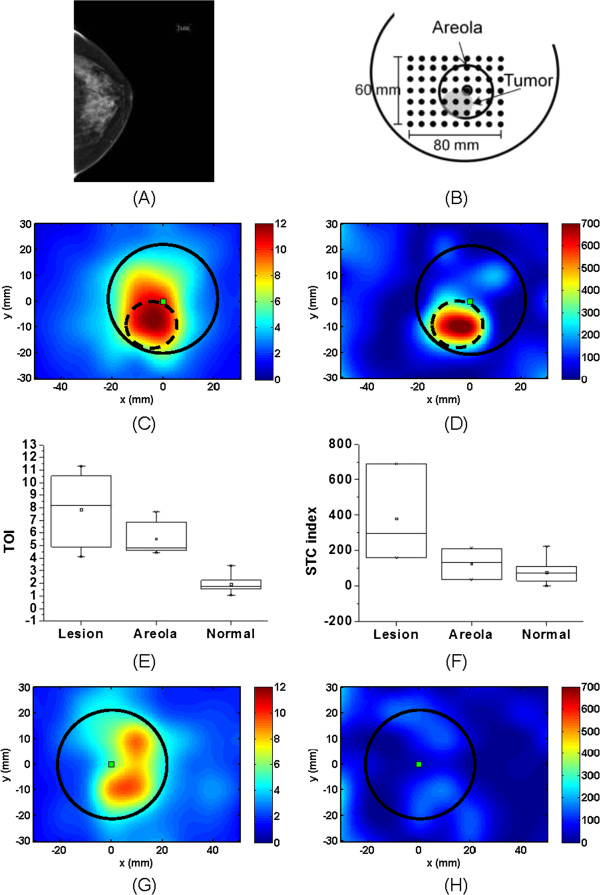
We performed a retrospective analysis on 24 radiographically dense breast cancer subjects measured with DOSI over a four-year period (Breast Imaging Reporting and Data System - BI-RADS, category 3 and 4, average age = 39 ± 7.6, average maximum size 31 ± 1 7 mm). Two previously-described DOSI contrast functions, the tissue optical index (TOI) and the specific tumor component (STC), which are based upon the concentrations and spectral signatures of hemoglobin, water and lipids, respectively, were used to form 2D optical images of breast tumors.
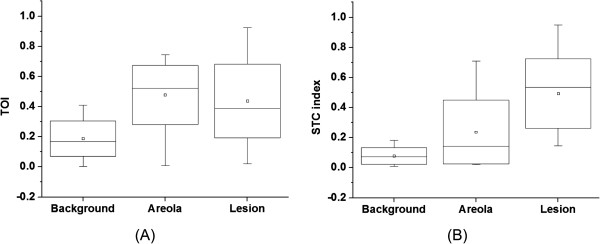
Using TOI and STC, 21 out of 24 breast tumors were found to be statistically different from the surrounding highly vascularized dense tissue and to be distinguishable from the areolar region. For these patients, the tumor to normal contrast was 2.6 ± 1.2 (range 1.3 to 5.5) and 10.0 ± 7.5 (range 3.3 to 26.4) for TOI and STC, respectively. STC images were particularly useful in eliminating metabolic background from the retroareolar region which led to identification of two out of four retroareolar tumors.
Using both the abundance and the disposition of the tissue chromophores recovered from the DOSI measurements, we were able to observe tumor contrast relative to dense breast tissue. These preliminary results suggest that DOSI spectral characterization strategies may provide new information content that could help imaging breast tumors in radiographically dense tissue and in particular in the areolar complex.
X线摄影密度会对乳腺X线摄影的性能产生不利影响,在年轻女性和高危女性中问题可能尤为突出。鉴于这一局限性,目前正在大力研发针对该人群的替代癌症筛查和检测策略。本初步研究评估了漫射光学光谱成像(DOSI)对致密乳腺组织中已知肿瘤进行成像的潜力。
我们对24名乳腺X线摄影显示致密的乳腺癌患者进行了回顾性分析,这些患者在四年期间接受了DOSI测量(乳腺影像报告和数据系统-BI-RADS,3类和4类,平均年龄=39±7.6岁,平均最大尺寸31±17mm)。使用两个先前描述的DOSI对比函数,即组织光学指数(TOI)和特定肿瘤成分(STC),分别基于血红蛋白、水和脂质的浓度及光谱特征,来形成乳腺肿瘤的二维光学图像。
使用TOI和STC,24个乳腺肿瘤中有21个在统计学上与周围高度血管化的致密组织不同,并且可与乳晕区域区分开来。对于这些患者,TOI和STC的肿瘤与正常组织的对比度分别为2.6±1.2(范围1.3至5.5)和10.0±7.5(范围3.3至26.4)。STC图像在消除乳晕后区域的代谢背景方面特别有用,这使得四个乳晕后肿瘤中有两个得以识别。
利用从DOSI测量中获得的组织发色团的丰度和分布,我们能够观察到相对于致密乳腺组织的肿瘤对比度。这些初步结果表明,DOSI光谱表征策略可能提供新的信息内容,有助于对致密乳腺组织尤其是乳晕复合体中的乳腺肿瘤进行成像。