Department of Thoracic Medicine, Medical School, University of Crete, 71110 Heraklion, Crete, Greece.
Oncol Rep. 2013 Dec;30(6):2617-24. doi: 10.3892/or.2013.2753. Epub 2013 Sep 25.
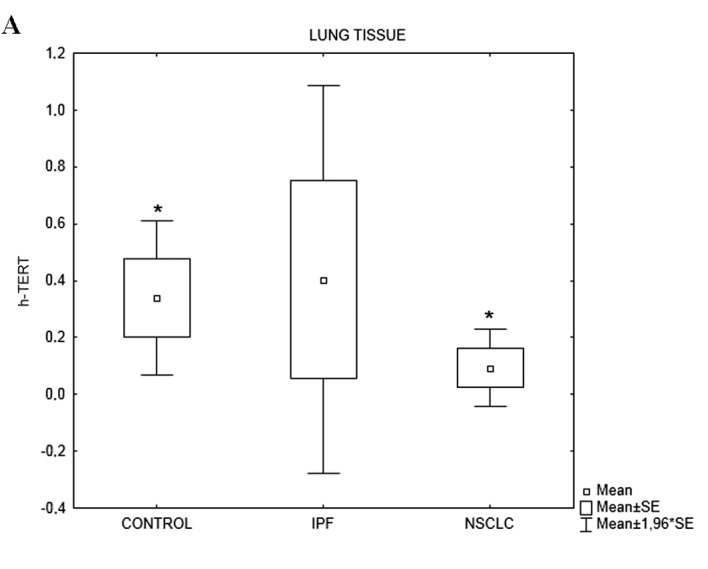
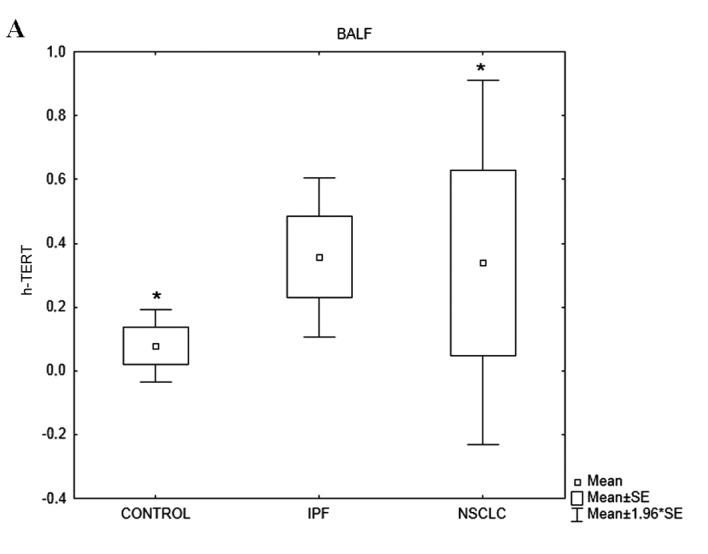
Telomerase is a reverse transcriptase ribonucleo-protein (h-TERT) that synthesizes telomeric repeats using its RNA component (h-TERC) as a template. Telomerase dysfunction has been associated with both fibrogenesis and carcinogenesis. In this study, we aimed to evaluate the telomerase mRNA expression levels of both subunits (h-TERT and h-TERC) in lung tissue and bronchoalveolar lavage fluid (BALF) from patients with idiopathic pulmonary fibrosis (IPF) and non-small cell lung cancer (NSCLC), since there are indications of common pathogenetic pathways in these diseases. We prospectively examined lung tissue samples from 29 patients with IPF, 10 patients with NSCLC and 21 controls. Furthermore, we examined BALF samples from 31 patients with NSCLC, 23 patients with IPF and 12 control subjects. The mRNA expression for both h-TERT and h-TERC was measured by real-time RT-PCR. In the lung tissue samples, both h-TERT and h-TERC mRNA expression levels varied among the 3 groups (p=0.036 and p=0.002, respectively). h-TERT mRNA levels in the patients with IPF were lower compared with those in the controls (p=0.009) and patients with NSCLC (p=0.004). h-TERC mRNA levels in the patients with IPF were lower compared with those in the controls (p=0.0005) and patients with NSCLC (p=0.0004). In the BALF samples, h-TERT mRNA expression levels varied among the groups (p=0.012). More specifically, h-TERT mRNA levels in the patients with IPF were higher compared with those in the controls (p=0.03) and patients with NSCLC (p=0.007). The attenuation of telomerase gene expression in IPF in comparison to lung cancer suggests a differential role of this regulatory gene in fibrogenesis and carcinogenesis. Further functional studies are required in order to further elucidate the role of telomerase in these devastating diseases.
端粒酶是一种逆转录酶核糖核蛋白(h-TERT),它使用其 RNA 成分(h-TERC)作为模板合成端粒重复序列。端粒酶功能障碍与纤维化和癌变都有关。在这项研究中,我们旨在评估特发性肺纤维化(IPF)和非小细胞肺癌(NSCLC)患者肺组织和支气管肺泡灌洗液(BALF)中端粒酶 mRNA 表达水平,因为这些疾病存在共同的发病途径的迹象。我们前瞻性地检查了 29 例特发性肺纤维化患者、10 例非小细胞肺癌患者和 21 例对照者的肺组织样本。此外,我们还检查了 31 例非小细胞肺癌患者、23 例特发性肺纤维化患者和 12 例对照者的 BALF 样本。通过实时 RT-PCR 测量了 h-TERT 和 h-TERC 的 mRNA 表达。在肺组织样本中,h-TERT 和 h-TERC 的 mRNA 表达水平在 3 组之间存在差异(p=0.036 和 p=0.002)。特发性肺纤维化患者的 h-TERT mRNA 水平低于对照组(p=0.009)和非小细胞肺癌患者(p=0.004)。特发性肺纤维化患者的 h-TERC mRNA 水平低于对照组(p=0.0005)和非小细胞肺癌患者(p=0.0004)。在 BALF 样本中,h-TERT mRNA 表达水平在各组之间存在差异(p=0.012)。具体来说,特发性肺纤维化患者的 h-TERT mRNA 水平高于对照组(p=0.03)和非小细胞肺癌患者(p=0.007)。与肺癌相比,特发性肺纤维化中端粒酶基因表达的衰减表明该调节基因在纤维化和癌变中发挥不同的作用。为了进一步阐明端粒酶在这些毁灭性疾病中的作用,需要进一步进行功能研究。