Edward Grey Institute, Department of Zoology, University of Oxford, , South Parks Road, Oxford OX1 3PS, UK, Department of Physics, Chemistry and Biology, Zoology, Linköping University, , 58183 Linköping, Sweden, Department of Physiology Anatomy and Genetics, University of Oxford, , Parks Road, Oxford OX1 3PT, UK.
Proc Biol Sci. 2013 Sep 25;280(1771):20131691. doi: 10.1098/rspb.2013.1691. Print 2013 Nov 22.
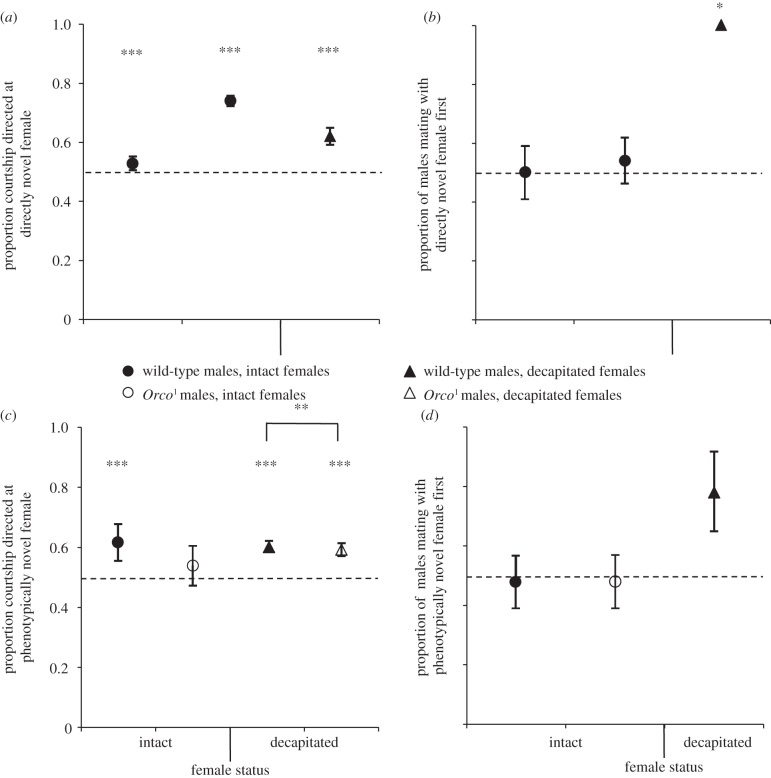
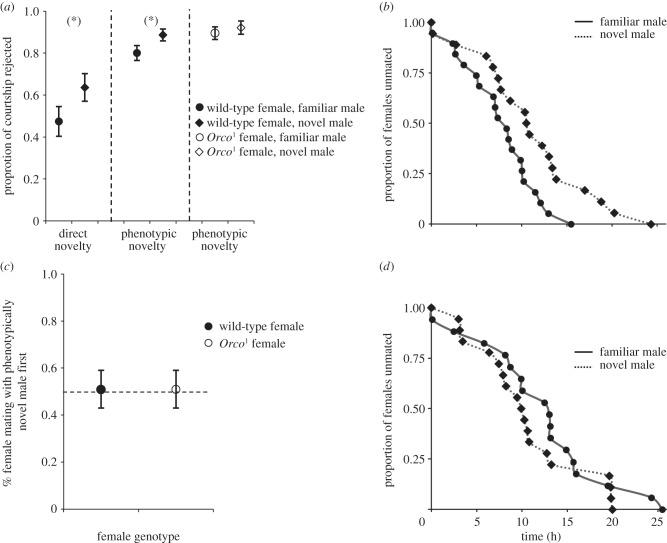
Studies of mating preferences have largely neglected the potential effects of individuals encountering their previous mates ('directly sexually familiar'), or new mates that share similarities to previous mates, e.g. from the same family and/or environment ('phenotypically sexually familiar'). Here, we show that male and female Drosophila melanogaster respond to the direct and phenotypic sexual familiarity of potential mates in fundamentally different ways. We exposed a single focal male or female to two potential partners. In the first experiment, one potential partner was novel (not previously encountered) and one was directly familiar (their previous mate); in the second experiment, one potential partner was novel (unrelated, and from a different environment from the previous mate) and one was phenotypically familiar (from the same family and rearing environment as the previous mate). We found that males preferentially courted novel females over directly or phenotypically familiar females. By contrast, females displayed a weak preference for directly and phenotypically familiar males over novel males. Sex-specific responses to the familiarity of potential mates were significantly weaker or absent in Orco(1) mutants, which lack a co-receptor essential for olfaction, indicating a role for olfactory cues in mate choice over novelty. Collectively, our results show that direct and phenotypic sexual familiarity is detected through olfactory cues and play an important role in sex-specific sexual behaviour.
交配偏好的研究在很大程度上忽略了个体遇到以前配偶(“直接性熟悉”)或与以前配偶具有相似特征的新配偶(例如来自同一家庭和/或环境)的潜在影响,即“表型性熟悉”。在这里,我们表明,雄性和雌性黑腹果蝇以根本不同的方式对潜在配偶的直接和表型性熟悉做出反应。我们让一只单一的焦点雄性或雌性接触两个潜在的伴侣。在第一个实验中,一个潜在的伴侣是新颖的(以前没有遇到过),另一个是直接熟悉的(它们以前的配偶);在第二个实验中,一个潜在的伴侣是新颖的(与以前的配偶无关,来自不同的环境),另一个是表型熟悉的(与以前的配偶来自同一家庭和饲养环境)。我们发现,雄性优先向新颖的雌性求爱,而不是直接或表型熟悉的雌性。相比之下,雌性对直接和表型熟悉的雄性表现出微弱的偏好,而不是新颖的雄性。在缺乏嗅觉必需的共受体的 Orco(1)突变体中,对潜在配偶熟悉程度的性别特异性反应明显减弱或不存在,这表明嗅觉线索在对新奇的选择中起作用。总的来说,我们的结果表明,直接和表型性熟悉是通过嗅觉线索来检测的,并在性别特异性性行为中起着重要作用。