Department of Public Health and Clinical Medicine, Umeå University, Umeå, Sweden.
BMJ Open. 2013 Sep 24;3(9):e003551. doi: 10.1136/bmjopen-2013-003551.
Adherence to preventive drug treatment is a clinical problem and we hypothesised that patients' beliefs about medicines and stroke are associated with adherence. The objective was to examine associations between beliefs of patients with stroke about stroke and drug treatment and their adherence to drug treatment.
Cross-sectional questionnaire survey.
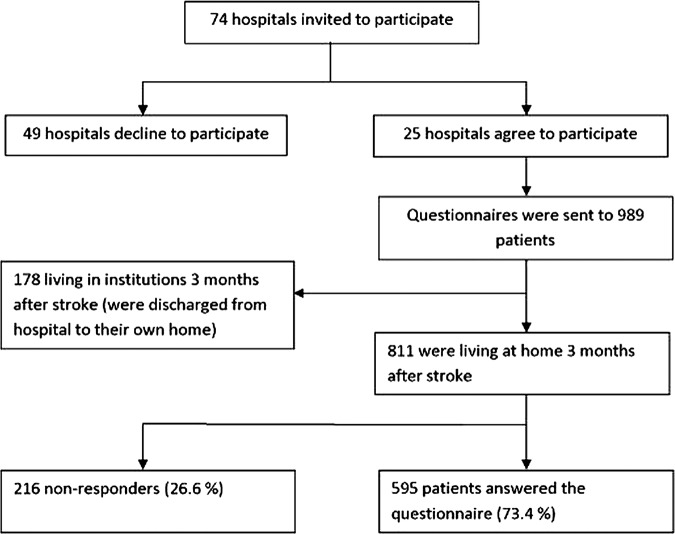
Patients with stroke from 25 Swedish hospitals were included.
Questionnaires were sent to 989 patients to assess their perceptions about stroke (Brief Illness Perception Questionnaire, Brief IPQ), beliefs about medicines (Beliefs about Medicines Questionnaires, BMQ) and adherence to treatment (Medication Adherence Report Scale, MARS) 3 months after stroke onset. Only patients living at home were included in the analysis. The primary outcome was self-reported adherence as measured on MARS. MARS scores were dichotomised into adherent/non-adherent. Background and clinical data from the Swedish Stroke register were included.
811 patients were still living at home and 595 answered the questionnaire. Complete MARS data were available for 578 patients and 72 (12.5%) of these were classified as non-adherent. Non-adherent patients scored lower on positive beliefs as measured on BMQ-necessity (OR = 0.90, 95% CI 0.83 to 0.98) and BMQ-benefit (OR=0.77, 95% CI 0.68 to 0.87), and higher on negative beliefs as measured on BMQ-concern (OR=1.12, 95% CI 1.05 to 1.21), BMQ-overuse (OR=1.29, 95% CI 1.14 to 1.45), and BMQ-harm (OR=1.12, 95% CI 1.01 to 1.24). The Brief IPQ showed that non-adherent patients believed their current treatment to be less useful (p=0.001).
This study showed associations between beliefs of Swedish patients with stroke about medicines and adherence. Positive beliefs were less common and negative more common among non-adherent. To improve adherence, patients' beliefs about medicines should be considered.
预防药物治疗的依从性是一个临床问题,我们假设患者对药物和中风的信念与依从性有关。目的是研究中风患者对中风和药物治疗的信念与药物治疗依从性之间的关系。
横断面问卷调查。
纳入了来自瑞典 25 家医院的中风患者。
中风发病后 3 个月,向 989 名患者发送问卷,评估他们对中风的认知(简要疾病认知问卷,Brief IPQ)、对药物的信念(药物信念问卷,BMQ)和治疗依从性(药物使用报告量表,MARS)。仅纳入居住在家中的患者进行分析。主要结局为 MARS 测量的自我报告依从性。MARS 评分分为依从/不依从。纳入了来自瑞典中风登记处的背景和临床数据。
811 名患者仍居住在家中,其中 595 名回答了问卷。578 名患者提供了完整的 MARS 数据,其中 72 名(12.5%)被归类为不依从。不依从患者在 BMQ-必要性(OR=0.90,95%CI 0.83 至 0.98)和 BMQ-获益(OR=0.77,95%CI 0.68 至 0.87)方面的正向信念评分较低,而在 BMQ-担忧(OR=1.12,95%CI 1.05 至 1.21)、BMQ-过度使用(OR=1.29,95%CI 1.14 至 1.45)和 BMQ-伤害(OR=1.12,95%CI 1.01 至 1.24)方面的负向信念评分较高。Brief IPQ 显示,不依从的患者认为当前治疗的效果较差(p=0.001)。
本研究显示了瑞典中风患者对药物的信念与依从性之间的关联。不依从的患者正向信念较少,负向信念较多。为了提高依从性,应该考虑患者对药物的信念。