Sellier Hélène, Rébillard Amélie, Guette Catherine, Barré Benjamin, Coqueret Olivier
Paul Papin ICO Cancer Center; Inserm U892; CNRS 6299 and Angers University; Angers, France.
JAKSTAT. 2013 Jul 1;2(3):e24716. doi: 10.4161/jkst.24716. Epub 2013 Apr 16.
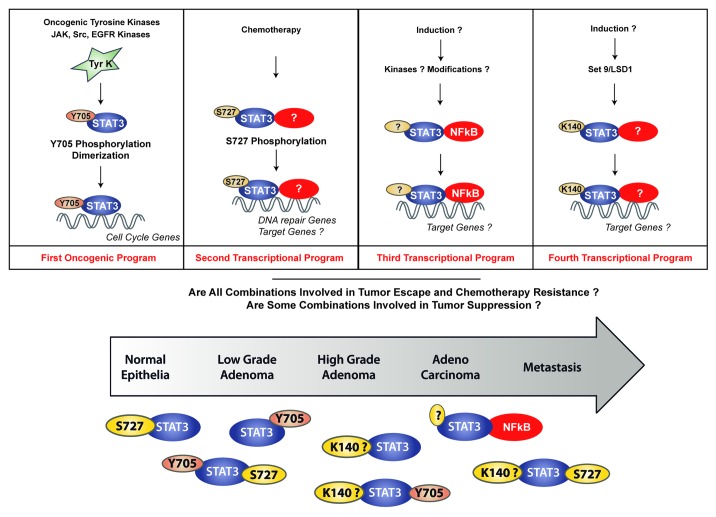
Aberrant activation of the STAT3 transcription factor has been reported in a large group of tumors and a strong biological basis now defines this protein as an oncogenic driver. Consequently, STAT3 is considered to be a promising target in the field of cancer therapy. For its inhibition to result in a successful therapeutic approach, the definition of a target tumor population identified by specific and detectable alterations is critical. The canonical activation model of STAT3 relies on a constitutive phosphorylation on its 705 tyrosine site, resulting in its dimerization, nuclear translocation, and the consequent activation of cancer genes. Therefore, it is expected that tumors expressing this phosphorylated form are addicted to STAT3 and will be sensitive to existing drugs which are targeting this dimeric form. However, recent results have shown that STAT3 can function as an oncogene in the absence of this tyrosine phosphorylation. This indicates that different forms of the transcription factor also play an important role in tumor growth and chemotherapy resistance. This complicates the definition of STAT3 as an oncogene and as a potential prognosis and predictive biomarker. The obligation to target a defined tumor type implies that future clinical trials should use a precise definition of STAT3 activation. This will allow tumors addicted to this oncogene to be identified correctly, leading to a strong rationale for patient stratification.
据报道,STAT3转录因子在大量肿瘤中存在异常激活,强大的生物学基础现已将该蛋白定义为致癌驱动因子。因此,STAT3被认为是癌症治疗领域一个有前景的靶点。为了使其抑制作用带来成功的治疗方法,确定由特定且可检测的改变所识别的目标肿瘤群体至关重要。STAT3的经典激活模型依赖于其705位酪氨酸位点的组成性磷酸化,导致其二聚化、核转位以及随后癌症基因的激活。因此,预计表达这种磷酸化形式的肿瘤对STAT3有依赖性,并且会对靶向这种二聚体形式的现有药物敏感。然而,最近的结果表明,在没有这种酪氨酸磷酸化的情况下,STAT3也可作为致癌基因发挥作用。这表明转录因子的不同形式在肿瘤生长和化疗耐药性中也起着重要作用。这使得将STAT3定义为致癌基因以及潜在的预后和预测生物标志物变得复杂。针对特定肿瘤类型的要求意味着未来的临床试验应使用STAT3激活的精确定义。这将使依赖这种致癌基因的肿瘤能够被正确识别,从而为患者分层提供有力依据。