Food Access and Community Health Programs, Bureau of Chronic Disease Prevention and Tobacco Control, New York City Department of Health and Mental Hygiene, 42-09 28th St, Queens, NY 11101, USA.
Prev Chronic Dis. 2013 Sep 26;10:E163. doi: 10.5888/pcd10.130113.
Increasing the accessibility and affordability of fresh produce is an important strategy for municipalities combatting obesity and related health conditions. Farmers markets offer a promising venue for intervention in urban settings, and in recent years, an increasing number of programs have provided financial incentives to Supplemental Nutrition Assistance Program (SNAP) recipients. However, few studies have explored the impact of these programs on use of SNAP benefits at farmers markets.
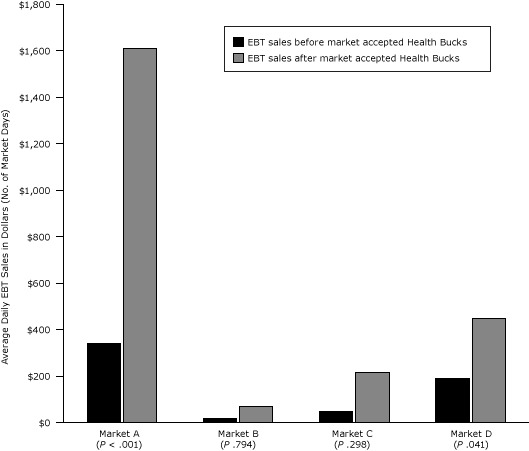
New York City's Health Bucks Program provides SNAP recipients with a $2 coupon for every $5 spent using SNAP benefits at participating farmers markets. We analyzed approximately 4 years of electronic benefit transfer (EBT) sales data, from July 2006 through November 2009, to develop a preliminary assessment of the effect of the Health Bucks Program on EBT spending at participating markets.
Farmers markets that offered Health Bucks coupons to SNAP recipients averaged higher daily EBT sales than markets without the incentive ($383.07, 95% confidence interval [CI], 333.1-433.1, vs $273.97, 95% CI, 243.4-304.5, P < 0.001) following the introduction of a direct point-of-purchase incentive. Multivariate analysis indicated this difference remained after adjusting for the year the market was held and the neighborhood poverty level.
When a $2 financial incentive was distributed with EBT, use of SNAP benefits increased at participating New York City farmers markets. We encourage other urban jurisdictions to consider adapting the Health Bucks Program to encourage low-income shoppers to purchase fresh produce as one potential strategy in a comprehensive approach to increasing healthful food access and affordability in low-income neighborhoods.
提高新鲜农产品的可及性和可负担性是各市政府对抗肥胖和相关健康问题的重要策略。农贸市场为城市环境中的干预提供了一个有前途的场所,近年来,越来越多的项目为补充营养援助计划(SNAP)的接受者提供了经济激励。然而,很少有研究探讨这些计划对 SNAP 接受者在农贸市场使用 SNAP 福利的影响。
纽约市的健康券计划为 SNAP 接受者提供了一个 2 美元的优惠券,每花费 5 美元的 SNAP 福利在参与的农贸市场。我们分析了大约 4 年的电子福利转移(EBT)销售数据,从 2006 年 7 月到 2009 年 11 月,初步评估了健康券计划对参与市场 EBT 支出的影响。
提供健康券优惠券给 SNAP 接受者的农贸市场的平均 EBT 销售额高于没有激励措施的市场(383.07 美元,95%置信区间[CI],333.1-433.1,与 273.97 美元,95%CI,243.4-304.5,P < 0.001)在引入直接的点购买激励措施后。多元分析表明,在调整市场举办年份和社区贫困水平后,这种差异仍然存在。
当 2 美元的经济激励与 EBT 一起发放时,参与纽约市农贸市场的 SNAP 福利使用增加。我们鼓励其他城市司法管辖区考虑采用健康券计划,鼓励低收入购物者购买新鲜农产品,作为增加低收入社区健康食品可及性和可负担性的综合方法的一种潜在策略。