Department of Internal Medicine, Wonkwang University Hospital, Wonkwang University School of Medicine, Iksan, Korea.
Gut Liver. 2013 Sep;7(5):605-10. doi: 10.5009/gnl.2013.7.5.605. Epub 2013 Jun 11.
BACKGROUND/AIMS: Small core biopsy samples can occasionally be obtained with conventional endoscopic ultrasonography-guided fine needle aspiration (EUS-FNA). Although most studies have focused on the cytological analysis of specimens, data regarding histological assessment is scarce. The aim of this study was to determine whether core biopsies by conventional EUS-FNA could increase the accuracy of EUS-guided sampling when combined with cytology in the absence of an on-site cytopathologist.
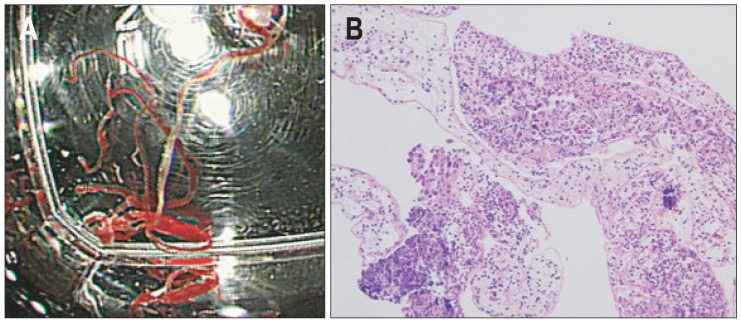
In the 95 consecutive patients (98 lesions) undergoing EUS-FNA of solid pancreatic masses and intra-abdominal lymphadenopathy, tissue coils from the needle were harvested for histology, and residual tissue was examined by cytology.
Adequate samples were obtained by EUS-FNA cytology, histology, and combined cytology-histology in 91.8%, 65.3%, and 94.8% of patients, respectively. From the pancreas (n=67), adequate samples for histology were obtained by EUS-FNA in 68.7% of cases, compared with 58.0% from non-pancreatic cases (n=31), respectively (p>0.05). The overall sensitivity and accuracy of EUS-FNA was 78.0% and 81.6% for cytology alone, 63.4% and 69.4% for histology alone, and 84.1% and 86.7% for combined cytology-histology, respectively.
Combined cytology and histology analysis for diagnosing pancreatic masses and intra-abdominal lymphadenopathy may increase the diagnostic yield of conventional EUS-FNA without on-site cytology.
背景/目的:传统的内镜超声引导下细针抽吸(EUS-FNA)偶尔可以获得小的核心活检样本。尽管大多数研究都集中在标本的细胞学分析上,但关于组织学评估的数据却很少。本研究旨在确定在没有现场细胞学专家的情况下,常规 EUS-FNA 核心活检是否可以通过与细胞学结合使用来提高 EUS 引导取样的准确性。
在 95 例连续接受 EUS-FNA 检查的胰腺实性肿块和腹腔内淋巴结病患者(98 例病变)中,从针上采集组织线圈进行组织学检查,并用细胞学检查剩余组织。
EUS-FNA 细胞学、组织学和联合细胞学-组织学分别在 91.8%、65.3%和 94.8%的患者中获得了足够的样本。来自胰腺(n=67),EUS-FNA 获得的组织学样本在 68.7%的病例中足够,而非胰腺病例(n=31)分别为 58.0%(p>0.05)。EUS-FNA 的总体敏感性和准确性分别为细胞学单独的 78.0%和 81.6%,组织学单独的 63.4%和 69.4%,以及细胞学-组织学联合的 84.1%和 86.7%。
联合细胞学和组织学分析可提高常规 EUS-FNA 诊断胰腺肿块和腹腔内淋巴结病的诊断率,而无需现场细胞学检查。